Trending Topics

 Trending
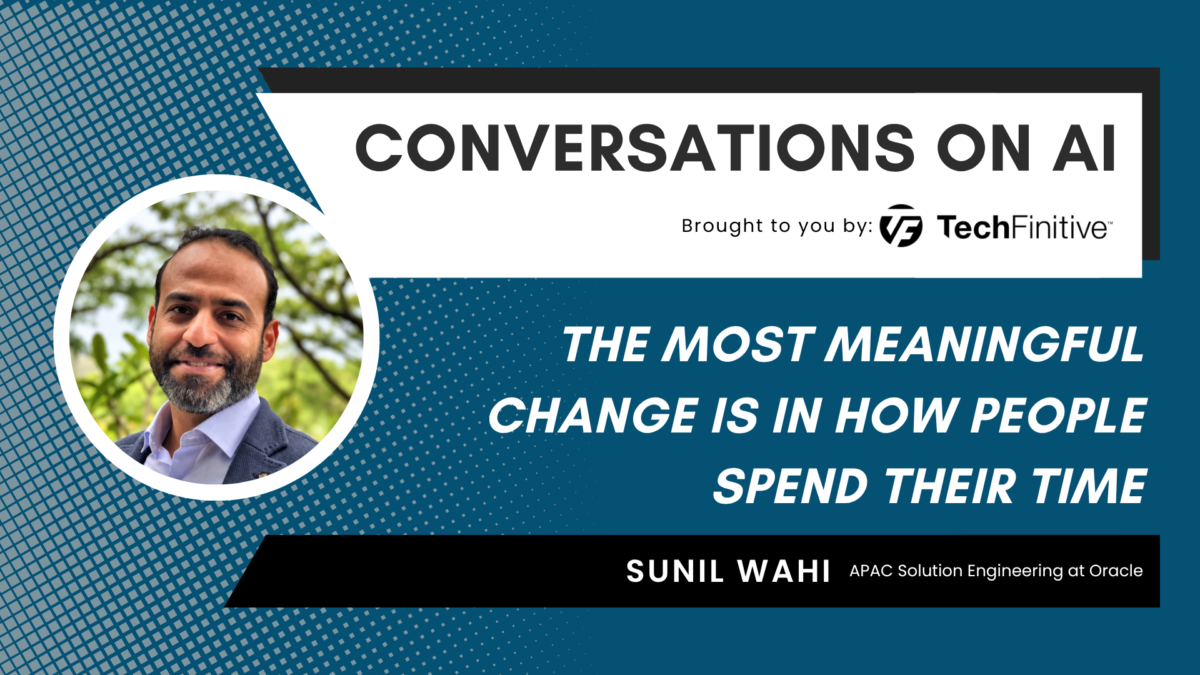
Sunil Wahi, VP, APAC Solution Engineering, Oracle : “The most meaningful change is in how people spend their time”

It should be no surprise that Sunil Wahi has a laser-like focus on business outcomes. As Vice President, APAC Solution Engineering, at Oracle, his goal is to help organisations harness the latest technology to deliver results – throughout our interview it was clear that he saw AI as the latest in a long line of tools.
That means ignoring the hype and using AI correctly. “Many AI systems are already capable of analysing information, identifying patterns and recommending next actions,” Sunil told us. “While helpful, this still leaves much of the execution work undone.”
So we should all give up on AI and carry on our lives as before? No: Sunil’s point is that AI has huge potential to transform businesses, and business processes, but they must be done right.
Take the example of a procurement scenario. “An AI assistant can identify a potential supplier and recommend issuing a sourcing event,” he said. “However, an agentic application could go further by owning and coordinating the whole process – from creating the sourcing event, to evaluating responses against business criteria, routing approvals according to policy, and updating contracts – while working within the organisation’s authority and maintaining governance.”
It’s a long way from the easy fix some organisations might be hoping for, and Sunil has similar words of caution for anyone who expects AI to “become a single know-it-all digital assistant”. Sadly, he explains, that’s not how businesses work.
“Companies consist of complex ecosystems of specialised functions, each with unique expertise, responsibilities and objectives across various functions such as finance, HR, supply chain, customer service and sales,” he said. “Organisations will need coordinated teams of specialised agents that work together toward a shared objective.”
But before you despair, Sunil can see business-transforming value here. “The real value of AI comes when intelligence, enterprise context, coordination and execution are connected across business processes,” he said.
Sunil’s three decades of experience shine through in the full interview below. And it might be worth taking notes, because he normally works with C-suite leaders across the Asia Pacific region. In particular, helping organisations embed AI into finance, supply chain, human resources and customer experience.
It’s a process, and fundamentally Sunil believes the greatest value comes when intelligence is built into everyday business processes themselves. Supported, he might add, by strong governance and human oversight. Our thanks to Sunil for taking the time to share his expertise.
How has AI changed your company’s product roadmap over the past 18 months? Were there projects you accelerated, delayed or abandoned altogether?
AI has been embedded in our applications for years, and most recently we have increasingly shifted our focus from AI that helps people do individual tasks toward agentic applications that can increasingly take on the process and work required to achieve a business outcome. We have built Fusion Agentic Applications as coordinated teams of specialised AI agents that can observe conditions, reason and plan, coordinate work, and execute defined actions within business processes using unified enterprise data, workflows, policies, approval hierarchies, permissions, and transactional context.
Most recently, we introduced an AI-native builder experience that enables customers and partners of all levels of experience to create agentic applications that run natively inside Oracle Fusion Cloud Applications, executing enterprise work with built-in security, governance controls, and auditability. This makes it easier for organisations to execute faster while maintaining control and security, as they do not need to build disconnected AI automations and then try to bolt on enterprise controls later.
Oracle Fusion Cloud Applications has shifted from a passive system of record into proactive Systems of Outcomes that extend the System of Record. The authoritative Fusion foundation remains essential. The shift is toward organising applications around achieving and measuring business outcomes, with the system increasingly taking on more of the process and work required to achieve them. Our goal is to help customers to integrate AI into core business operations more seamlessly and support faster execution, changing how work gets done and improving business responsiveness while maintaining governance and security.
Many SaaS vendors now describe themselves as “AI-powered”. What actually separates companies creating real customer value from those simply adding AI features?
There are many types of AI available for organisations. For example, copilots answer questions, and AI assistants summarise calls and help employees generate ideas.
Those advances matter, but they also encourage leaders to focus too much on the number of AI agents vs. what they can do. Enterprises don’t create value by accumulating agents. They create value by solving business problems, including reducing payroll issues, accelerating workforce scheduling, lowering supplier sourcing costs, increasing sales win rates, or improving cash collection.
Take IHH Healthcare as an example. As one of the world’s largest integrated healthcare providers, IHH Healthcare is using Oracle Fusion Cloud Applications across its enterprise finance, HR, and supply chain systems. This enables IHH to operate more efficiently as a unified multinational network while leveraging real-time AI-driven insights to strengthen clinical and operational decision-making, driving sustainable growth.
This shows the value of embedding AI directly in the applications where work already happens. This helps organisations use that enterprise context to both inform and increasingly move work forward towards a business outcome.
Agentic applications build on this foundation by organising specialised agents, skills, tools, data, services, and business processes around an end-to-end outcome. It owns and coordinates the process, while Fusion Applications remain the authoritative System of Record.
What is the biggest misconception enterprise customers still have about adopting AI within business-critical software?
One of the most common misconceptions in the market is treating recommendations and execution as the same thing.
Many AI systems are already capable of analysing information, identifying patterns and recommending next actions. While helpful, this still leaves much of the execution work undone.
Take a procurement scenario as an example. An AI assistant can identify a potential supplier and recommend issuing a sourcing event. However, an agentic application could go further by owning and coordinating the whole process – from creating the sourcing event, to evaluating responses against business criteria, routing approvals according to policy, and updating contracts – while working within the organisation’s authority and maintaining governance.
Ultimately, AI that can execute improves outcomes.
How is AI changing the role of your customers? Are you replacing repetitive work, augmenting decision-making, or fundamentally changing how people do their jobs?
AI is doing all three, but the most meaningful change is in how people spend their time. It can take on repetitive, administrative, and coordination-heavy work. Or it can surface the right information and recommendations at the moment a decision is needed. Increasingly, agentic applications can take on more multistep processes and execute defined work within the policies, controls and authority an organisation has already established.
That changes the role of the person. Instead of navigating applications and executing every step themselves, people can increasingly define the outcome, set objectives and boundaries, exercise judgment where it matters, review evidence and exceptions, and remain accountable for the result.
Finance teams can spend less time reconciling and more time guiding the business. HR teams can focus more on coaching and employee experience. Sales teams can devote more time to build relationships with customers and partners. The goal is to change a person’s role from performing every step toward setting direction, exercising judgement, overseeing outcomes, and managing exceptions, while the system increasingly takes on the work within defined authority.
Beyond productivity gains, what business outcome are your customers most excited about when they invest in AI?
While organisations are excited about increasing productivity through AI, companies are now focusing on whether AI is improving their business outcomes.
For example, Tamaki Health, one of New Zealand’s leading privately owned healthcare groups, is using Oracle Fusion Cloud Human Capital Management (HCM) to modernise and simplify complex HR processes. Tamaki Health serves 365,000 patients across 52 clinics in New Zealand and employs more than 1,000 staff that provide care to approximately 5,000 people each day. It needed to replace its legacy HR, recruiting and learning systems to expand workforce insights and reduce hiring timelines, enabling clinicians to focus on delivering high-quality care to the communities.
Another example is CaratLane, India’s leading omnichannel fine jewellery retailer. The retailer operates more than 380 stores across over 150 cities in India, alongside a robust ecommerce business. It needs to better manage seasonal demand and decided to move its finance and supply chain operations to Oracle Fusion Cloud Applications. With the migration, CaratLane has better inventory visibility and improved its omnichannel order management, getting AI-driven insights to deliver faster, more informed decision-making.
Customers are looking for greater business responsiveness. They want applications that can continuously observe what is happening, coordinate the routine work across various functions, and execute defined actions toward an outcome. That is where the value moves beyond productivity: faster execution, stronger business outcomes, and better employee experience.
If you could give one piece of advice to another SaaS executive planning their AI strategy today, what would it be?
Many companies expect AI will eventually become a single know-it-all digital assistant, but this doesn’t align with how a business operates. Companies consist of complex ecosystems of specialised functions, each with unique expertise, responsibilities and objectives across various functions such as finance, HR, supply chain, customer service, and sales. Organisations will need coordinated teams of specialised agents that work together toward a shared objective.
Take hiring a new employee as an example. The finance team will first confirm the budget availability with a manager’s approval. Once confirmed, the recruiting team will identify the right candidate, while the HR department will handle the onboarding process. An Agentic Application can coordinate these specialised capabilities across the complete process, so the right work happens in the right sequence and with enterprise governance controls.
Executives should focus on how they could leverage AI to change how work gets done and achieve business outcomes, rather than the number of AI agents or the best AI models. The real value of AI comes when intelligence, enterprise context, coordination, and execution are connected across business processes.
Some more great reads
About The Author