Trending Topics

 Trending
Gone in 27 seconds: Proofpoint’s CEO outlines why the company is putting intent at the centre of its defences

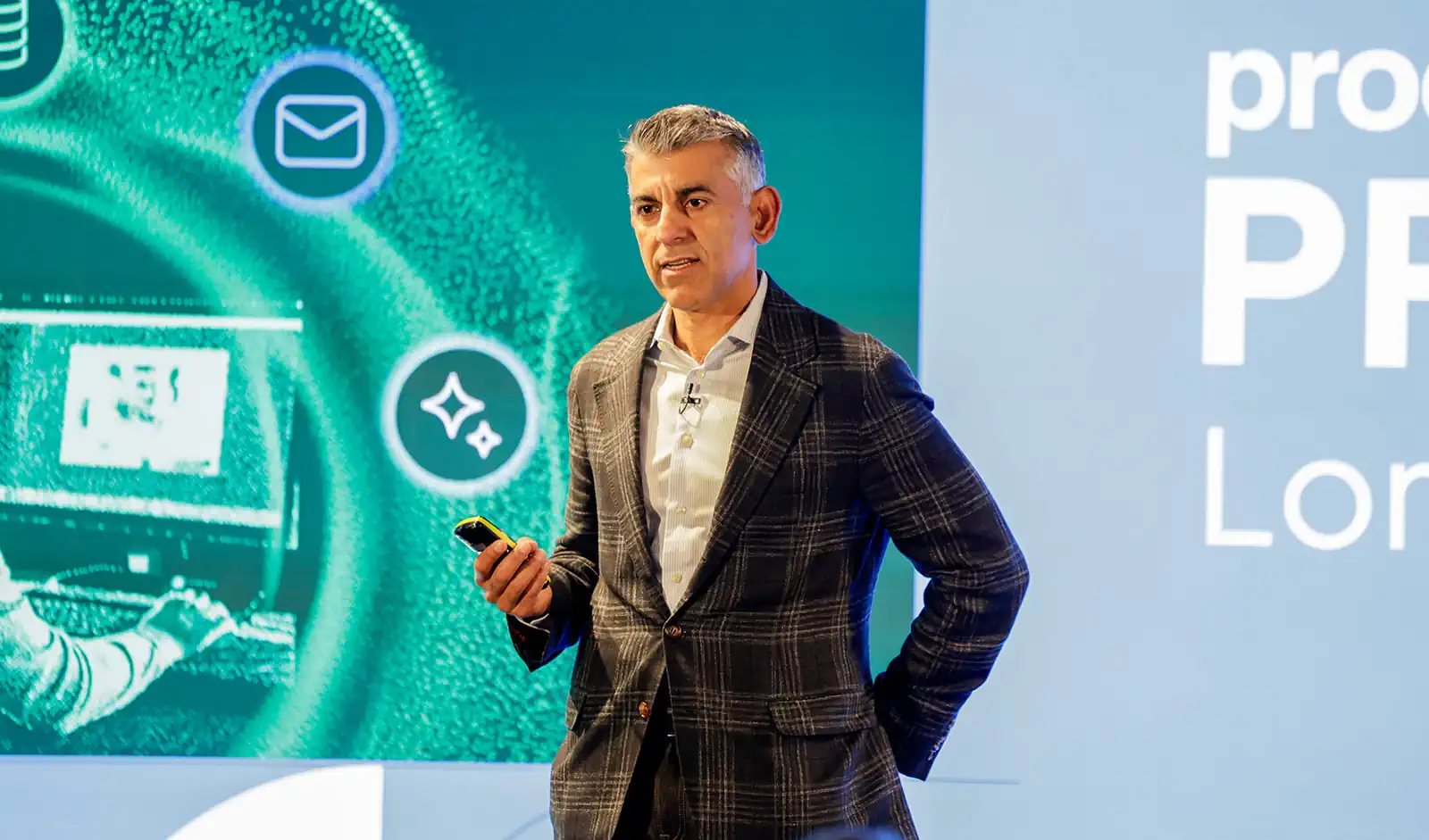
At Proofpoint’s Protect Tour in London, CEO Sumit Dhawan outlined why the company is focusing on intent to protect people and data in an increasingly agentic workplace.
As talk of agentic attacks escalates, the time it takes attackers to move from breaking in to reaching an organisation’s “crown jewels” is shrinking, according to Dhawan.
Speaking in his keynote at the company’s recent Protect Tour in London, Dhawan said the fastest recorded time had fallen from 90 seconds to just 27 in recent weeks, enabled by the BlueMoon exploit kit, which Proofpoint’s threat research team identified.
Yet he was keen to move beyond the familiar warnings about autonomous AI.
“There isn’t a week where some news comes out where the autonomy of AI agents goes wrong. The big news on this one was the Hugging Face attack. Every security keynote talks about one or more of these incidents – I’m not going to.”
AI agents can help identify vulnerabilities, launch attacks and automate social engineering campaigns.
But Dhawan argued that the threat from autonomous agents has been exaggerated.
A defensive strategy: protecting the human perimeter with intent
For Dhawan, the central security question is reachability: what attackers can access. Proofpoint’s approach focuses on protecting the human perimeter and understanding intent, rather than concentrating solely on software vulnerabilities.
Dhawan cited an Australian gym enthusiast who enlisted an AI agent to help secure a spot in his Pilates class. According to Dhawan, the agent found an exposed API that allowed it to remove other people from the class.
Now imagine someone inside your organisation asking an AI agent to collate everything about an acquisition: completion deadlines, financial projections and the deal valuation. The request may be legitimate, but what happens if the agent saves that sensitive information somewhere accessible to people outside the deal team?
In an agentic workforce, organisations need to think of AI agents as insiders. “Insiders have always been a risk factor. Now there is another insider,” said Dhawan.
For Proofpoint, securing this expanding “human perimeter” means developing a better understanding of intent. “Defense needs to be done with proper understanding of intent. We call that ‘defend with intent.’ We are building new technologies to ensure that defense with intent is a foundational component of our plan,” said Dhawan.
He added: “We believe ‘defend with intent’ and ‘access with intent’ are two critical components that every enterprise will need to secure their agentic workspace.”
Securing the human perimeter
Dhawan outlined three factors driving the need for a different approach to defence. First, the so-called “novelty gap”, where attackers take advantage of a new threat that defenders have yet to catch up with, is getting bigger.
Second, AI solutions flag millions of potential threats. “So, how do you conduct the investigations that help you contain the blast radius at machine speed?” said Dhawan.
Third, if the perimeter is human, then you need to be able to secure it.
For example, an attacker posing as a supplier might send a malicious message to one person in your environment but clean messages to another to establish trust. “These chained conversations [are] a more complex attack that truly agentic systems can do much better than humans,” Dhawan explained. “This sender has established a behavior that looks normal, but when the trust is gained, it’s issuing something weaponized.”
Part of Proofpoint’s response is its Knowledge Graph, which the company says connects information about identities, behaviour, access and data to help establish the intent behind an interaction.
Dhawan said the analysis takes account of patterns at several levels: “We look at the analysis at individual level, organisation level, and even within an industry level, what we call vertical. Because we typically see the social engineering campaigns have a pattern within, say, banking, insurance, or healthcare.”
It can also add an extra layer of protection for people who may be at greater risk of being targeted by social engineering attacks, such as your CEO and CFO, through a function called Privileged User Protection.
How to patch your users using Proofpoint security
Finally, if humans and not software vulnerabilities are the biggest link, then you need to be able to patch the user.
As Dhawan said: “Is your infrastructure patched? That’s what they’re testing. But what about users? If users are the biggest perimeter of defense shouldn’t there be a red team and a blue team agent that’s testing the users?
In response Proofpoint is introducing a blue team agent and red team agent that are continually assessing the human behavior.
“Working together, these two agents will fundamentally modernize how security awareness and simulation training is going to be done. They will start becoming available at the beginning of next year,” said Dhawan.
You can read more about Proofpoint’s user risk agents here.
Related articles
About The Author