Trending Topics

 Trending
NetSuite Next will change the way we work, promise Oracle NetSuite VPs: “You don’t tell the app what to do, you tell it what your problem is”

Much of the recent SuiteConnect event in London focused on NetSuite Next, the next-gen iteration of the popular cloud ERP with conversational search at its heart. NetSuite Next is already being trialled by hand-picked clients in the USA, with a view to a full rollout later this year. And we now know that British companies will be trialling NetSuite Next this year, with an official release due by April 2027.
Having attended SuiteConnect London, where hundreds of NetSuite customers came along for demos, presentations and networking, I can safely say that the audience is excited for the switch. But perhaps not quite as excited as NetSuite’s Craig Sullivan, GVP Product Management, and Patrick Puck, GVP of AI Strategy, Engineering and Design, who I interviewed that afternoon.
“It’s the first time many people will actually be encountering AI formally in their business role,” said Sullivan. “We think that’s a huge step forward for them, and also a journey that we take very seriously in terms of making sure that we can help them embrace that and benefit from it as soon as possible.”
And that’s what this interview focuses on. How will the transition to NetSuite Next work in practice, and how will the Oracle brand ensure that the rollout happens smoothly not just in the US but around the world?
NetSuite Next: AI for business
“We see people using ChatGPT to book travel and do homework, and all the things that you hear about kids doing at school, but it’s still rare [for] a solution at the breadth and depth of what NetSuite does, running 43,000 customers and counting, of all sizes,” said Sullivan.
But more than that: “In essence, just sort of incorporating AI, as if by magic, into that system as it’s running is unheard of. And so customers that we’ve been speaking with are very excited and very, very interested in it.”
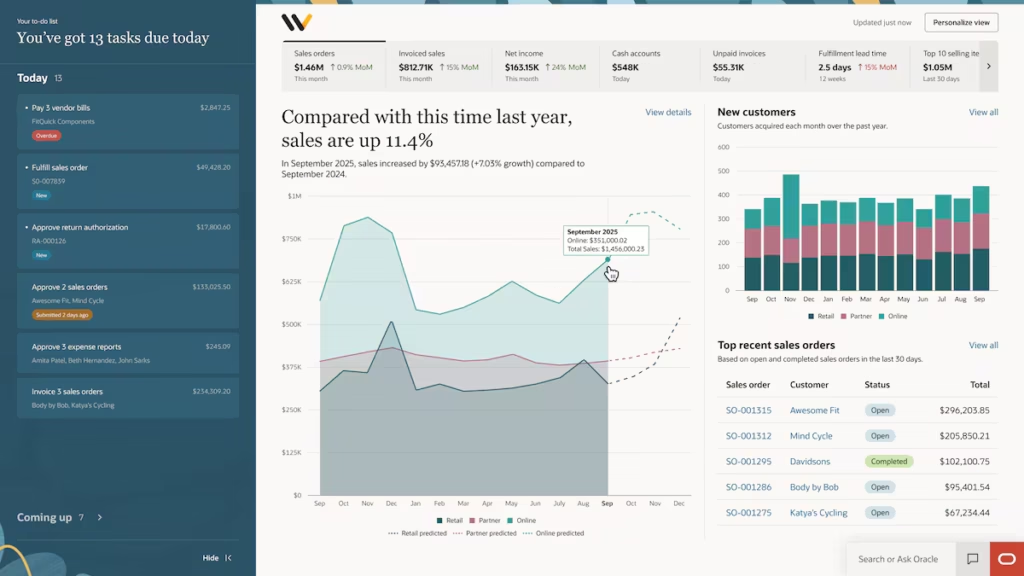
For this is the big promise of the transition from the current iteration of NetSuite to NetSuite Next: that it can happen at the press of a button. At which point, a new interface will appear with an “Ask Oracle” dialog box sitting at the bottom-right. Customers can then ask natural language questions to access new and existing powers that many have previously been unable to tap as they don’t have the technical know-how.
To ease the transition, NetSuite has already introduced many AI features into its current cloud ERP. “And then we’ve got [a] group of customers that have been exploring with ChatGPT to use what we call the ‘bring your own AI’ approach, so that they can leverage Claude or Gemini or ChatGPT from outside in the meantime and start to get more familiar with it,” said Sullivan.
“It’s not so much playing as practising,” added Sullivan, who mentioned one a demo earlier that day where a non-profit company spun up an application in a few hours using NetSuite’s AI tools. “[This] changes the game of what people can do with these systems. The barrier to entry is increasingly low for people to start to benefit from this technology in conjunction with the incredible data set and perspective that the NetSuite system provides.”
Why the long wait for NetSuite Next outside the USA?
This all makes sense. What may be tougher for companies outside the USA to understand, I suggested, is why NetSuite Next will be rolled out in America this year but next year (at the earliest) for the rest of the world.
“We run a business [that’s] a finance system,” said Sullivan, “and we take that responsibility very seriously. We help our customers with their compliance needs, regulatory needs. So we want to make sure, and maybe [we’re] being over cautious, but I’d rather do that than than jump in.
“So we’re making sure, first, that all of that is squared away for [US companies], and then we’re ramping up to make sure that all of the new things that NetSuite Next does also then ensure that they remain compliant.”
As GVP of AI Strategy, Engineering and Design, this is also where Patrick Puck’s expertise comes to the fore. “Every region and country has its own challenges, localisation challenges.,” he said. “There are regulatory challenges. We run out of data centres, but many data centres across the world deploy the technology to these different data centres. So there’s just a certain process that we need to follow to make sure we do it right in all the different regions.”
Ease of upgrading to NetSuite Next
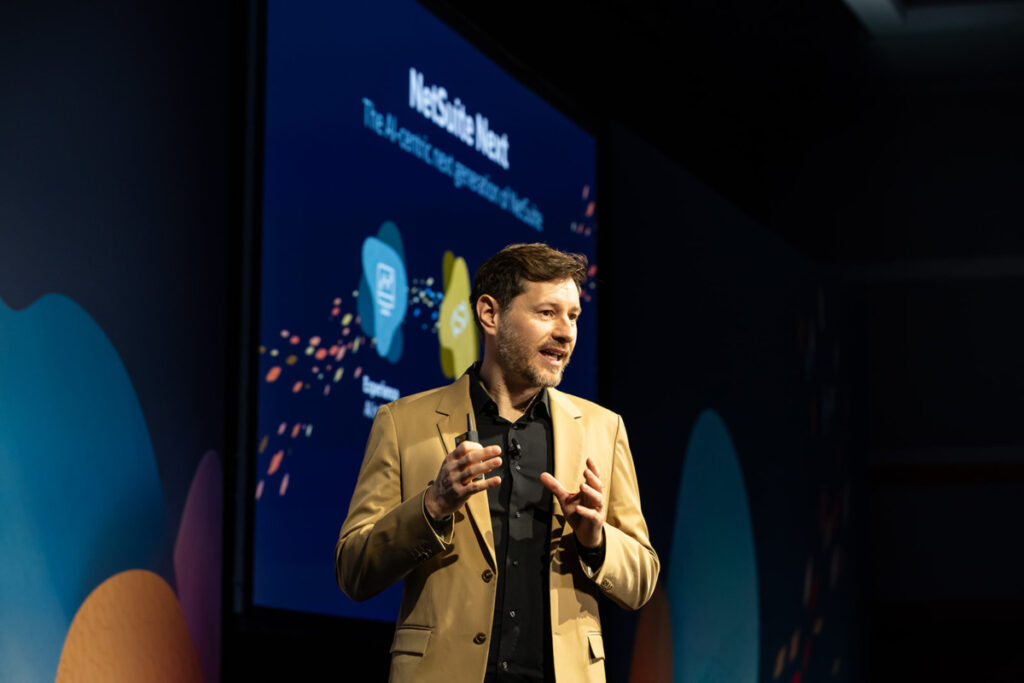
When Puck talked on stage earlier that day, he made it sound as if the switch would be to literally press a button. He had even shown a demo on-stage that showed this process. But what’s the reality going to be like, I asked?
“For existing customers, we wanted to the friction to get Next to be the absolute minimum,” said Puck. “That was a real demo. Really, literally, just click the button you switch to next. There is no day-long migration. There is nothing to do and it will just work. All customisations are functional.”
He added that the power will be in the hands of administrators on how they want to roll out the upgrade. “The administrators can decide that they want to give it to all users at once, or to some users or not other users. Or they can even decide that certain functions can happen in NetsSuite Next and other functions don’t happen in NetSuite Next.”
And what if admins decide their company isn’t ready having set the upgrade in motion. “It’s very, very flexible,” said Puck. “Administrators will have the option, at least for some time, for users to switch back. They can say… there’s this one function [where] my process is just built for current NetSuite, and I don’t want to switch right now.”
It’s all down to what makes sense for each business, Puck insisted. “If they want to switch all at once, all at the same time, on day one, they can do that. If they want to do it in a very gradual way, across different users and profiles and tasks, they can do that as well.”
Lessons learned so far
As already mentioned, NetSuite has rolled out Next early to a few organisations in the USA. What lessons learned have they asked so far, I wondered.
As well as loving the new UI and ease of upgrading, said Puck, they are also “incredibly excited about the power and the promise of Ask Oracle and the ability to democratise AI for their users.
“Any user can now get much more insight. They can learn how to use the system. They can unlock more parts of the suite in ways that was much more difficult to do before.”
They also learned that although switching was easy from an IT admin’s point of view, it still required work to teach the new system to the users. “They have processes. They have documents written, they have procedures. And even though the system is very similar and very, very compatible, they still need to update their training materials. They need to roll out this training.”
NetSuite also discovered that users aren’t as versed in AI as might be expected. “This will be the very first business system that is AI first, that is an AI system,” said Puck. So it will fall on organisations to “tell them how to write questions, how to ask, what kind of things to build”.
But he also sees this as an opportunity for NetSuite to “help the administrators, give them the tools and make the systems self consumable. And so we’re spending time on making the onboarding experience really easy, really handhold the users into this new experience.
“Here’s things that you can try for your industry. Try these questions. Here’s the best practices. If you get lost, do this, etc.”
There will be challenges ahead, then, but Puck believes that “five years from now, this is the way we will work. Every business will be using AI systems, but right now it’s not the case. So it’s an opportunity for us, and also, I think, a challenge for our customers, because this is change, even though we make it super easy, it’s still change.”
Wider impact of AI on work
Which brought us to arguably the topic that will define the next five years: How do organisations change their ways of working to integrate AI? Will NetSuite Next, for instance, change workflows?
“It absolutely will,” said Sullivan. “Today, in any business system, you run a report so that you can review that… you get insights from that, and then you take an action. Well, now that you have access to AI, you can actually just go straight to the action and basically ask for the insight, and then the AI will suggest an appropriate action. So it definitely changes how users can skip multiple steps to get to the end result.”
It’s also a chance to examine historic practices, he suggested. “There are things that you do today in your business that you only do that way because you’re running four systems. Or Joe, who left three years ago, implemented that process that way. You’re doing things not because that’s necessarily the best way to do them, but because that’s how you’ve had to cobble things together to make make it work.
“The changing of a system is your opportunity, in some cases, to rethink those things, right? Very often, companies don’t actually necessarily take those opportunities, because then it’s a rush to get it [implemented].”
Sullivan said that AI offered a “fast path to figuring out what the right way is to get to your end result and to understand why that end result is the the action you want to take”.
“Call it the transition to intent-driven user experience,” said Puck. “In the past, imagine you had a meeting with the customer, and you need to prepare for that meeting. So you may have said, pull all my notes about the customer. Tell me what the last sales order were. Tell me if there any issues. Tell me if there’s any pending returns, how much money do they owe me?”
With NetSuite Next, he suggest, that thinking becomes outdated. “What you put into Ask Oracle is: ‘I’m meeting with this customer. What should I know?’ And Ask Oracle figures out what’s interesting and what to pull, so a level higher up. It’s a higher level of intent… You don’t have to tell it anymore what to do. You tell it what your problem is, and then it figures out what to do. And that definitely is going to change the way we work.”
More on the Future of Work
About The Author

Tim Danton
NEXT UP


