Trending Topics

 Trending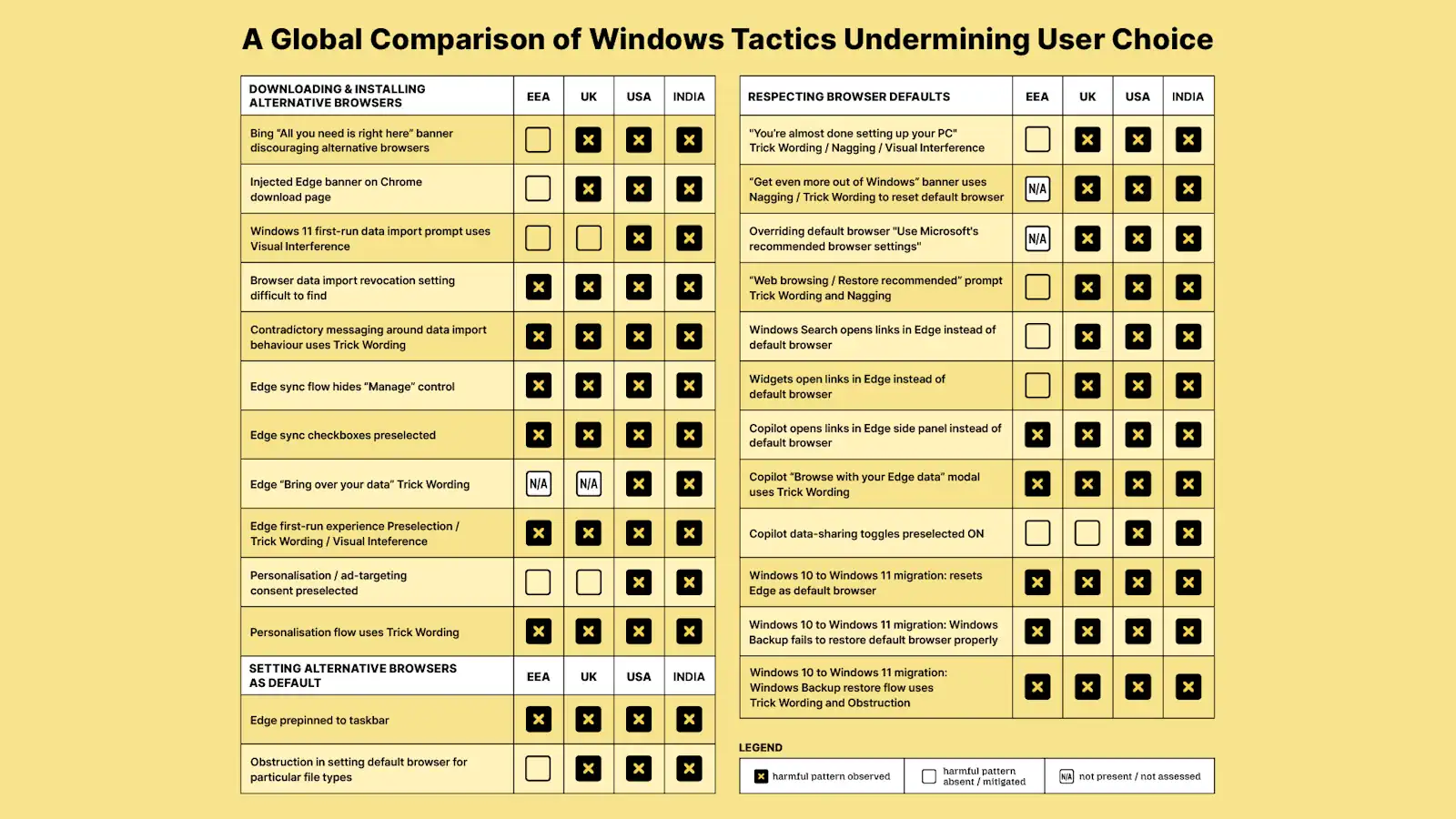
Experts in “deceptive design” say Microsoft still using coercive tactics to stop people switching from Edge

What browser are you using? Chances are that it’s one of Apple Safari, Google Chrome and Microsoft Edge, but a new report suggests that “deceptive design” is making it harder for you to make a free choice.
“We find that Microsoft still employs a number of harmful patterns, including Trick Wording, Obstruction, Visual Interference, and Preselection,” write Harry Brignull and Cennydd Bowles in a report Over The Edge 2.0 published today.
“We urge Microsoft again to stop using harmful design patterns that undermine users’ free choice of browser,” the report’s executive summary concludes. “Further, we suggest that regulators and researchers keep a close eye out for harmful patterns as AI products become further interwoven with operating systems and web browsers.”
However, EU citizens are benefiting from tougher legislation. As are Brits, to a lesser extent. Those in India and the USA – the two other regions covered by the research – are less fortunate.
So what exactly is Microsoft doing? Is it unique to that company or do Apple and Google use similar tactics? And why should you trust the authors of this report – one that was sponsored by Mozilla.
Can you trust the “deceptive design” Edge report?
Let’s start with trust. While Mozilla commissioned this report – a follow-up to Over The Edge in 2024 – it claims that it had no editorial influence. “The findings are the researchers’ own,” Mozilla says.
A claim echoed by the report’s authors.
“As with the first version of this report, we must address the potential for conflict of interest,” they state. “As browser makers themselves, the report’s sponsors Mozilla have a commercial interest in understanding – and potentially opposing – the design practices of OS manufacturers.
“The authors stress, however, that we have acted as entirely independent researchers. The findings that follow are ours alone. We also make no claim that Microsoft might be alone in their potential use of harmful design patterns. Researchers have found that many tech companies use similar techniques.”
Why trust Harry Brignull? His CV is convincing, starting with his PhD in Cognitive Science. He also runs an independent website called deceptive.design and “has been investigating deceptive user interfaces since 2010”, to again quote the report.
Cennydd Bowles describes himself as a technology and design ethicist. “He holds Masters degrees in both ethics and IT and has twenty years of experience working in digital product design and technology regulation,” the report states.
Key accusations of report
The report asks, and answers, three key questions:
- Does Microsoft allow users to download and install an alternative browser without harmful interference? No.
- Does Microsoft allow users to set an alternative browser as their default without harmful interference? No.
- Does Microsoft respect users’ choice of default browser and allow them to continue using it without harmful interference? No.
It also found that the European Union’s efforts to curb Microsoft’s enthusiasm when it came to blocking rivals had borne fruit. Harmful patterns, to use the report’s phrase, were “less frequently employed” in the EEA region.
For example, EEA residents aren’t shown the Bing’s “All you need is right here” panel to discourage anyone searching for other browsers. It is shown to those in the UK, USA and India.
The EU’s laws are having an effect on Copilot too. For example, the Copilot data-sharing toggle defaults to “On” in the US and India, but “Off” in the UK and the EEA.
You can see exactly how aspects compared in the table below:
Mozilla’s take on the “Over the Edge 2.0” report
It all makes for interesting reading, but we had questions for Mozilla. In particular, for Kush Amlani, Global Competition and Regulatory lead at the organisation.
First, why does Mozilla believe that Microsoft can still get away with “deceptive design”? Is it simply too nuanced to be proven in court under existing anti-competitive legislation?
“Regulators and governments all over the world are recognising the harms to people that result from platforms having monopoly power and deploying deceptive design techniques to undermine user choice,” said Amlani.
“They are starting to take action and we have seen cases (both consumer protection and competition) and legislative proposals in this space. But Microsoft is not alone in using these tactics – the difference is that most other companies don’t have 1.4 billion users locked into their ecosystem. The changes Microsoft has made in Europe show that a better (though still problematic) version of Windows is possible.”
Can’t the same argument be aimed at Google and Safari?
“Although this research specifically analyses Microsoft and finds many issues, our Five Walled Gardens report looked at the use of deceptive design practices across operating system providers, including Google and Apple,” Amlani replied.
“However, the poor behaviour of other companies is no defence for Microsoft’s. As the authors of Over the Edge note: if we accept this argument, the internet becomes a race to the bottom.”
Has flagging these practices in the first report helped Firefox gain market share?
“We have seen positive growth metrics over the last few years,” Amlani said, so not quite answering our question.
“Our reason for commissioning the research is to ensure that Windows users can have their choice respected and that independent browsers like Firefox can have a level playing field. We’ve already seen that when you give people real choice, they choose alternatives.”
Isn’t this typical behaviour in the software world?
“Even if others do it, that’s no excuse,” Amlani replied, which is tough to argue with. “We would like to see competitive markets where tech companies are challenging to innovate and people have agency over the products they use.
“Overriding user choice through wholesale use of deceptive design is a world that no one should accept – not governments, not regulators, not rival companies, and not users.”
What the Browser Choice Alliance had to say…
We also received this statement from the Browser Choice Alliance (BCA).
“We applaud the research team for once again shining a spotlight on practices that distort competition and limit user choice. The researchers’ findings in “Over the Edge 2.0” reveal how Microsoft continues to use manipulative tactics to push users toward Edge, limiting users’ ability to choose and run their chosen browser. The report demonstrates how Microsoft deploys harmful patterns against users on Windows 11 devices at a global scale.
“We call on Microsoft to respect its users and stop using the Windows ecosystem to steer users toward its own browser in ways that restrict user choice, undermine web freedom, and unfairly tilt the playing field away from fair competition and innovation.”
Specifically, the BCA wants Microsoft to make the following changes across the globe:
- Allow browser suppliers to compete for preinstallation and default deals with Windows PC manufacturers
- End dark patterns targeted at users seeking to download and effectively use other browsers (including as system level default)
- Bring back the ability for users to make switching default browsers simple and transparent with a “single click” change for all relevant file types and apps (including PDFs)
- Open all web links in users’ selected system-level browser of choice
- Eliminate manipulative Microsoft-exclusive banners pushing Edge in Windows, including when users are searching for other browsers
- Stop using operating system updates to push users back to Edge
- Remove the restrictive configurations of existing S mode devices that block usage of third-party browsers
Microsoft’s right to reply to “deceptive design” Edge accusations
Finally, we asked Microsoft if it had any response to the report. They told us that they had nothing to add.
Related articles
About The Author

Tim Danton
NEXT UP


