Trending Topics

 Trending
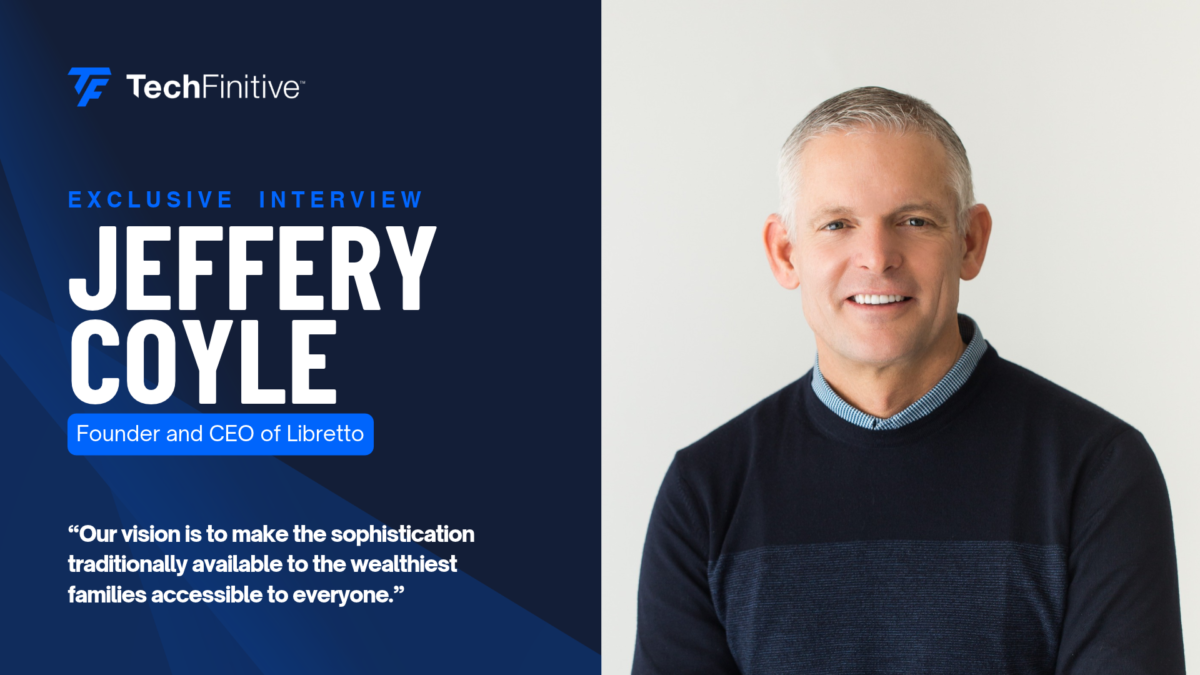
Jeffery Coyle, Founder and CEO of Libretto: “Our vision is to make the sophistication traditionally available to the wealthiest families accessible to everyone.”
Financial advice has traditionally focused on a client’s investment portfolio, but that can leave some of the most important parts of their financial lives out of the picture. A business, property, future earnings, pension entitlements or outstanding liabilities can all influence a household’s financial position – sometimes more than its investments.
For Jeffery Coyle, Founder and CEO of Libretto, this narrower approach can lead to recommendations that look sensible on paper but fail to reflect a client’s actual circumstances. Having worked with ultra-affluent families, Coyle developed a broader approach to wealth management that considers the complete financial picture, connecting investment decisions with personal priorities, future spending needs and risks beyond the markets.
Libretto was initially designed for ultra-high-net-worth clients, but its ambition is to make this level of advice available across an advisor’s entire client base. In this interview, Coyle explains why he believes traditional measures of investment risk need rethinking, how a client’s human capital and other assets should influence portfolio construction, and where AI can help advisors work more effectively without replacing professional judgment. He also discusses what needs to change to make comprehensive wealth advice more accessible and scalable.
Libretto, the ‘total wealth’ advice platform for financial advisors and family offices, was originally designed around ultra-high-net-worth clients but now aims to bring ‘total wealth’ advice to clients across different wealth levels. What was missing from traditional financial planning that led you to develop this approach?
Throughout my career working with ultra-affluent families, I found it difficult to make sensible recommendations without considering the client’s complete financial structure. A family’s largest asset might be a private business, while homes, liabilities, future earnings, and family commitments could influence financial outcomes far more than the investment portfolio.
We developed an approach built around three principles. First, advisors should manage total wealth, not simply investment accounts. Second, planning and portfolio construction should be connected, so investments support how people intend to live. Third, risk management should extend beyond portfolio volatility to address market, business, property, and personal risks.
We founded Libretto to integrate and scale these disciplines for advisors serving clients of all wealth levels. Our ambition is to make the level of rigor traditionally available to the wealthiest families accessible to everyone. We like to say that we help advisors make every client feel like they’re worth $100 million.
Your methodology looks beyond a client’s liquid investment portfolio to include private assets, liabilities, and future inflows. How does taking that broader view change the way an advisor thinks about risk and investment decisions?
It can fundamentally change portfolio construction. Rather than using risk questionnaires and Monte Carlo simulations, we help advisors consider the client’s total wealth, including homes, mortgages, human capital, pensions, businesses, properties, and other resources.
Consider an executive whose salary, deferred compensation, and company shares depend on the same employer. Their investment accounts may appear diversified, yet their total wealth could be highly concentrated in one company’s fortunes.
Another example is Social Security, which is similar to a long-term inflation-adjusted bond. You can estimate how much a client’s Social Security would be worth if valued like a bond, and that number can impact the way you think about their fixed income portfolio.
We help advisors think of investable assets as a completion portfolio. Rather than managing investments independently, advisors can design them to complement everything the household already owns while supporting future spending needs.
You’ve said that “technology alone doesn’t create better advice.” What do you think the wealth management industry gets wrong when it assumes that adding more technology automatically improves the client experience or the quality of advice?
Technology has greatly improved efficiency, access to information, and the client experience. But sometimes improvements in delivering advice can be confused with improvements in the advice itself.
An advisor may have a consolidated view of every client account, which is valuable. But if the recommendation remains a conventional model portfolio that ignores broader wealth, obligations, and personal priorities, they haven’t fundamentally improved the solution.
The distinction is between automating existing processes and enabling better methods. At Libretto, we began with the methodology. We connected priorities-based planning with portfolio construction, applying asset-liability matching to determine how resources should support desired outcomes. We then built technology to make those methods practical and scalable.
AI is increasingly being introduced into wealth management, including at Libretto through AI-assisted data entry, client onboarding, and your AI assistant, Mert. Where do you see AI genuinely improving the work of an advisor, and where should human judgment remain firmly in control?
I see tremendous opportunity for AI to remove friction, improve access to information, and help advisors communicate sophisticated concepts. Consider the time spent gathering information, entering data, preparing analyses, and producing client materials. Much of this work is necessary but might not require deep professional judgment.
At Libretto, we’re applying AI to help advisors extract information from documents, streamline onboarding, and prepare personalized communications. Our AI assistant, Mert, helps advisors navigate modeling questions, access knowledge resources, and communicate strategies using client-specific context.
Financial advice requires judgment, an understanding of clients’ personal priorities, and thoughtful evaluation of trade-offs. With AI, we’re focused on giving advisors more time to engage clients while making that judgment more informed and productive.
Libretto’s Insights hub covers areas such as valuing human capital, rethinking risk management, and going beyond Monte Carlo analysis. Which assumptions or established practices in financial planning do you think advisors most urgently need to reconsider?
I would begin with how risk is defined and measured. Our industry traditionally focuses on investment volatility and the probability of achieving financial goals. Both are useful, but neither fully captures a household’s vulnerabilities or the consequences when things go badly.
Planning should begin with client priorities, distinguishing essential spending from discretionary objectives. Through wealth allocation and asset-liability matching, we help advisors identify how resources should be invested to fund those commitments with appropriate confidence.
Human capital is another consideration. For younger households, future earnings may represent their largest asset, yet careers are neither risk-free nor readily marketable. Disability, death, or job displacement can disrupt earnings, requiring different protections. Working longer may provide flexibility but depends on health and employment opportunities.
Discussing these types of topics with clients naturally leads to comprehensive risk management. Beyond diversification and volatility measures, advisors can coordinate hedges, reserves, insurance, and other protections to address market, business, property, and personal risks.
If the goal is to make sophisticated advice available across an advisor’s entire client base rather than reserving it for their wealthiest clients, what needs to change – both in the technology and in the way advisors structure and deliver their services?
Two things need to come together: a consistent methodology for sophisticated advice and technology that makes it economically practical across client segments. Historically, comprehensive advice has required substantial professional time, custom analysis, and specialist coordination, limiting its scalability.
Technology changes those economics. Information gathered during onboarding can flow into planning, portfolio construction, and risk management. Recommendations can be developed consistently, refined by advisors, and updated as circumstances change without rebuilding the analysis.
Firms also need to organize advice differently. Rather than delivering planning, investments, and risk management separately, they can integrate them into a unified process connecting client priorities to financial strategies.
Our vision is to make the sophistication traditionally available to the wealthiest families accessible to everyone. Unified methods, scalable technology, and empowered advisors can make that possible.
You might also be interested in
About The Author