Trending Topics

 Trending
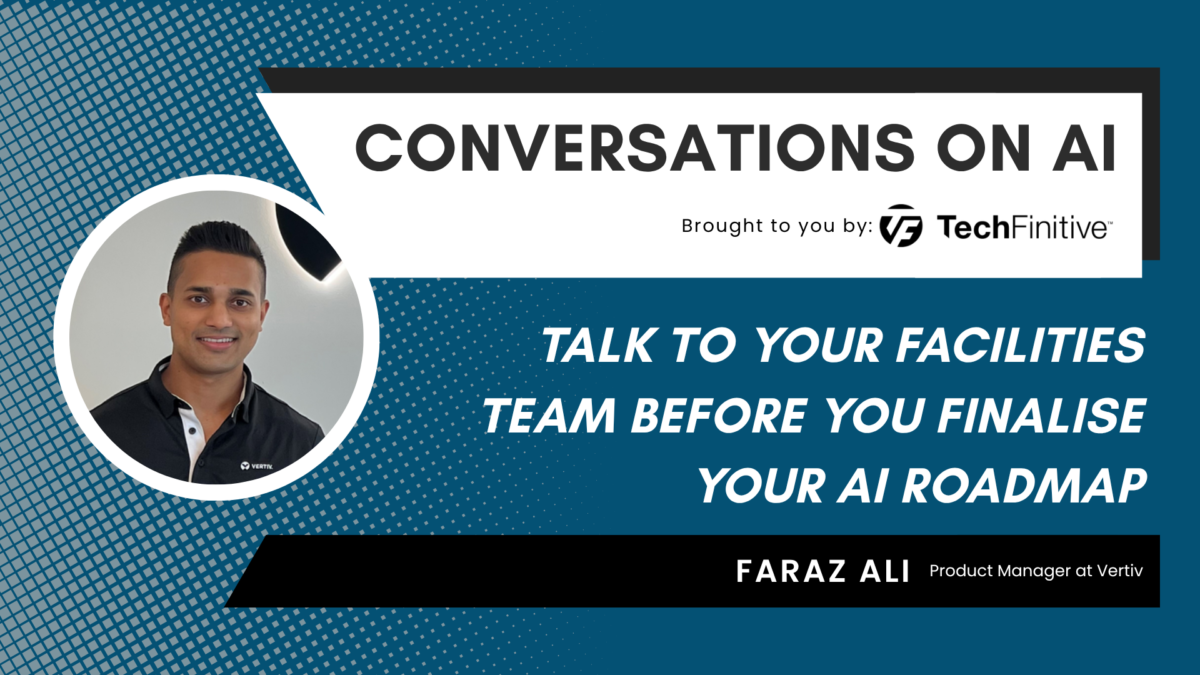
Faraz Ali, Product Manager at Vertiv: “Talk to your facilities team before you finalise your AI roadmap”

With so much talk about AI focusing on the software side, it was fantastic to get down and dirty and talk hardware with Faraz Ali, a Product Manager at Vertiv Australia and New Zealand. As someone who helps design the infrastructure of data centres, he needs to use all his years of electrical engineering experience to ensure it stays cool and can keep up with demands today and years into the future.
And the only predictable thing about AI is that it wants more, more, more. “We are seeing customers who planned for 10-15 kW per rack now exploring deployments above 100 kW,” Faraz told us. You need to consider power and cooling early, he explained. “When they are an afterthought, they become the bottleneck no amount of software innovation can solve.”
One technical solution to this is liquid cooling – this has brought familiar names such as Castrol into the market, as we reported two months ago – with Faraz describing it as “one of our fastest-moving development areas”. Data centres are becoming packed with ever more compute per square metre, he explained, with AMD, Intel and Nvidia all focusing on ever-more-dense chips. This brings yet more challenges, with Vertiv’s teams “designing for the next generation of compute while simultaneously meeting today’s demand”.
Faraz has a message for enterprises looking to adopt AI too: while that proof of concept project may have worked well, it doesn’t mean it will scale. “I have seen organisations reach the point where AI is delivering real results, only to discover that scaling means upgrading electrical distribution, redesigning cooling or re-evaluating their data centre footprint,” he told us. “Those are not quick fixes.”
Luckily, if you read our full interview with Faraz you will have a much idea about the hard (pun intended) challenges ahead of embracing AI at scale. “AI strategy is not just a software conversation,” he concludes. “The physical environment determines how far and how fast you can go. The earlier that reality is part of the plan, the fewer surprises along the way.”
Our huge thanks to Faraz for taking the time to share his insights.
Everyone says AI is transforming software, but where do you believe the industry is still overestimating its impact and where is it underestimating it?
The industry is overestimating how quickly AI can scale without confronting a very physical bottleneck: power and cooling. A single AI training cluster can require significant amounts of power, and the heat it generates is driving the need for more advanced cooling technologies.
What is being underestimated is the ripple effect. We are seeing customers who planned for 10-15 kW per rack now exploring deployments above 100 kW. That is not incremental, it fundamentally alters how a data centre operates, from thermal profiles to maintenance patterns to capacity planning timelines.
The organisations getting this right treat infrastructure planning as a parallel workstream to their AI software strategy. When power and cooling are considered early, AI scales faster. When they are an afterthought, they become the bottleneck no amount of software innovation can solve.
How has AI changed your company’s product roadmap over the past 18 months? Were there projects you accelerated, delayed or abandoned altogether?
The biggest shift has been speed. Eighteen months ago, liquid cooling was a growing part of our roadmap, today it is one of our fastest-moving development areas. We have accelerated direct liquid cooling and rear-door heat exchanger solutions because GPU-dense environments generate heat that air cooling alone cannot manage.
We have also accelerated prefabricated modular infrastructure. Customers need capacity in months, not years. Modular, factory-built solutions let them deploy power and cooling at speed without compromising reliability.
We have also invested heavily in predictive capabilities within our monitoring and management tools. As environments become denser and more complex, the ability to identify emerging issues before they affect operations is becoming essential rather than optional.
Priorities have shifted. The pace of change at the chip level – what Nvidia, AMD, Intel and others are delivering – means our teams are designing for the next generation of compute while simultaneously meeting today’s demand.
What is the biggest misconception enterprise customers still have about adopting AI within business-critical software?
That they can pilot their way to scale. Many organisations start with a small proof of concept, it works, and they assume they can simply expand. But moving from a handful of GPUs to production-scale AI introduces entirely different infrastructure requirements.
I have seen organisations reach the point where AI is delivering real results, only to discover that scaling means upgrading electrical distribution, redesigning cooling or re-evaluating their data centre footprint. Those are not quick fixes.
The misconception is not that infrastructure matters, most people understand that conceptually. It is that the gap between a successful pilot and production deployment is much larger than expected. A pilot runs comfortably within existing capacity. Scaling that workload can increase power draw dramatically and create thermal challenges the facility was never designed to handle.
The organisations that avoid this trap involve infrastructure planning from the outset, not after the AI team has proven the concept.
What has been the hardest challenge in bringing AI capabilities into your products? Technology, data quality, customer trust, regulation, pricing or something else?
Designing for a target that keeps moving. When Nvidia moved from the H100 to the B200, thermal design power per GPU increased significantly. That single change has implications for power distribution, cooling architecture and rack layout.
We cannot simply react to each chip release; we need to anticipate where processor technology is heading. That means collaborating directly with chip manufacturers during their development cycles so we understand thermal profiles and power requirements before products reach market.
The hardest part is balancing preparedness with pragmatism. Customers need solutions they can deploy now, not theoretical designs for hardware that does not yet exist. So, we focus on modularity, designing power and cooling systems that can be configured for today and adapted as compute evolves.
It is a different kind of engineering challenge. We are building infrastructure that needs to perform well today and remain relevant as the technology it supports changes rapidly.
How is AI changing the role of your customers? Are you replacing repetitive work, augmenting decision-making, or fundamentally changing how people do their jobs?
The most interesting shift is in data centre operations teams. These skilled professionals have traditionally managed facilities through experience, intuition and manual monitoring. Now we are seeing a transition towards data-driven operations.
Take thermal management. Previously, a facilities engineer might walk the floor, check temperatures and adjust cooling manually. In an AI-dense environment with thousands of sensors, that same engineer can see thermal patterns across an entire facility, predict hotspots and optimise cooling proactively.
The role is not being replaced, it is being elevated. Instead of routine checks and reactive troubleshooting, operations teams are becoming strategic planners, making decisions about capacity allocation and energy optimisation based on data they never had before.
Human judgement remains essential. AI tools surface insights, but experienced operators provide the context that turns those insights into good decisions. The best outcomes happen when intelligent tools and experienced teams work together.
Beyond productivity gains, what business outcome are your customers most excited about when they invest in AI?
Customers are genuinely excited about using intelligence to reduce the energy cost of running high-performance computing.
Traditional cooling systems often operate at fixed capacity regardless of demand. Intelligent systems adjust dynamically based on real-time workload and environmental data. In facilities running AI workloads that fluctuate throughout the day, that dynamic response delivers meaningful energy savings without compromising uptime.
Customers are also excited about extending the life of existing infrastructure. Not every organisation can build new facilities for AI. Intelligent monitoring helps identify where existing infrastructure has headroom and where upgrades deliver the most impact.
The broader goal is sustainable growth, expanding AI capabilities without a proportional increase in energy consumption. In markets where power is constrained and costs are rising, that is not just a responsibility goal, it is a competitive advantage.
If you could give one piece of advice to another SaaS executive planning their AI strategy today, what would it be?
Talk to your facilities team before you finalise your AI roadmap. It sounds simple, but it is remarkable how often the infrastructure conversation happens after technology decisions have already been made.
I have seen organisations commit to ambitious AI deployments then discover their data centre cannot deliver the power density required, or that cooling needs a significant upgrade. Those are solvable problems, but they take time, and can delay an AI strategy by months if not anticipated.
The executives who get the most from AI treat infrastructure as an enabler, not a constraint. They ask early: do we have the power capacity? Can our cooling handle higher density? Is our facility designed for the compute we are planning?
AI strategy is not just a software conversation. The physical environment determines how far and how fast you can go. The earlier that reality is part of the plan, the fewer surprises along the way.
More great interviews
- Thomas Plank, CEO of Tributech: “Blind trust is exactly what an attacker who manipulates data relies on”
- Jenny Peng, CTO at Aptean: “We are overestimating how quickly AI will eliminate traditional enterprise software and human expertise”
- Christos Spatharakis, CEO of Ferryhopper: “We turned being trapped on an island into a business”
- The security middle child: why midmarket businesses are being left behind by the tools meant to protect them
About The Author