Trending Topics

 Trending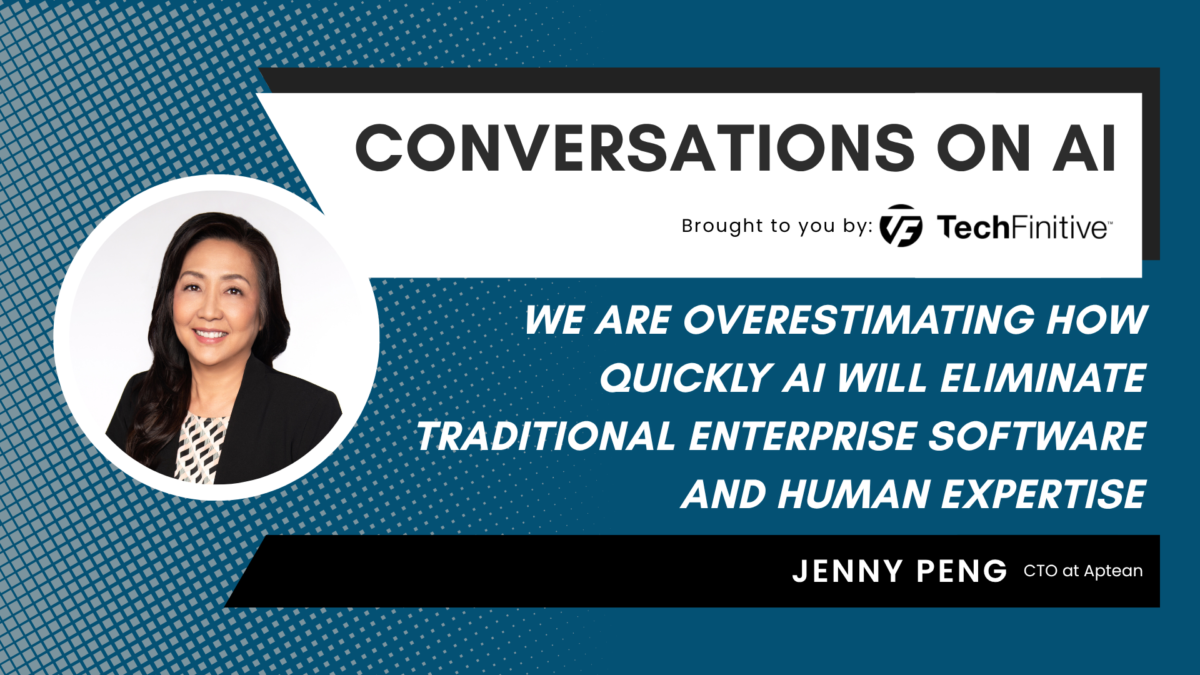
Jenny Peng, CTO at Aptean: “We are overestimating how quickly AI will eliminate traditional enterprise software and human expertise”

With nearly three decades of experience in enterprise software, Jenny Peng has seen first-hand how powerfully technology transforms how businesses operate. Now, she’s putting that experience to use as Chief Technology Officer at Aptean, a company that boldly proclaims to provide “AI-powered enterprise software that delivers proven results”. With AI changing software on both the developer and client side, Jenny and Aptean see an opportunity to rethink how work gets done.
She remains sceptical of the idea that AI will make traditional enterprise software obsolete. When it comes to the security, control and domain knowledge that business systems depend on, AI still “doesn’t eliminate any of those requirements” Jenny told us. The real impact, she argues, comes in software’s ability to take action. As systems begin to “increasingly execute work across systems” people can spend more time directing the work, handling the exceptions and making the decisions that require human judgement.
That shift is already changing how Jenny approaches product development at Aptean. Rather than simply using AI to help engineers write code, she sees a move toward an increasingly “AI-led” development process. As she puts it, the opportunity is not simply to do existing work faster, but to “attempt more than we ever could before”.
That same focus on the outcome shapes Jenny’s view of what separates genuine innovation from meaningless “AI-powered” labels. Meaningful value comes when AI can draw on trusted data, apply knowledge and execute across applications. This distinction is central to her approach at Aptean, and she has this advice to other businesses: “The test is simple. What job is the AI doing? What outcome is it helping the business achieve? If you can’t answer those two questions clearly, you have an AI feature rather than an AI solution.”
So with Jenny’s priorities established, we need to know where she sees AI going from here. That’s why we began by asking where she thought the industry was getting ahead of itself, and where it might still be underestimating AI’s potential.
Everyone says AI is transforming software. Where is the industry still overestimating its impact, and where is it underestimating it?
We are overestimating how quickly AI will eliminate traditional enterprise software and human expertise. Business-critical systems still require deterministic processes, controls, security, domain knowledge, and accountability. AI doesn’t eliminate any of those requirements.
Where we are underestimating AI is in how fundamentally it will change the way work gets done. The real shift isn’t a better chatbot sitting on top of an application. It’s software that can understand context, surface insights, help make decisions, and increasingly execute work across systems.
Over time, people will spend less time operating software and more time defining outcomes and orchestrating intelligent systems. Their work will shift toward managing exceptions and applying judgment where it matters most.
How has AI changed your company’s product roadmap over the past 18 months? Were there projects you accelerated, delayed, or abandoned altogether?
AI has changed more than our roadmap. It has changed both what we build and how we build it.
On the product side, we’ve accelerated investment in our AI platform, our enterprise data and semantic capabilities, intelligent workflows, and agents. At the same time, we’ve deprioritised work that simply digitises another manual process or adds another screen.
The question we now ask ourselves is different: should we build another workflow for a person to operate, or should AI be able to do that work on their behalf?
Just as importantly, we’re moving from an AI-assisted software development lifecycle (SDLC) to an AI-led one. The distinction matters. AI-assisted development starts with the engineer doing the work and asking AI to help. AI-led development starts by asking how much of the work AI can do, and where human engineering judgment must guide it.
That shift raises the bar for the engineer’s role. Instead of spending their time writing code with AI as an assistant, engineers increasingly define the intent, architecture, requirements, constraints, and acceptance criteria – and then direct AI agents to execute a growing share of the development, testing, and remediation work. The engineer becomes the architect, the orchestrator, and the quality owner.
What really changes is our capacity. We can take on work that previously wouldn’t have justified the investment, and we can deliver it to customers far faster. That’s the part I find most interesting. It’s not about doing the same work with fewer people but being able to attempt more than we ever could before.
Many SaaS vendors now describe themselves as “AI-powered.” What separates companies creating real customer value from those simply adding AI features?
The difference is whether AI changes a business outcome or simply changes the user interface. Adding a chatbot, a summarisation button, or a generative feature is relatively easy. The harder and far more valuable work is connecting AI securely to enterprise data, understanding the business context, embedding domain expertise, orchestrating actions across applications, and measuring the result.
For us, the test is simple. What job is the AI doing? What outcome is it helping the business achieve?
If you can’t answer those two questions clearly, you have an AI feature rather than an AI solution.
What’s the biggest misconception enterprise customers still have about adopting AI within business-critical software?
Choosing the right model is the AI strategy. The model is becoming just one component of a much larger architecture. In enterprise AI, the hard questions are about data, context, permissions, security, governance, integration, and trust. An AI system needs to know not only what information exists, but what that information means to the business. It also needs to know how different information relates, who is allowed to access it, and what actions it is authorised to take.
The model may provide the intelligence, but the enterprise context, semantics, and governance are what make that intelligence useful and trustworthy.
If you were launching your company today with AI available from day one, what would you build differently?
I’d start with the business outcome, not the application.
I’d ask: what outcome are we trying to achieve? What must be true for us to achieve it? What work needs to be performed to make that happen? And then: how much of that work can we engineer AI to perform?
That’s fundamentally different from how most enterprise software has been designed. Historically, we identified a business process, built software to support it, and trained people to operate that software. If I were starting today, I’d design for AI to do the work from the beginning.
The role of people would increasingly focus on defining the desired outcomes, providing judgment and oversight, and orchestrating the AI. Our job as a software company would be to create the conditions for success and give AI what it needs to succeed – the right tools, trusted data, business semantics, permissions, guardrails, and access to actions across the enterprise.
So instead of starting with screens, workflows, and features, I’d start with outcomes, work, and intelligence -then engineer the software, data, and AI around accomplishing those outcomes. The fundamental question shifts from “what software should we give people to help them do the work?” to “how do we enable AI to do the work, with people orchestrating and governing it?”
How is AI changing the role of your customers? Are you replacing repetitive work, augmenting decision-making, or fundamentally changing how people do their jobs?
All three shifts are happening. Repetitive work is being automated, decision-making is being augmented, and jobs themselves are beginning to change. The third is the most important.
We’re moving from people operating software to people orchestrating intelligent work.
Instead of spending hours gathering information, reconciling data, navigating applications, and moving work between systems, people can increasingly focus on defining outcomes, handling exceptions, exercising judgment, and making higher-value decisions.
This doesn’t diminish the importance of people. It changes where their expertise creates the most value. The future isn’t people working faster with AI assistance – it’s a different division of work between people and intelligent systems.
What has been the hardest challenge in bringing AI capabilities into your products? Technology, data quality, customer trust, regulation, pricing, or something else?
The hardest challenge isn’t a single technology. It’s making AI enterprise-ready at scale. A prototype can be impressive in weeks. Building something customers trust with business-critical operations requires far more: reliable data, business context, security, permissions, evaluation, observability, predictable behaviour, cost management, governance, and a strong user experience.
AI has dramatically reduced the cost and time required to create functionality, but it hasn’t reduced the importance of engineering discipline. In some ways it has made that discipline even more important because we can now build the wrong thing much faster.
So, the challenge isn’t simply making AI work. It’s making AI reliable, scalable, understandable, and trustworthy enough to do meaningful work inside the enterprise.
There’s growing discussion around AI agents replacing traditional software workflows. Do you see the future as applications becoming collections of intelligent agents, or will conventional interfaces remain central?
Conventional interfaces won’t disappear – not right away, but they will evolve. More importantly, the interaction surface between people and software is going to widen dramatically. Voice will become a core part of that interface. Just as we speak to each other to communicate and define work, we’ll increasingly do the same with AI.
For decades, enterprise software has expected people to come to the application: sit in front of a screen, open the right system, navigate menus, and execute a workflow. AI changes that model. Software now needs to meet people where the work happens.
That might be in Outlook or Excel, in a car, on a factory floor, through a mobile device or wearable, while someone is walking a warehouse, or simply through voice while their hands are occupied. AI allows the intelligence of enterprise software to move beyond the conventional interface and connect more naturally to both the digital and physical worlds.
Behind those interactions, applications will increasingly become collections of capabilities, data, and intelligent agents that can reason, coordinate, and act. But people won’t necessarily experience those agents as another application they have to operate. The best experiences may become almost invisible- the right intelligence appearing in the right context, through the right interaction, when it’s needed.
So, I don’t see the future as agents replacing interfaces. I see AI dramatically expanding the interface to enterprise software—from something we go to, to something that surrounds us and meets us wherever work happens.
How do you balance innovation with responsible AI? Where do you draw the line between moving quickly and making sure customers can trust the outputs?
Responsible AI isn’t a brake on innovation. It’s what makes AI deployable in business-critical environments.
The level of autonomy should be proportional to the consequence of the action. An agent summarising information can operate very differently from an agent changing a production schedule, issuing a financial transaction, or modifying customer data.
We focus on clear permissions, traceability, testing, monitoring, and human approval where the risk warrants it. As AI becomes more autonomous, knowing what the AI did, why it did it, what information it used, and what authority it had becomes increasingly important.
The goal isn’t zero risk. That would stop innovation. The goal is known risk, appropriate controls, and clear accountability.
Beyond productivity gains, what business outcome are your customers most excited about when they invest in AI?
Speed to outcome.
Productivity matters, but customers ultimately care about what that productivity enables: resolving a customer issue faster, responding to demand sooner, reducing downtime, improving inventory decisions, accelerating an order, or identifying a problem before it becomes expensive.
AI also creates the opportunity to shorten the distance between signal, insight, decision, and action. Instead of spotting something in a report and then asking someone to investigate and act, intelligence can increasingly connect those steps. The most compelling AI conversations are moving from “how many hours can this save?” to “how much faster can my business sense, decide, and act?”
Looking ahead three to five years, what part of today’s SaaS experience will disappear because AI makes it obsolete?
The traditional idea of SaaS as a destination will begin to disappear.
Today we think of SaaS as an application you log into: you go to a particular system, navigate its interface, find the information you need, perform a task, and then move on to the next application. AI gives us the opportunity to change that model fundamentally.
In the future, the service a software company provides needs to be available wherever the work happens. It should be connected, reachable, and transferable as people move between environments and interaction surfaces – whether they’re in Outlook or Excel, on a mobile device, in a vehicle, on a factory floor, using a wearable, talking through voice, or sitting at a traditional desktop.
The important thing is continuity. I shouldn’t have to restart my interaction every time I change devices or environments. The intelligence should understand my context, carry the work with me, and let me move naturally from one surface to another.
That also changes how we think about managed services. Customers aren’t buying access to an application; they’re buying a capability and an outcome. Increasingly, that capability should be continuously available and intelligently delivered wherever it’s needed.
So, three to five years from now, I think we’ll talk less about going into a SaaS application and more about accessing an intelligent service that follows the work. AI needs to meet me where the work happens, not require me to go where the software happens to live.
If you could give one piece of advice to another SaaS executive planning their AI strategy today, what would it be?
Don’t start by asking where you can add AI to your existing software. Start with the business outcome and work back from there.
Ask: what business outcome are we trying to create? What must be true to achieve it? What work needs to be performed? Then ask how much of that work can be engineered for AI to do, with people providing the judgment, direction, tools, data, business semantics, and governance AI needs to succeed.
That requires a very different mindset from simply making today’s applications “AI-powered.” It means moving from AI-assisted to AI-led and designing for AI to do the work first rather than having people do the work with AI helping along the way.
It also means rethinking the boundaries of the application itself. AI shouldn’t require people to come to the software. It should meet them where work happens, across applications, devices, and the physical world, and carry context and work smoothly between those surfaces.
My advice is simple: reimagine the work that AI now makes possible.
That requires a very different mindset from simply making today’s applications “AI‑powered.” It means shifting from AI‑assisted to AI‑led development and designing for AI to do the work first, rather than having people do the work with AI helping along the way.
Recommended reading
About The Author

Rowan Campbell
NEXT UP