Trending Topics

 Trending
FFFACE.ME AR Mirror: 10 ways brands use AI & AR smart mirrors

This is a sponsored article brought to you by FFFACE.ME.
AR mirrors are moving well beyond the novelty phase. In retail and experiential marketing, they are increasingly being used as practical interfaces for product discovery, virtual try-on, personalization, entertainment, and conversion.
What makes the format interesting is its flexibility. The same core setup — a screen, camera, tracking technology, and software layer — can behave very differently depending on where it sits in the customer journey.
Here are 10 ways brands are using FFFACE.ME AR mirrors today.
1. Speed up product discovery
One of the clearest applications of AR mirrors is helping customers explore more products in less time.
In categories such as eyewear, beauty, and accessories, shoppers can compare multiple options without physically trying every product.
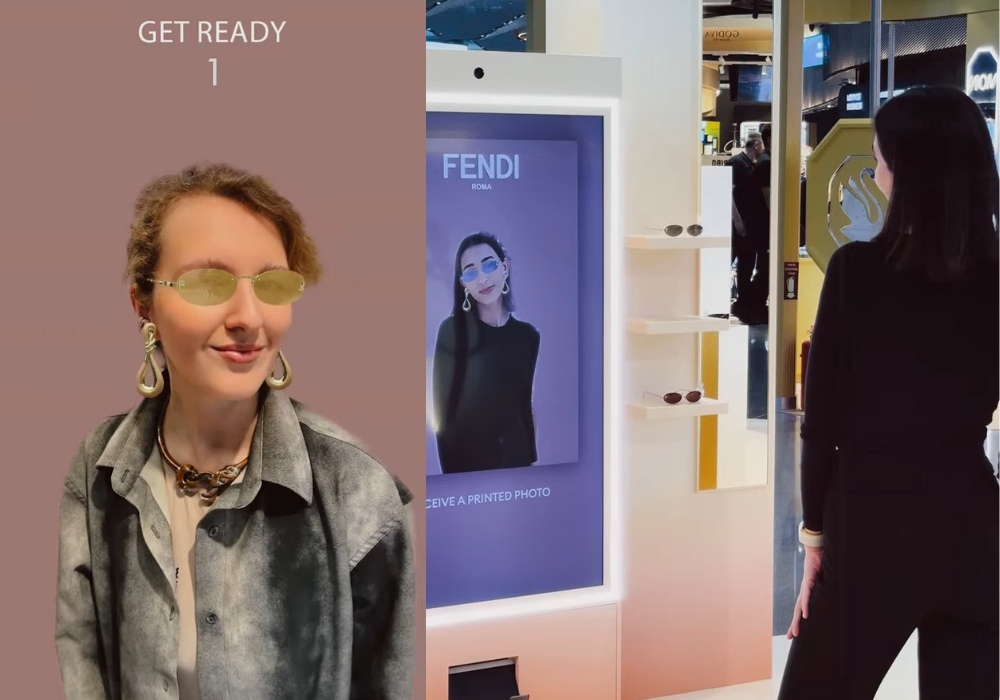
For Fendi at Istanbul Airport, an AR mirror allowed visitors to virtually try on sunglasses and print a branded image. The featured line later sold out, while sales were 43% higher year over year compared with a non-AR period.
The value here is not simply the visual effect. It is the reduction of friction between seeing a product and considering it.
2. Use AI try-on before the fitting room
AI clothing try-on gives customers a fast way to browse a collection before deciding what deserves a physical try-on.
For H&M × Stella McCartney, visitors could explore more than 40 looks through an AI-powered experience.
This kind of setup is most useful when it works as a discovery layer rather than a replacement for physical fitting rooms. It lets customers narrow down options first, making the next step more intentional.
3. Use the mirror as a content engine
A smart mirror can also function as a photobooth, allowing visitors to capture photos or videos with branded AR effects.
The output can be downloaded via QR code, printed, or shared later.
This creates a useful link between physical experience and digital distribution. The in-person interaction may last less than a minute, but the resulting content can continue travelling across social platforms.
For this reason, the quality of the output matters as much as the interaction itself.
4. Turn the storefront into an acquisition channel
Store windows have traditionally been passive media. AR mirrors can turn them into interactive entry points.
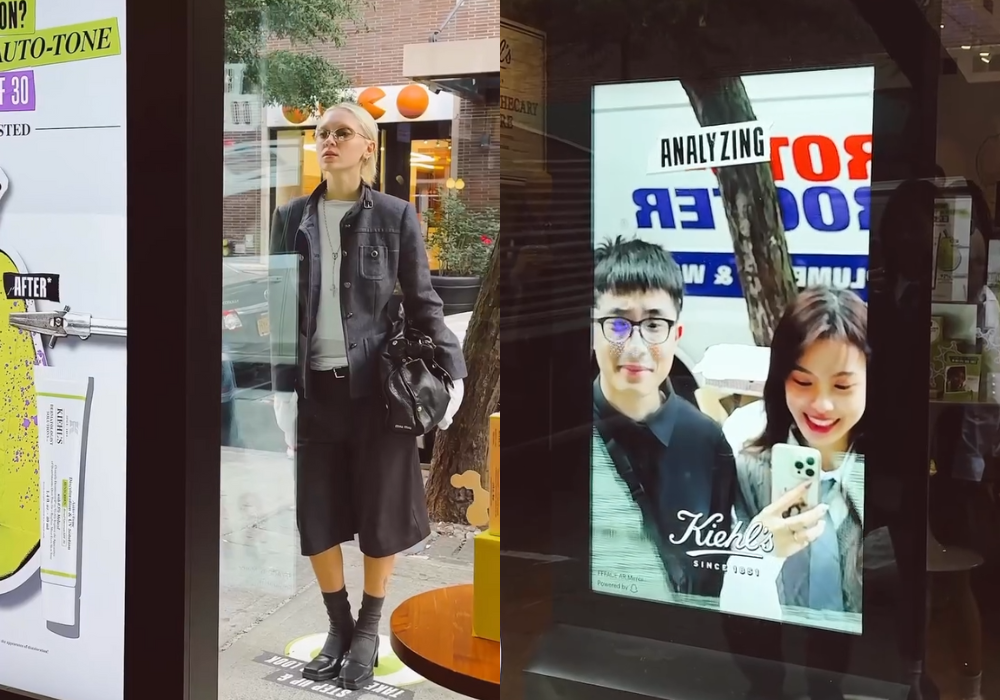
For Kiehl’s in New York, an AR storefront generated 3,118 interactions and was associated with a 20% increase in foot traffic. Bershka’s Madrid storefront generated more than 10,000 unique interactions during its first weekend.
The important shift is that the storefront stops being only a branding surface. It becomes measurable and participatory.
5. Use gamification to increase dwell time
Not every smart mirror needs to start with product selection.
Gesture tracking, face tracking, and body tracking can turn the screen into a game interface, allowing visitors to complete challenges, score points, or unlock rewards.
For brands, this is useful in high-traffic environments where the first goal is attention and participation rather than an immediate product decision.
The strongest concepts still connect the game to the brand, product, or campaign narrative rather than treating entertainment as a separate layer.
6. Combine AR with AI recommendations
A more advanced use of smart mirrors is to move from visualization into guidance.
AI can help suggest products, complete a look, recommend another category, or change the next step based on what a customer has already explored.
This is where AR mirrors begin to resemble interactive sales interfaces rather than campaign installations.
The value depends heavily on relevance. Recommendations need to be useful enough to improve decision-making rather than simply adding another AI feature.
7. Add a digital layer to beauty consultation
Beauty is particularly well suited to smart mirrors because visual comparison is already part of the purchase process.
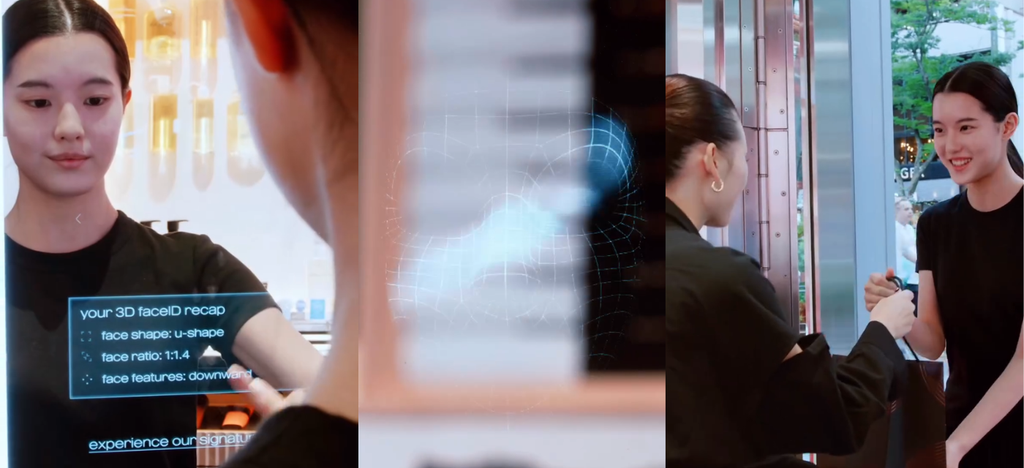
An AR or AI mirror can combine virtual try-on with face analysis, product education, recommendations, and human consultation.
For Shu Uemura in Tokyo, FFFACE.ME and loook.ai developed a reflective AI mirror combining real glass, digital content, and 3D facial analysis.
The broader opportunity is not simply to digitize makeup testing, but to add more context around the decision.
8. Put the customer inside the campaign
AI and AR mirrors can also turn the visitor into the campaign creative.
Instead of watching a branded visual, people can see themselves transformed into a character, fashion look, visual identity, or campaign world.
This changes the role of campaign content. It is no longer only something distributed by the brand; it can also be generated by the audience.
That is particularly relevant for fashion, beauty, entertainment, and product launches where visual identity is already central to the campaign.
9. Connect the mirror to the wider retail journey
The most effective AR mirrors are rarely isolated experiences.
They can connect the storefront to the store, the digital try-on to the physical fitting room, the consultation to the product shelf, or the interaction to a QR code, printout, or purchase.
That connection is what determines whether the technology becomes a useful retail tool or remains a one-off attraction.
For brands, the question is therefore not simply where to place an AR mirror, but what role it should play before, during, or after the purchase decision.
10. Apply AR mirror technology to large screens
AR mirrors do not need to resemble conventional mirrors.
The same camera-based interaction can be used on storefront displays, LED walls, event screens, and digital billboards.
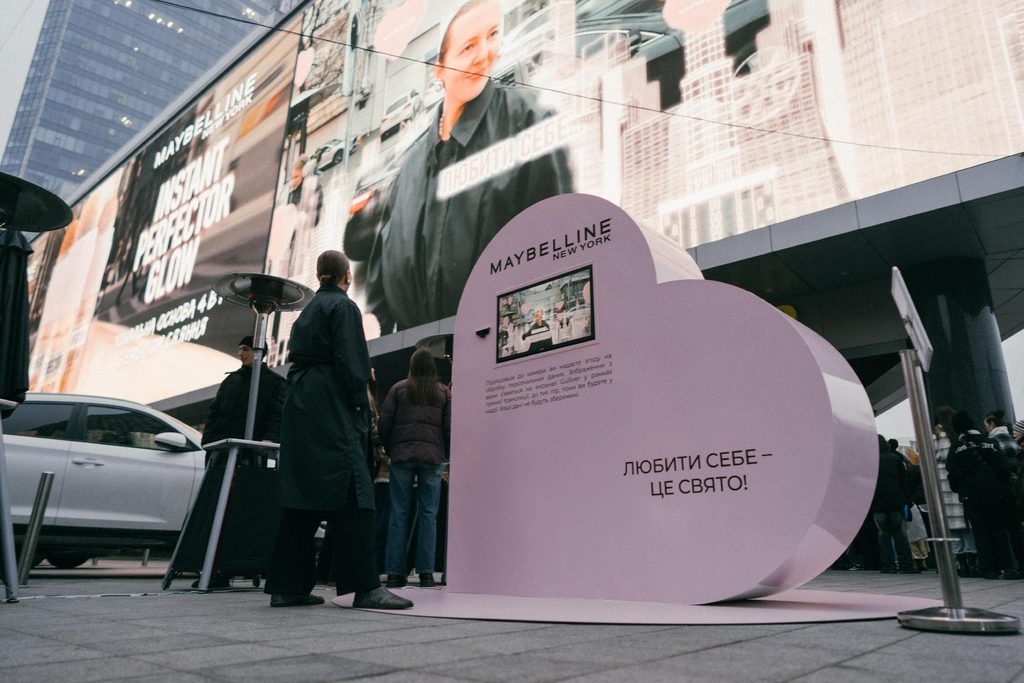
For Maybelline New York, FFFACE.ME created a 4,000 m² AR mirror experience that generated more than 10,000 interactions in eight hours.
At this scale, the format starts to overlap with digital out-of-home. The difference is that the audience is no longer only watching the media — it can become part of it.
AR mirrors are becoming a flexible retail interface
Across fashion, beauty, retail, and experiential marketing, AR mirrors are taking on increasingly different roles.
They can attract attention, reduce friction in product discovery, support consultations, generate content, increase participation, or help customers navigate large collections.
The underlying technology may be similar, but the business value depends on how well the experience is designed around the audience, physical environment, and customer journey.
That is why the most interesting AR mirror projects are no longer defined by the mirror itself. They are defined by the problem the interface is designed to solve.
FFFACE.ME develops AI and AR mirror experiences for global brands across retail, fashion, beauty, events, and digital out-of-home — from virtual try-on and interactive storefronts to AI-powered consultations, games, photobooths, and large-scale AR screens
About The Author

Gabriel Jones
NEXT UP