Trending Topics

 Trending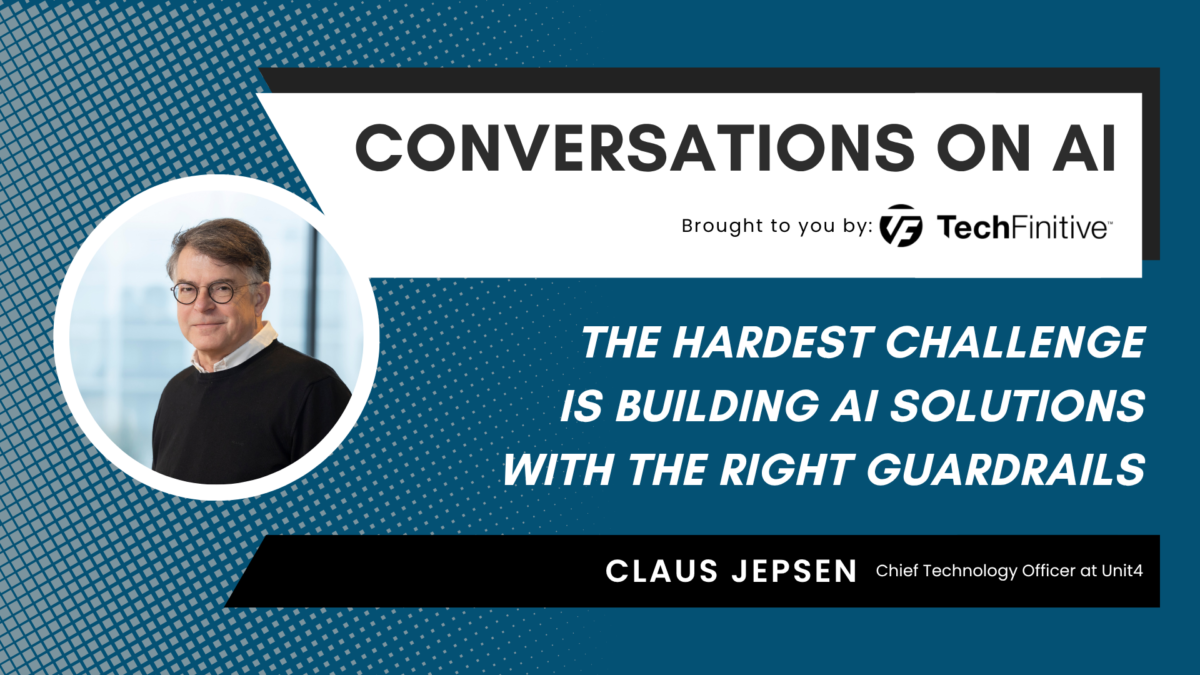
Claus Jepsen, Chief Technology Officer at Unit4: “The hardest challenge is building AI solutions with the right guardrails”

At age 14, Claus Jepsen received a Tandy TRS-80 Model I. There wasn’t much enterprise software available for that computer, launched in 1977, but it still served as the inspiration for Claus’s career and gave him an understanding of underlying complexity that he still finds important today when modernising the systems business rely on. Now Chief Technology Officer at Unit4, he’s helping to move enterprises’ ERP onto cloud-based, scalable platforms.
Claus sees AI’s impact on software development as fundamental. “When everyone can ‘write’ code, it loses its value as the IP,” he told us during our interview. This, he argues, is forcing companies to reassess where their true product value lies. The more important question then becomes what sits around the code: understanding the decomposition of the problem, the data and the architecture to turn generated code into something reliable and useful to the company.
That distinction becomes even more important when AI moves from experimentation phase and into the core systems a business relies on. Claus is wary of assuming that simply because AI can generate an application, every organisation should simply now build their own. Large enterprises may have the capacity and resources to achieve this, but for mid-market businesses and those in highly regulated fields, the margin for error is significantly lower. In particular, “ensuring there is effective oversight and maintenance of software remains important and it should not be assumed AI can do this job”.
AI is already changing how Claus’s team builds software, but the biggest shift may be found before the code is written. His modelling suggests that development can become “five to 15 times faster,” yet that speed requires engineers to spend more of their time defining the problem and setting clear boundaries. A necessity in Claus’s eyes: “Give it vague or inaccurate instructions and it should be no surprise it will produce poor quality output.”
So while AI may be making software production faster, Claus sees the real transformation as reliant on what sits beneath it. With this in mind, we wanted to know where he thought the industry was overestimating the impact of AI, and where yet it may have room to grow.
Everyone says AI is transforming software, but where do you believe the industry is still overestimating its impact and where is it underestimating it?
AI is clearly having a transformative effect in various ways, but as an industry we don’t yet completely understand the value of that impact.
Take software development. Overnight producing code has gone from a scarcity to abundance. When everyone can “write” code, it loses its value as the IP. This is forcing companies to reassess where their true value to customers lies.
What we’re finding in the ERP sector is that you must be careful not to overestimate the potential of AI. If you are a large enterprise with a big IT department you could potentially write your own applications using AI. However, if you are in a highly regulated industry, or you are a mid-market company with more limited IT resources, then you cannot risks issues around hallucinations especially in core functions like General Ledger and related financial systems. Ensuring there is effective oversight and maintenance of software remains important and it should not be assumed AI can do this job.
How has AI changed your company’s product roadmap over the past 18 months? Were there projects you accelerated, delayed or abandoned altogether?
Since the start of the year, our engineering teams have been integrating AI coding tools into our product development roadmap to understand how they can add value. In the modelling we have done, we have found we can accelerate product development five to 15 times faster, but it has also led to us adopting a different approach to engineering new products. Using AI tools requires much more interrogation of the problem, prior to producing code. If you are allowing AI to autonomously develop functionality you must be absolutely certain it has the right framework and guardrails around it. Give it vague or inaccurate instructions and it should be no surprise it will produce poor quality output.
Many SaaS vendors now describe themselves as “AI-powered.” What actually separates companies creating real customer value from those simply adding AI features?
It’s really important to separate out those vendors who are sprinkling AI on top of their existing systems and bragging about how many agents they have, and those vendors who are fundamentally changing how their ERP works.
It is crucial customers understand this point because the former group is really just adding automations through LLMs which will drive some level of efficiency, but will not get to the real value AI can offer. The approach to data is crucial. Only when a vendor is building semantic context and an ontology that enables the AI to communicate effectively with core ERP systems will customers see a step change in the value of the technology.
What is the biggest misconception enterprise customers still have about adopting AI within business-critical software?
Believing you can simply add AI on top of your existing systems via APIs. If AI is to be truly effective, it requires metadata to provide context and understanding when it receives instructions. AI requires ontologies, so that it understands meaning. For example, the word “project” means something different in the worlds of professional services and non-profits. If the AI doesn’t understand the language of a particular industry, then it may hallucinate and take longer to train.
How is AI changing the role of your customers? Are you replacing repetitive work, augmenting decision-making, or fundamentally changing how people do their jobs?
As I mentioned earlier, we are already seeing a positive change for our engineering teams in terms of how quickly we can develop new functionality. We are also seeing it augment decision-making as AI’s analytical capabilities means we can crunch through more data to inform how we think about problems.
There is some level of change in how decision-making works. In traditional organisational structures there are some (what I would call) ceremonial layers of decision-making, which AI can now automate. This is a good thing as it speeds up decisions and also places teams closer to the customer problems they are looking to solve.
This, though, is also leading to new requirements for managers to act as roadblock removers, as there are still situations where there are two possible outcomes and no wrong answer. This requires human intervention to find the resolution that best meets the needs of the business.
As we look into the future, AI will continue to automate some elements of coding, but that does not mean students should stop taking computer science degrees. It is absolutely crucial we have people qualified to interrogate what the AI is doing and identify when it is trying to break out of the guardrails that have been set. That demands an understanding of the fundamentals of computer science.
It is the same for our customers. Lawyers have been worrying about AI automating some repetitive tasks, such as drafting contracts, but it is essential to train the AI to draft the contract in the right way. Equally, a contract must be checked before being shared with a client. Those are roles requiring a lawyer’s expertise and experience.
What has been the hardest challenge in bringing AI capabilities into your products? Technology, data quality, customer trust, regulation, pricing or something else?
The hardest challenge is building AI solutions with the right guardrails. In ERP, our customers are running core financial processes which have no room for error. If you are building an AI for a finance system, it cannot hallucinate about financial results or staff utilisation in project planning. This comes back to ensuring you have the right ontologies and metadata so the AI understands the context of what it is being asked to do.
There’s growing discussion around AI agents replacing traditional software workflows. Do you see the future as applications becoming collections of intelligent agents, or will conventional interfaces remain central?
How users interact with ERP systems will change. It will become a much more conversational interface. Agents will take on responsibility for workflows, rather than replace them operating in the background as what we call Ambient ERP. For the user, the ERP will become much more invisible and the conversational interface will only pop when there is a need to involve a human.
These interfaces will also be built on demand rather than pre-built, which will make the user experience more dynamic, but overall I expect AI will mean there is less burden on users to complete tasks enabling them to better use their time to focus on work that matters.
How do you balance innovation with responsible AI? Where do you draw the line between moving quickly and ensuring customers can trust the outputs?
We’re in the EU, so we must comply with regulations and ensure our customers trust what we’re doing. That does not slow down our pace of innovation because we have worked hard to put the right guardrails in place to ensure AI is operating with the parameters we expect.
Looking ahead three to five years, what part of today’s SaaS experience do you think will disappear because AI makes it obsolete?
How customers pay for software is likely going to change, which is why there is so much discussion around value-based pricing models such as outcome-based.
Some software may disappear in the sense that it will be fully automated by AI, but that will only happen in non-regulated industry sectors. Where regulatory compliance is crucial there will still need to be software development and maintenance.
If you could give one piece of advice to another SaaS executive planning their AI strategy today, what would it be?
Get your data in order and ensure the ontology for your business processes and tasks is accurate.
More articles relating to Unit4
About The Author

Ricardo Oliveira
NEXT UP