Trending Topics

 Trending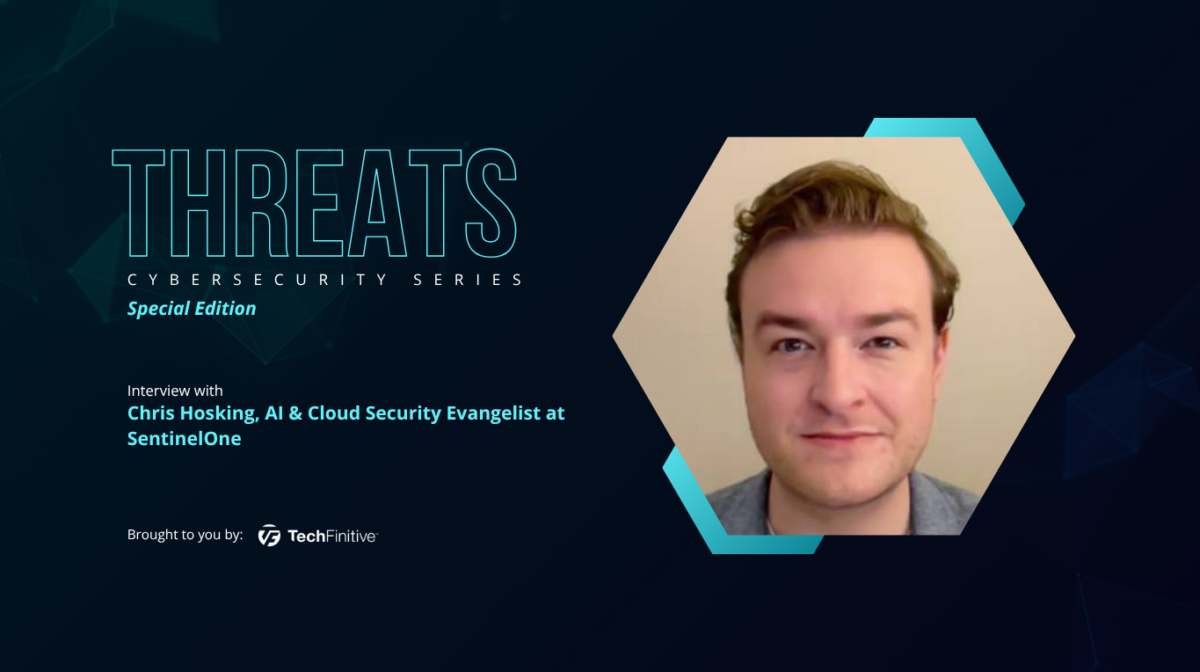
Chris Hosking, AI & Cloud Security Evangelist at SentinelOne: “Lots of security teams can’t see what’s going in or coming out of AI across their employees”

For Chris Hosking, cybersecurity has always been about more than technology. Having once directed theatre productions, he says he was naturally drawn to the “drama of cyber security”, where the stakes are clear and the landscape is constantly changing.
After over a decade of working across cloud security and AI, he now serves as Cloud Security Evangelist at SentinelOne, helping organisations build security programmes that can keep pace with an increasingly sophisticated threat landscape.
The greatest challenge facing security leaders today, according to Chris, is the pace at which AI has become embedded all across organisations. Often faster than security policies can evolve. Consider the rise of Shadow AI, “essentially the bad big brother of Shadow IT“, he says. Employees unknowingly bypass governance and monitoring, often exposing sensitive information outside of approved channels.
Combined with compromised credentials and increasingly automated attacks, these unprotected areas create a rapidly expanding attack surface that organisations are only just beginning to understand.
What makes generative AI especially attractive to threat actors, Chris argues, is its ability to compress time and expertise. More concerningly, attackers are beginning to use AI prompts for “end-to-end attack planning,” being able to identify vulnerabilities and adapt tactics in real-time. As Chris puts it, some campaigns are “identifying the target, finding a way in and then maximising the breach once inside”.
Despite this growing sophistication of AI-powered attacks, Chris believes the strongest defences still come from security fundamentals. Companies must maintain visibility across AI usage, protect credentials and automate the detection of potential attack paths to reduce risk before an incident can occur.
He also believes cybersecurity remains a deeply collaborative profession, and his greatest piece of advice for those who want to learn more mirrors that: “Security can be a small world, but everyone loves to help out and there’s so much to learn! Just get stuck in!”
As we mentioned at the start, Chris’s unique perspective comes from technical experience with an earlier passion for theatre and storytelling. With that unconventional path in mind, we wanted to start by asking how that journey began.
Could you please introduce yourself to our audience and share how you ended up working in cybersecurity?
Hi, I’m Chris Hosking! I’m a Principal Evangelist for SentinelOne, which is a fancy way of saying my role is to talk to people about all things cybersecurity and SentinelOne. I’m often talking about cyber security trends, the realities of breaches, the threat landscape we currently face, what lessons from the past can we reapply now and how to build outcome-driven security programmes with SentinelOne’s products.
I have always been drawn to the drama of cyber security (and briefly had a previous life directing theatre shows!). The balancing sides of attackers and defenders, the clear stakes when cyber impacts regular life, the speed at which new technology is adopted by both sides – all incredibly interesting and detailed. It’s a constantly changing field and it’s a privilege to work alongside defenders across industries.
My work began with an email security vendor and then expanded to working with organisations to mostly help them adopt cloud (and now AI) securely. That, in itself, is always a coin with two sides: how can organisations be secure by design as they build and adopt new technology, to ideally reduce the number of attacks they see and how can they have detection and response capabilities so that when an attack does inevitably happen, they are equipped to respond.
What are the biggest cybersecurity challenges those in leadership roles are facing?
The adoption of AI is certainly a top cyber challenge for leadership. In what feels like the blink of an eye, AI has become deeply embedded in day-to-day work, across business departments. What began as a few websites and maybe just engineering or IT has grown to hundreds of websites, new desktop and mobile apps and now AI agents, for daily use by HR, marketing, legal, sales and so on. This adoption has been fantastic. It’s already reaping speed and innovation for many organisations. However, it’s often adopted without employees understanding their organisation’s security policy or operating outside the security team’s visibility.
It’s essentially the bad big brother of Shadow IT. We’re seeing Shadow AI, where corporate data and sensitive information are now being operated outside of approved channels, bypassing governance and monitoring. Put short, lots of organisations and security teams can’t see what’s going in or coming out of AI across their employees.
For power users who might be using their own or unmanaged API keys to operate AI across systems, a single compromised AI key can unlock access to multiple connected systems. It’s a hard-to-detect blind spot with significant risk, potentially creating a domino effect where one compromised asset opens the door to others. There’s also the problem of scale. Think of the headache from an employee clicking a bad email or bad link, now imagine AI clicking one hundred within a minute.
What are some prevention strategies you believe every business should adopt?
AI-driven risks are creating new headaches for security leaders. To reduce exposure, businesses must continuously monitor their AI usage and understand their AI attack surface. This means maintaining an up-to-date inventory of internet-facing assets, critical cloud services and sensitive databases, while ensuring configuration changes are promptly reflected in the organisation’s risk assessments. By doing so, organisations can maintain visibility and control across evolving cloud and AI environments, enabling them to quickly identify and address vulnerabilities before they are exploited.
Many organisations also underestimate the importance of securing LLM and AI keys and fail to apply the same protections used for other high-value credentials. AI credentials should be treated as critical assets. Businesses should use organisation-managed AI and LLM keys rather than personal or ad-hoc credentials, enforce least-privilege principles and implement regular key rotation. Continuous monitoring of AI usage, including shadow AI activity, is essential to detecting misuse and anomalous behaviour.
Automation also plays a key role in cybersecurity defence strategies. By automatically scanning for exposed secrets, mapping potential attack paths and triggering remediation actions such as key rotation, access revocation and policy enforcement, organisations can move beyond slow, manual processes that are easily bypassed or delayed. This enables them to identify and remediate risks in real-time, ensuring continuous protection of critical systems.
What is it about generative AI that makes it so prone to exploitation by threat actors? Conversely, how can it be used for good?
There are already many examples of attackers using generative AI for malicious purposes, including optimising malware code and creating more convincing phishing content and deepfakes. However, the most concerning use case is how generative AI is being operationalised to support end-to-end attack planning, from identifying the most effective extortion strategies to pinpointing weaknesses in systems. What makes generative AI particularly dangerous is its ability to rapidly process vast amounts of data, enabling attackers to uncover vulnerabilities and refine tactics far more quickly than traditional manual reconnaissance. Generative AI has also significantly lowered the barrier to entry to cybercrime, as what once required specialist expertise and significant time investment can now often be executed with a simple prompt.
On the defensive side, AI and Machine Learning have long been used in security and are highly effective at detecting threats. However, Large Language Models (LLMs) add a new dimension through their conversational and reasoning capabilities. For instance, a SOC analyst can ask an LLM in natural language to identify suspicious login activity by querying logs over a specific time window and correlating results with user roles and permissions. Security teams can then ask follow-up questions to gather all relevant information about an incident and receive suggested remediation actions. This shift moves security towards more autonomous, intelligent SOC operations, where AI helps anticipate attacker behaviour and strengthen overall security posture.
Easier, incremental gains include using AI to automate triage by filtering and prioritising security alerts, enabling security teams to focus on the most critical issues. However, the most immediate and straightforward benefit is automating reports, such as incident summaries, compliance reports and executive dashboards, reducing manual effort to allow security leaders to focus on higher-value tasks.
What’s something that has drastically changed about cybersecurity since you first got started in the field?
One of the most significant shifts in cybersecurity has been the adoption of AI by cybercriminals. When generative AI gained widespread adoption in 2023, threat actors used it for relatively simple use cases, such as automating phishing emails and basic reconnaissance. Now, as the technology has significantly advanced, cybercriminals are using AI to automate network intrusion and rapidly exploit software vulnerabilities.
Essentially, some campaigns are running AI end-to-end. From identifying a target, finding a way in, and then maximising a breach once inside. We’ve even seen AI used to auto-create ransom/extortion notes.
Famously the MoveIT breach took months, not because it was a long attack, but because the threat actors had to parse through everything they stole and threaten companies one by one.
We’re also seeing a shift to AI being used within malware itself. Our discovery of MalTerminal, the earliest known example of LLM-enabled malware, illustrates this shift. MalTerminal operates by using stolen API keys and carefully crafted prompts, providing live access to OpenAI GPT-4 to generate ransomware code or reverse shells on demand. The ransomware isn’t directly embedded in the malware’s code like in traditional attacks, so static signature detection becomes far less effective. This means that attacks slip past defences and stay hidden for longer.
This discovery represents a fundamental shift toward AI-driven threats, showing AI can generate and modify attack behaviour in real-time. While it is just one example, it highlights how attackers are increasingly focusing their efforts on weaponising the same cloud-based LLMs that defenders rely on.
What advice do you have for aspiring professionals wanting to work in cybersecurity?
I believe we are going to need domain expertise as AI takes on more generalist roles, so being unafraid to dive deep into an area you find particularly exciting will be a superpower. I also know AI is here to stay, and those who can turn human and AI from an additional sum to a multiplicative sum, real gains will be seen, recognised, and hired!
My advice would also be to lean in on the community. Security can be a small world, but everyone loves to help out and there’s so much to learn! Just get stuck in!
More interviews
- Nick Turner, CEO of Dreamdata: “Resist the temptation to talk in probabilities”
- Dr Deepak Kumar, Founder and CEO, Adaptiva: “Even with partial automation, organizations are leaving too much on the table.”
- Neha Duggal, Chief Product Officer at P0 Security: “Security teams need control at the point where an identity tries to take action”
About The Author

Rowan Campbell
NEXT UP


