Trending Topics

 Trending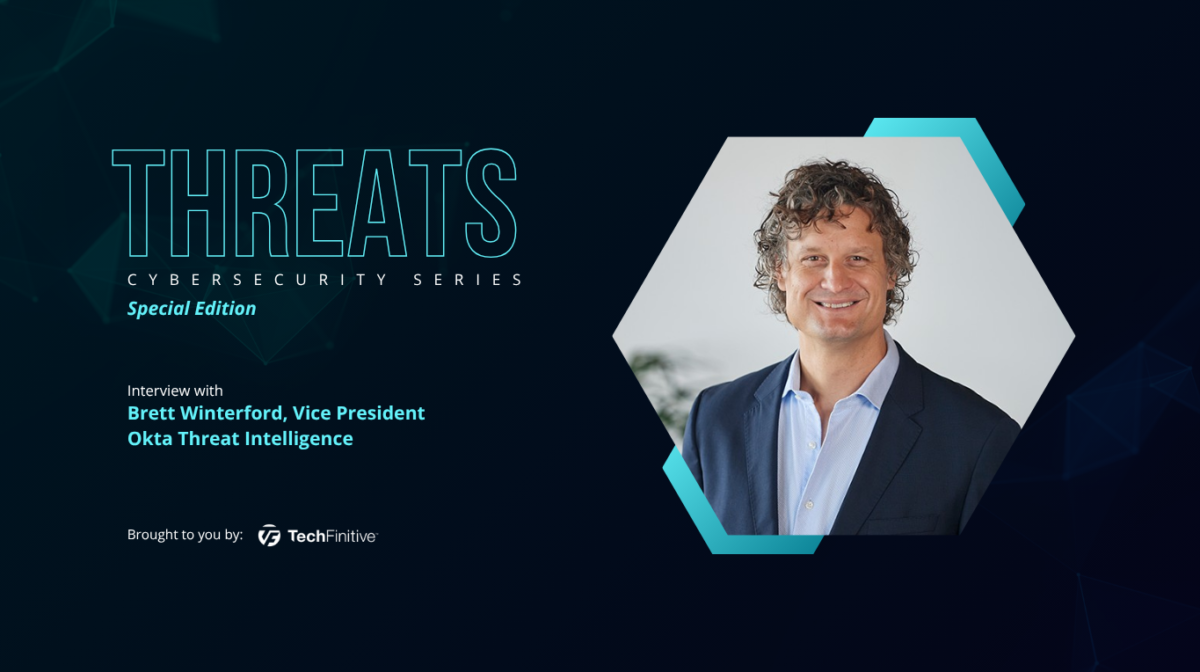
Brett Winterford, Vice President, Okta Threat Intelligence: “The defining challenge today is securing agentic access”

Brett Winterford’s journey into cybersecurity has been far from conventional. Having spent years covering the industry as a journalist, an argument in the bar turned into an unorthodox job offer looking after cybersecurity at a bank – which led him onto the path to where he is today, Vice President of Okta Threat Intelligence.
Perhaps it’s this outside-in perspective that has led Brett to the forefront of the industry, where he now works with researchers and security teams alike to navigate organisations through an increasingly AI-driven landscape.
For Brett, and most of those we’ve interviewed as part of our Threats series, the most significant challenge facing organisations today is the race to adopt AI. As businesses push to become “agentic enterprises” in pursuit of efficiency, they are also creating entirely new risks. The problem, as Brett sees it, is that “agent deployment is moving faster than governance,” leaving exposure as AI agents gain access to sensitive systems, applications and data.
Should these issues go unchecked, it risks broadening and weakening the attack surface at a time when these risks are far too great.
Attackers can now leverage AI to “conduct entire attack chains with minimal guidance,” Brett explains, effectively accelerating any cybersecurity threats. The challenge lies in ensuring that security keeps pace with attackers in this AI arms race.
To achieve this, Brett believes that organisations need to rethink how they manage identity. As AI agents become more embedded within business operations, they should be treated as new “first-class identities” with clearly defined permissions and a human owner responsible for their actions. In applying these principles, organisations can harness the benefits of AI while reducing the risks that come with increasingly autonomous systems.
But that’s the here and now. Let’s start with how it all began.
Could you please introduce yourself to our audience and share how you ended up working in cybersecurity?
I’m the VP of Okta Threat Intelligence. I had an unorthodox journey here – I wrote about cybersecurity as a journalist for many years. An argument in a bar ended in a job offer in a cyber security team at a bank. Next thing you know I was writing public policy submission and board briefings and presenting to customers on cyber-enabled fraud. I joined Okta as regional Chief Security Officer in Asia Pacific and Japan, and in that role, advised business and tech leaders on all things identity.
I now work with a team of world-class researchers to turn Okta’s observations of the threat environment into actionable advice for security teams. Okta Threat Intelligence delivers timely, highly relevant and actionable insights about the threat environment, with a focus on identity-based threats.
What are the biggest cybersecurity challenges those in leadership roles are facing?
The defining challenge today is securing agentic access. Every organisation is in a race to become “agentic enterprises” to unlock new operational efficiencies. They are inadvertently expanding their threat surface.
AI agents introduce significant risks because they require deep access to tools, databases, and SaaS applications to be effective. This often necessitates handling sensitive “secrets,” from API keys to OAuth tokens. Yet our research indicates that these agents are currently untrustworthy stewards of such credentials.
The core problem is not AI itself, but rather agent deployment is moving faster than governance. As agents take on more work, they act as identities inside enterprise systems. That means they need the same kind of control plane and governance policies already in use for people and service accounts.
Leadership is now caught in a balancing act, between democratising AI capabilities while ensuring they don’t hand over the keys to the kingdom.
The answer here is to treat AI agents as a new class of identity, with least privilege access, strong governance and auditability built in.
What are some prevention strategies you believe every business should adopt?
Securing the agentic enterprise requires a comprehensive, multi-layered strategy. At minimum, we need to address how agents are authorised to access resources. Static tokens should be avoided wherever possible in favour of tokens that are short-lived and tightly scoped. Secret storage should be centralised and secure. Organisations also need visibility into where agents are deployed, an ability to enforce access policies, and easy ways to shut agents down if something goes wrong.
AI agents should be treated as “first-class identities”. This means every agent must have a verifiable identity, clearly defined permissions, a human owner, and a governance lifecycle aligned with organisational policies and risk tolerance. Accountability is achieved by linking every agent action to a verified human authority, enforcing least-privilege access through policy-based authorisation, and generating a continuous, auditable record.
What is it about generative AI that makes it so prone to exploitation by threat actors? Conversely, how can it be used for good?
AI agents remove the knowledge gap between the most skilled and least skilled attackers. Agents can ingest vast quantities of documentation to use tools more effectively and solve complex challenges faster than humans can. They can conduct entire attack chains with minimal guidance, which significantly compresses the time between initial compromise and impact.
By consequence, every organisation now has the challenge of needing to focus on prevention and minimising their attack surface in an environment where disruptive innovations are forcing everyone to move faster.
Which cybersecurity best practices are being adopted with the most success by companies?
The most reliable control we have available is to enrol users in phishing-resistant MFA and to require phishing resistance in policy. These stronger authenticators use public key cryptography to bind an authenticating device to a specific user, and to bind the user an authenticator to a specific service at enrolment.
This is a provably secure method – to the degree that most modern social engineering campaigns now focus on MFA downgrade or deactivation. We have even identified campaigns where threat actors instruct users to avoid using Okta FastPass, knowing that they can’t bypass phishing-resistant authentication. We routinely observe attacks that fail against organisations that get this right.
Beyond the authenticator, we’re still observing that a “zero trust” approach to access pays dividends. When all access is federated through a single policy enforcement point (the IdP), and when that access is limited to managed, policy-compliant devices and known, trusted networks, adversaries have their work cut out for them.
It’s also important in my experience to apply zero trust thinking to non-human access (via APIs, for example), and to constrain the use of tokens issued after authentication.
What’s something that has drastically changed about cybersecurity since you first got started in the field?
AI agents in the hands of attackers!
Historically, security teams have to prioritise work based on the likelihood and impact of an adverse event. Assumptions on “likelihood” are now up for debate – an AI-augmented attacker doesn’t get held up by all the tedious tasks that go into turning a stolen credential into an enterprise-wide compromise. We are seeing entire stages of attacks collapsing and attackers achieving their objectives faster than detective controls can kick in. There is an escalating volume of newly discovered vulnerabilities and attempted intrusions.
I suspect the speed and scale of the adversarial environment will have some pretty profound impacts on what cyber security teams have the bandwidth to focus on, even to the degree that we will question the value of many traditional cyber security roles.
About The Author

Rowan Campbell
NEXT UP


