Trending Topics

 Trending
Intel simplifies vPro for 2025: should your business take advantage?

Intel has announced that it has radically simplified the implementation of vPro, making it far easier for companies of all sizes to take advantage. And it couldn’t come at a better time, as it has just released vPro versions of its Core Ultra 200V “Lunar Lake” CPUs. If you’ve read our review, you’ll know that we think these are an excellent choice for thin and light laptops.
The question we ask here is simple: will this be enough to persuade businesses to do so?
To try and answer this, we’re drawing upon two of our interviews at CES 2025. One featuring Jennifer Larson, General Manager of Commercial Client Segments in Intel’s Client Computing Group, another with Rahul Tikoo, Senior Vice President & GM of AMD’s Client Business Unit.
What Intel promises vPro can do
Intel launched vPro in 2006 with an emphasis on remote management of desktop PCs within an office. Since then it has evolved to cover laptops and add extra layers of security.
“We’ve been doing a built-for-business platform to address commercial customer pain points for nearly 20 years,” said Larson. “Each year that we brought vPro to market, we have innovated, and we’ve brought new capabilities, so that where we started 20 years ago has vastly improved to where we’re at today.”
This proved itself, she added, during the CrowdStrike crisis.
“In July last year, we had the outage that occurred, and so vPro was a really wonderful tool for IT to be able to utilise the automated manageability capabilities had they activated AMT [Active Management Technology].”
This is worth emphasising: that if vPro was fully activated, IT teams could fix and diagnose problems remotely, even if the laptop or PC was switched off.

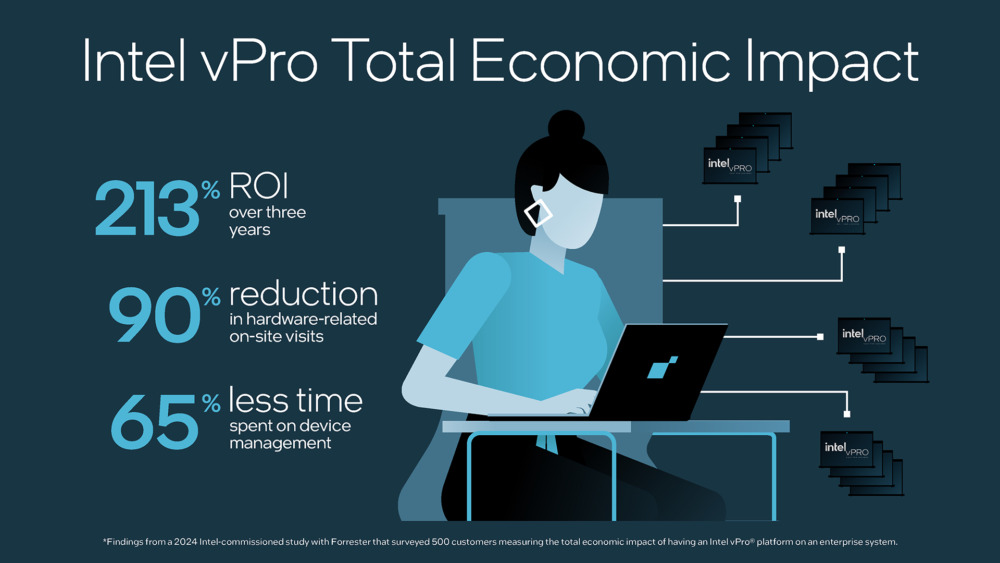
Intel goes further than this, suggesting that the “total economic impact” of vPro means it delivers a return on investment within three years. This figure stems from a Forrester report last year, covering 500 customers, and was commissioned from Intel.
Intel’s vPro update at 2025
This all sounds positive, but question marks remain over exactly how many companies that buy vPro-enabled laptops and PCs actually use them. AMD’s Rahul Tikoo was in charge of Dell’s client computing division until he left to join AMD in mid-2024, so when he says that the figure is “low” there is good reason to believe him.
Exactly how low is trickier to say, and Tikoo initially plumped for a “back of the napkin” figure of 5% before suggesting it could be twice that. But it will be in that range. And it’s worth adding that he said it was also a “low” number for AMD’s equivalent technology, Ryzen Pro.
One reason for Intel’s modest uptake is that it has until now been tricky to implement.
“We made significant improvements that we just announced today to reduce the steps to activate from 24 to six, minutes versus days,” Larson said, “so that everybody can recover and remediate from an outage, in the event of one occurring.”
The CrowdStrike incident clearly emphasised to Intel and its customers that not enough of them were taking advantage of vPro. “We listened to our customers. We heard them,” said Larson. “We just announced the biggest upgrade that vPro has ever experienced.”
So is 2025 the year for Intel vPro?
To end, let’s return to that central question: can 2025 be the year of vPro? Larson emphasised that “we are absolutely doubling down [on Intel vPro]”.
That includes practical measures. “We want to make sure that we make it very easy for our customers to know what activating vPro means, and so you’ll see us come out with a commercial implementation guide this week, where from soup to nuts, you can know exactly what vPro equals from a security perspective, from a stability perspective, connectivity perspective, manageability perspective.”
She added: “What’s important for us is really to resonate with our customers, to let them know what they’re getting. It’s not the same thing that they got 20 years ago. There’s a lot more.”
Of course, Intel isn’t the only solution. From our point of view, what matters is that companies use the protections available so that events such as CrowdStrike don’t cripple them.
That might be AMD’s equivalent to vPro, Ryzen Pro. Tikoo, naturally, is bullish about his company’s technology. “Intel has put a great marketing machinery around vPro and how important vPro is, but the reality is that Ryzen Pro does that and more. And companies can do exactly what they want to do in manageability or security or deployment of their products [with AMD] that can do with the other side.”
We don’t have skin in this game. Intel or AMD, we don’t care. But if you have bought vPro or Ryzen Pro technology and you haven’t activated it, now is an excellent time to investigate your options.
About The Author

Tim Danton
NEXT UP