Trending Topics

 Trending
HPE GreenLake: what’s new for 2025

Discover groundbreaking updates to HPE GreenLake for 2025: Simplified cloud management, enterprise-grade AI, and cost-saving innovations await.

Edge-to-cloud, built to transform your business. Learn more about it here.
HPE GreenLake is evolving. As enterprises continue to grapple with hybrid complexity, rising AI demands, and shifting cloud economics, HPE’s edge-to-cloud platform is stepping up with fresh capabilities for 2025.
With this year’s updates, HPE GreenLake is undergoing its most significant evolution yet, bringing greater flexibility, stronger security, and enterprise-grade AI infrastructure to hybrid and private cloud environments. At the heart of this refresh is a focus on simplifying complex IT operations and accelerating time-to-value for organizations of all sizes.
Whether you’re modernizing legacy systems or scaling AI workloads, here’s what you need to know about what’s new – and what’s next – for HPE GreenLake in 2025.
Private cloud upgrades
HPE’s Private Cloud Business Edition has received a major refresh for 2025, aimed squarely at mid-size enterprises and edge deployments.
The biggest change is integration with Morpheus VM Essentials, which delivers unified management across virtual machines and containers. This simplifies operations, especially for teams juggling legacy workloads and cloud-native apps.
Organizations will also benefit from significant cost savings: by providing unified management across virtual machines and containers, Morpheus VM Essentials reduces operational complexity and lowers labor costs through automation and streamlined orchestration. Organizations also benefit from faster time to value, while improved visibility and resource optimization help avoid overprovisioning, cutting waste and lowering infrastructure expenses.
The platform will soon support HPE SimpliVity systems, too, allowing customers to cut their data center footprint and energy use significantly.
These upgrades make the platform a highly attractive option for businesses looking to streamline hybrid operations without the heavy lift of refactoring or replatforming. It’s HPE’s clearest signal yet that private cloud doesn’t need to mean “complex” or “expensive” – and that enterprises deserve public cloud agility with on-prem control.
Air‑gapped security
In response to rising cyber threats and tightening regulatory demands, HPE has introduced an air-gapped version of its Private Cloud Enterprise solution.
This allows enterprises to physically isolate workloads from external access, ideal for highly regulated industries such as defense, finance, and critical infrastructure. But it’s not just isolation; it’s smart isolation. The platform can dynamically ‘switch off’ connectivity in response to suspicious activity, while continuing to run mission-critical operations uninterrupted. This moves HPE GreenLake into sovereign cloud territory, where data governance and operational continuity go hand in hand.
“With the rise in adoption of data-fueled AI applications, organizations are facing more sophisticated threats to anywhere data is stored, captured or transmitted,” said Phil Mottram, EVP and general manager of HPE Aruba Networking. “HPE’s security solutions deliver advanced protection to help organizations mitigate risk, defend against attacks and build resiliency.”
With cyber resilience now a board-level priority, HPE’s new zero-trust capabilities put it ahead of competitors still relying on conventional perimeter defense models.
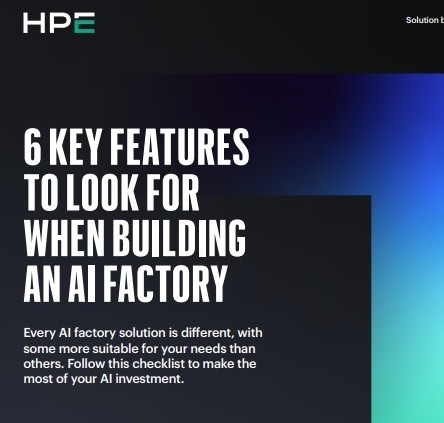
6 key features to look for when building an AI factory
An AI factory transforms your organization’s data into actionable intelligence, but choosing the right approach can be complex since offerings range from basic guidance to fully integrated solutions like those from HPE.
Whether turnkey or custom-built, the best AI factory solutions share six essential features – learn what to look for and how HPE can help accelerate your AI initiatives.
Enterprise-grade AI
AI adoption is being held back by infrastructure sprawl and spiraling costs. HPE’s answer is a tightly integrated, full-stack AI infrastructure available through HPE GreenLake, built in partnership with NVIDIA.
At March 2025’s NVIDIA GTC, HPE unveiled a powerful AI acceleration strategy for 2025, centered on its “NVIDIA AI Computing by HPE” initiative. This brings full-stack, turnkey AI servers powered by the latest Blackwell Ultra GPUs to HPE GreenLake Private Cloud AI, enabling seamless training, tuning and inference for generative, agentic and physical AI models.
The refreshed solution integrates the NVIDIA AI Data Platform into HPE GreenLake, introducing a unified data layer. This intelligent layer links structured, unstructured and streaming data – across edge, on‑prem and cloud – ensuring high-throughput pipelines that feed AI-ready datasets with reduced friction
HPE’s enhancements also include Alletra MP storage optimized for inline metadata tagging, ransomware detection, and accelerated RDMA transfers to GPU memory.
Developers benefit from a new AI development node – complete with integrated storage, software stack and ready‑built NVIDIA blueprints – so teams can launch pilot models, deploy use-case-specific agents such as Deloitte’s Zora, and run digital twins without heavy lift. Plus, GPU workload observers in HPE OpsRamp offer real-time visibility into performance and cost efficiencies.
Nonstop-compute as a service
HPE is bringing its fault-tolerant computing to the cloud era with the launch of NonStop Compute NS5 X5 and NS9 X5 via HPE GreenLake.
These systems, built for mission-critical workloads in banking, telco, and manufacturing, now deliver double the memory, enhanced security, and up to 15% more performance.
“One of our auto manufacturing customers has been using HPE’s fault-tolerant systems for more than 35 years without any unplanned downtime,” said Casey Taylor, general manager of HPE Nonstop. “With the launch of HPE Nonstop Compute NS5 X5 and NS9 X5, we are reinforcing our commitment to deliver an architecture designed for fault-tolerance and high performance so that our customers can scale their businesses and innovate with confidence.”
What’s most transformative, however, is the as-a-service model: customers get continuous availability and scale without the traditional CapEx burden. With integrated Intel Xeon scalability and next-gen fabric, these platforms minimize downtime to nearly zero, offering true enterprise-grade reliability on demand. For industries where failure is not an option, HPE GreenLake’s NonStop Compute is more than an upgrade; it’s a strategic shift towards operational assurance in the hybrid age.
Easier pricing and partner adoption
HPE GreenLake has long promised cloud economics for hybrid IT, but 2025 brings meaningful improvements to its pricing and procurement model.
First, there’s a new tiered, pay-per-use pricing structure for storage – meaning lower unit costs as consumption increases, while quote generation has also been accelerated, with most partners now receiving pricing within a day.
HPE has also added “disconnected” deployment options for HPE Alletra MP storage, ideal for sovereign or isolated environments. These changes reduce friction in the buying process and broaden HPE GreenLake’s appeal to governments, financial services, and multinational enterprises with complex compliance needs.
By making the platform easier to buy, manage, and scale, HPE is removing the traditional roadblocks to hybrid cloud adoption – and doubling down on customer choice.
About The Author

Carly Page
NEXT UP