Trending Topics

 Trending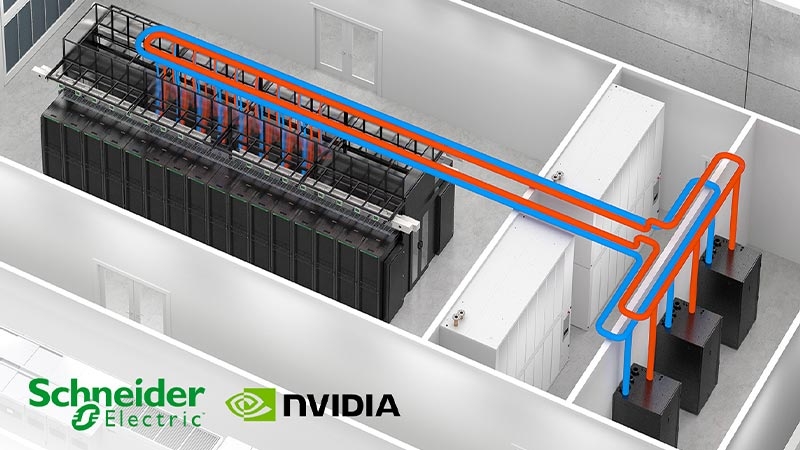
The real message behind Schneider Electric and Nvidia’s new blueprint for the AI data centre

Schneider Electric’s latest AI infrastructure push is really about one thing: forcing IT leaders to stop thinking of the AI data centre as a bigger version of a normal server room.
Two things point to this conclusion. First, the company’s Nvidia-aligned reference design for liquid-cooled clusters, optimised for the GB200 NVL72 and Blackwell platform. These support up to 132 kW per rack.
Second its Galaxy VXL UPS, which delivers up to 1.25MW in one frame, with 52% less footprint than the industry average.
AI infrastructure is no longer an IT fit-out problem. It is a power, cooling and systems-engineering problem.
The hardware explains why
Nvidia’s GB200 NVL72 is a rack-scale, liquid-cooled system that connects 36 Grace CPUs and 72 Blackwell GPUs in a single NVLink domain. Nvidia claims that it delivers 30x faster real-time trillion-parameter inference and 25x better energy efficiency than H100-based infrastructure in the cited scenarios.
That kind of compute density is exactly why Schneider’s reference design matters. It gives operators a validated power-and-cooling blueprint for clusters that are already stretching beyond what traditional air-cooled data hall assumptions can handle.

Galaxy VXL fills the other half of the gap. Schneider is pitching it as the power protection layer for these denser AI environments, with up to 1,042 kW/m² power density, 99% efficiency in eConversion mode, and scaling to 5 MW with four units in parallel. In practical terms, that means more usable white space, less compromise on redundancy, and fewer excuses for treating UPS design as an afterthought once the GPUs arrive.
The broader industry significance is bigger than either product.
At GTC 2026, Schneider executives described AI facilities as entering a “systems era” in which power, cooling, compute and grid interaction must be modelled before construction starts. That view looks increasingly credible. The IEA says data-centre electricity use rose 17% in 2025, AI-focused facilities grew even faster, and total data-centre consumption could rise from 485 terawatt-hours (TWh) in 2025 to 950TWh by 2030.
By 2027, a single advanced AI rack could have peak demand comparable to 65 households.
That is the real takeaway for enterprise buyers. The next wave of AI infrastructure will be won less by who can procure accelerators fastest than by who can build the physical environment around them without wasting space, power or time.
Schneider’s message is that the AI data centre now begins with hardware architecture, not just silicon.
You might also be interested
About The Author

Kihara Kimachia
NEXT UP


