Trending Topics

 Trending
Breaking up the broligarchy: the three steps we need to take

Break up monopolies, build alternative systems and enforce existing regulations – those are the three steps to yanking back control of technology from the “broligarchy”.
That’s according to speakers at this year’s Mozilla Festival, held in Barcelona, Spain, pointing to the collection of largely American CEOs leading the companies that make up Big Tech that together have an inordinate amount of power – including over governments. You know, Elon Musk et al.
Of tech infrastructure and systems, Cori Crider, Senior Fellow of FutureTech said: “They really think this is theirs… and we have no right or say in it. But that isn’t true.”
It may not feel particularly possible to do anything about it at this particular point in time, Crider noted, but society-dominating monopolies have been picked apart before. Think about the era of “robber barons”, she said.
So if you want to build a tech industry, infrastructure and whatever else that’s free from the broligarchy, here’s how to get started.
Break up monopolies

Big Tech is made up of monopolies. Though their PR departments methodically deny they have such market power, courts are starting to officially disagree. Google was recently deemed to have a monopoly in search and ad tech, for example, with the threat of a breakup looming.
Breaking up some of those giants into smaller companies is an “essential first step to clear space for… alternatives,” said Crider, adding that if the path to market is controlled by “robber barons” then it’s much harder for better-behaved, smaller alternatives to reach an audience.
One criticism of the call to break up Big Tech is that it’s detrimental for innovation. But Crider counters that by noting that previous antitrust activity in the US has actually sparked innovation, pointing to Bell Labs being forced to licence patents in the mid 1950s – including some for transistors that potentially sped up the development of computers. Beyond that, monopolies are disliked by regulators for how they stamp out competition and innovation in a market.
Beyond monopolies, Crider called for interoperability. By locking users into platforms, Big Tech companies make it too hard for people to shift to alternative services. “We need that kind of remedy that says you can’t lock people in – people call it walled gardens, but it’s more like a cock-fighting cage,” she said.
Build your own infrastructure
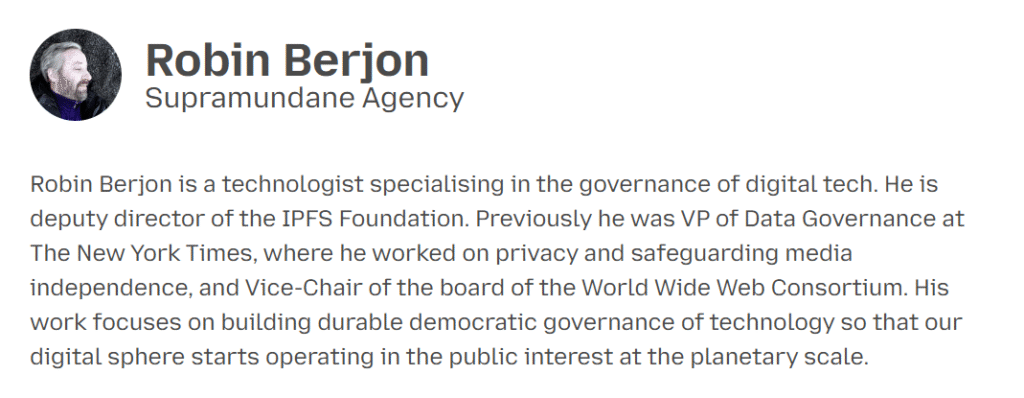
Much of the power of tech is embedded in infrastructure. That includes data centres, networks and other physical bits, but also ad networks and even browsers, says Robin Berjon, Head of Supramundane Agency and Deputy Director of the IPFS Foundation.
That’s because whoever controls digital infrastructure gets to set rules for how people use it – and what other businesses can grow on it. This is what’s behind recent pushes for digital sovereignty, he notes, but if a company gets to set the rules on infrastructure, then it doesn’t matter where the data centre sits.
So Berjon calls for activists, campaigners, governments and whoever else to democratise any bits and pieces of infrastructure, tackling aspects of these systems to see what works. “This is a marathon, it’s going to take a while,” he said.
Taking back control also means getting a cut of the market – and that’s no small thing. If anyone else managed to build an ad network that could compete with Google, they’d be able to nab a cut of that $600bn annual market, which is set to grow to $1 trillion by 2030.
And then those funds could be used to rebuild infrastructure that better serves the rest of us – that’s one reason Berjon has previously called for ads on Wikipedia.
He added: “A trillion dollars kicks a lot of ass.”
Break up the broligarchy through enforcement
Given the state of the tech world, it may come as a surprise that we have plenty of good laws that could actually improve the situation, Crider noted.
She said that even players in the tech industry have welcomed the European Union’s Digital Markets Act (DMA) – including Y Combinator, which she said suggested real support given that the people who make up that tech funding firm are hardly “noted communists”.
The problem is that the European Commission (EC) believes the DMA to be a self-executing law that will reign in tech monopolies without much enforcement effort. But she says: “You have to do the work.”
Even if the EC wanted to crack down on big tech monopolies, Crider noted that Brussels has 80 members of staff to tackle DMA enforcement – but the city has twice as many people working as parking wardens doling out fines for errant cars. “If we are serious about enforcing this law, we’ll need more staff and some of them should ideally know something about computers,” she added.
Skilled enforcement is necessary because companies push back with claims that need to be factchecked, leaving regulators unsure whether they’re about to make a major misstep that could hurt businesses.
That regulatory dialogue should be seen as regulatory capture, Crider suggested. “We are in an adversarial posture with these companies,” she said.
So to end the rule of the broligarchy, break up tech monopolies, build alternative infrastructure and enforce existing laws – it’s a lot of work, but it’ll be good for democracy.
More articles by Nicole Kobie
About The Author

Nicole Kobie
NEXT UP