Trending Topics

 Trending
5 storage lessons SMBs can learn from enterprises

From ransomware resilience to smarter scaling, enterprise IT has plenty to teach SMBs about getting more from their storage
Enterprise organisations treat storage as far more than somewhere to keep data. For them, it’s a cornerstone of cyber resilience, business continuity and IT strategy. Small and medium-sized businesses (SMBs), meanwhile, have often focused on a more immediate question: how much capacity can we afford?
Thankfully, enterprise IT has become less exclusive. Many of the approaches developed by large organisations are now realistic options for businesses with far fewer people and much tighter budgets. Here are five lessons every SMB can take on board.
1. Think beyond capacity
Storage conversations often start with terabytes, but enterprise IT teams rarely stop there. They view storage as a critical part of their recovery strategy should disaster strike.
Whether the threat comes from ransomware, accidental deletion or hardware failure, the ability to recover quickly is just as important as keeping data in the first place. Features such as snapshots, replication and backup integration all help reduce downtime and minimise disruption when something inevitably goes wrong.
That approach is reflected in how organisations are using Dell PowerVault. One customer, quoted in a PeerPaper Report 2026, describes using snapshots extensively alongside Veeam backups, saying: “We use snaps quite a bit… we use it as a backup target for some of our Veeam systems.”
For SMBs, building resilience doesn’t necessarily mean investing in more infrastructure. It means ensuring storage forms part of a wider business continuity plan rather than existing in isolation.
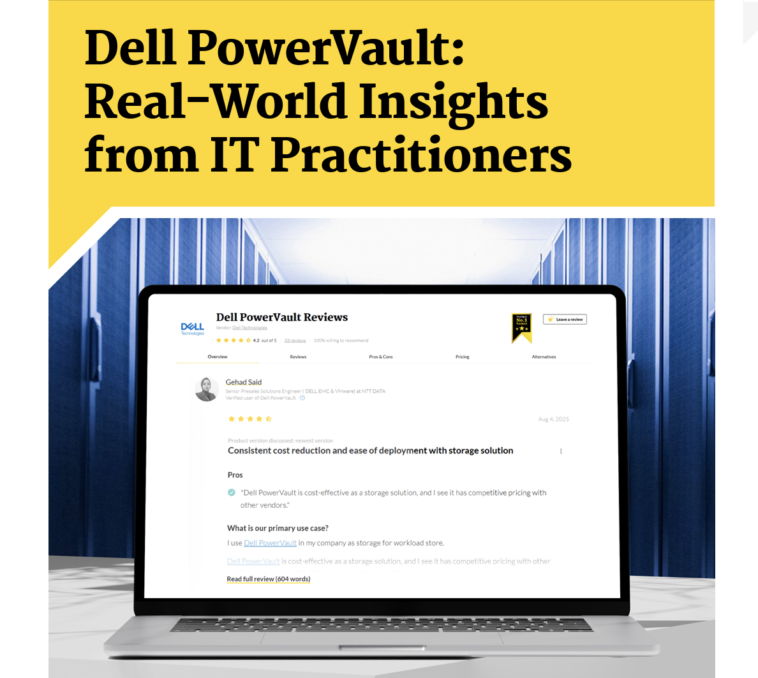
Dell PowerVault: Real-World Insights from IT Practitioners
As data continues to grow across the enterprise, IT teams are being challenged to manage storage more efficiently while supporting business growth, controlling costs, and reducing operational complexity.
This report shares real-world perspectives from IT practitioners on modern storage strategies, highlighting lessons learned, common challenges, and practical approaches to improving efficiency and scalability.
2. Simplicity is a competitive advantage
Large IT departments know that every additional tool or management process brings more overhead. The more systems there are to look after, the more time engineers spend maintaining them instead of working on projects that move the business forward.
The same principle arguably matters even more for SMBs. Here, storage administration often falls to generalist IT staff juggling networking, security, cloud services and user support alongside everything else.
In the same PeerPaper, Richard Lynch, an architect at an energy and utilities company, credits the administration he finds in professional storage solutions as being key: “Replacing a bad drive is fairly simple. It is just fairly easy to administer it.” The question for an SMB IT professional needs to ask themself is whether they can say the same thing.
Ease of use may not be the most exciting feature on a specification sheet, but over the lifetime of a storage system it can significantly reduce operational overhead and free IT teams to focus on work that delivers greater business value.
3. Speed matters long after procurement
A storage project only starts delivering value once it’s in production. The less time spent installing, configuring and migrating data, the less disruption there is for the business.
Large organisations understand this well because lengthy deployments quickly become expensive. Delays increase project costs, extend disruption and postpone return on investment.
SMBs have just as much to gain from getting new storage into production quickly. Shorter implementation windows reduce business disruption and place less pressure on already stretched IT teams.
Fast deployment also makes future upgrades less daunting. When infrastructure can be introduced with minimal disruption, organisations are less likely to postpone necessary improvements simply because the migration feels too risky.
4. Let automation do the repetitive work
One of the biggest differences between enterprise and SMB IT isn’t necessarily technology – it’s time.
Enterprise teams increasingly automate routine administrative tasks wherever possible, allowing specialists to focus on architecture, security and innovation instead of repetitive maintenance.
SMBs can benefit from exactly the same approach. Routine monitoring, health checks, alerting and capacity planning all become easier when administrative workloads are reduced.
The goal isn’t to eliminate human involvement. Rather, it’s to ensure skilled IT professionals spend less time babysitting infrastructure and more time supporting the business.
For lean IT teams, every hour saved on routine maintenance is another hour available for higher-value work.
5. Buy for tomorrow, not just today
Few organisations can accurately predict how quickly their data will grow. New applications, compliance requirements, hybrid working and AI initiatives all have a habit of consuming storage faster than expected.
Enterprise buyers therefore tend to avoid thinking purely about today’s capacity requirements. Instead, they look for systems that can expand gradually without requiring wholesale replacement.
That lesson applies equally to SMBs. Storage should be able to grow alongside the business without forcing costly forklift upgrades every few years.
Erhan Parlaz, a senior sales consultant at Teccle Group, says that’s exactly what he’s seen in practice: “I definitely feel that Dell PowerVault products grow along with my needs,” adding that Dell has continued to develop the platform in response to customer feedback and changing market demands.
Enterprise thinking without the enterprise budget
The biggest lesson SMBs can take from enterprise IT isn’t to buy the biggest storage array they can afford. It’s to think differently about the role storage plays within the organisation.
Storage is no longer simply where data lives. It’s a foundation for resilience, operational efficiency and future growth. By prioritising recoverability, simplicity, rapid deployment, automation and scalability, smaller organisations can adopt many of the same best practices that larger enterprises have spent years refining.
The encouraging part is that those capabilities are no longer reserved for organisations with vast IT departments and equally vast budgets. As the experiences gathered in the PeerPaper report suggest, enterprise-style storage practices are becoming increasingly accessible to businesses of every size.
| Enterprise lesson | Why it matters | How Dell PowerVault users put it into practice |
| Think beyond capacity | Storage should be part of a broader recovery strategy, helping organisations recover quickly from ransomware, hardware failures and accidental deletion. | Users describe taking frequent snapshots and using PowerVault as a backup target for Veeam to strengthen recovery and data protection. |
| Keep it simple | Straightforward administration reduces the burden on lean IT teams and frees up time for more strategic work. | Reviewers consistently praise PowerVault’s ease of use, highlighting simple firmware updates, straightforward drive replacements and day-to-day management. |
| Deploy quickly | Faster deployments reduce disruption, accelerate projects and deliver value sooner. | Customers report getting systems into production in as little as a few hours, with intuitive setup and configuration. |
| Embrace automation | Automating routine storage management helps small IT teams spend less time on maintenance and more time supporting the business. | Users frequently cite the platform’s straightforward management and low ongoing administration, making routine operations easier to handle. |
| Plan for growth | Storage requirements rarely stay the same, so infrastructure should expand without requiring wholesale replacement. | Reviewers highlight the ability to add capacity over time, describing the platform as growing alongside changing business needs. |
About The Author

Carly Page
NEXT UP