Trending Topics

 Trending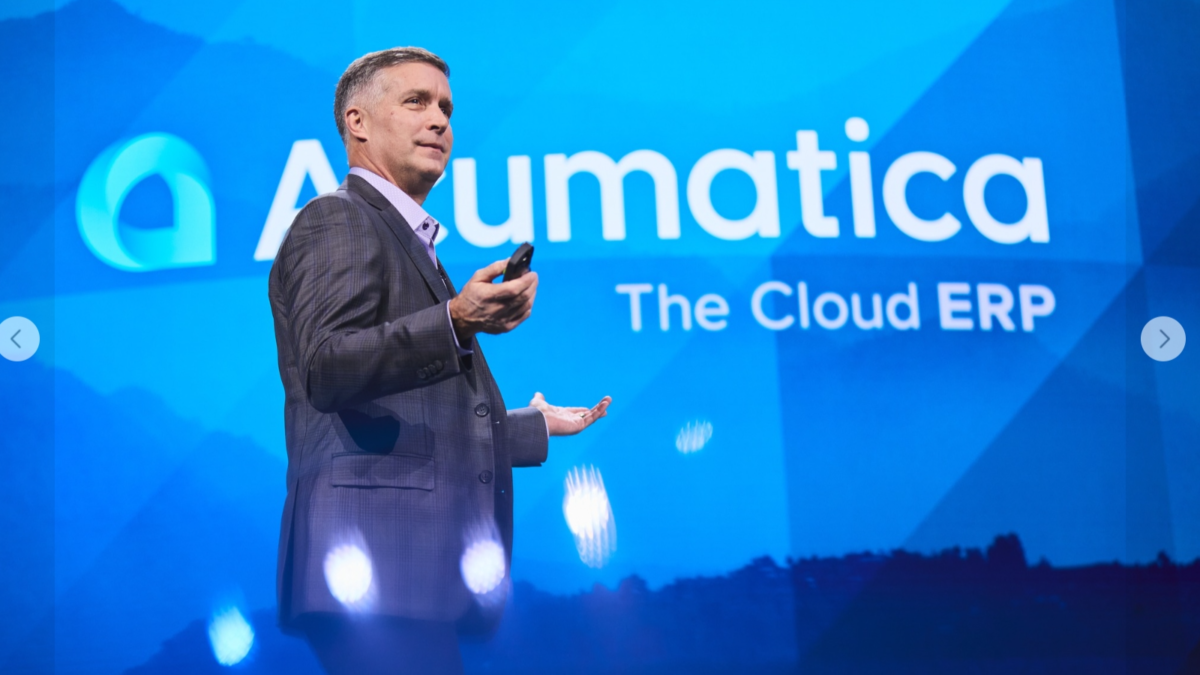
10 things we learned at Acumatica Summit 2026

For the first time, Acumatica’s flagship event was held in Seattle this year. Taking place from January 25 to 28, it felt like a statement as much as a venue change. With over 3,000 attendees packed into the convention centre, Acumatica used Summit 2026 to hammer home a clear theme: moving ERP from potential to impact, because “the future is here now.”
In this article, we cover ten key takeaways from the event. You can also see some of the highlights in the video below!
1. The future of ERP is “impact now” not “potential later”
If Acumatica Summit 2026 had one recurring refrain, it was this: stop waiting.
In the opening keynote, CEO John Case framed the moment bluntly, “you don’t have to wait… the future is here, now, ready for you”.
That “impact now” posture wasn’t abstract. Acumatica’s messaging around AI repeatedly came back to real-world results powered by “new AI capabilities with human ingenuity,” rather than theory, hype or labs-only experimentation.
2. AI-first, human-centred ERP is becoming the default
Acumatica’s AI philosophy is less about replacing humans and more about removing friction. The company repeatedly positioned AI as something that should be usable, practical, responsible and in service of the people doing the work.
Day 2 sharpened the technical direction with Miten Mehta, the Chief Engineering Officer, describing a roadmap that moves ERP from system of record to system of intelligence, shifting from reactive to proactive, and from scripted automation to objective-based autonomy, backed by “real-time data governance at the point of data entry”.
3. New AI tools are turning ERP into a digital co-worker
Two announcements did most of the heavy lifting here: AI Studio and AI Assistant, positioned as tools for customers and partners to configure and apply AI “in meaningful ways,” with transparency and business context.
And Acumatica didn’t shy away from the metaphor of “digital coworker”. In the follow-up blog, Jim Desler, the company’s VP of Communications, described the AI Assistant as such. The concrete example given is that of an AI Cross-Sell Assistant by Acumatica that scans sales history for buying patterns and ranks recommendations. This reads like the kind of small, daily win that actually gets adopted.
4. Modern user experiences are as important as features
A theme that kept popping up: you can’t “AI” your way out of a clunky ERP experience.
This is the reason the company has placed a great emphasis on a modernised UI, such as cleaner layouts, faster navigation, no-code personalisation and more consistent workflows.
In the Day 2 keynote wrap, Jon Pollock, Acumatica’s new Chief Product Officer, summed up the product posture as the convergence of modern UX, industry depth and AI-first, aimed at helping businesses move faster and reduce complexity.
5. Industry editions are getting deeper and more connected
The most telling phrase here was the idea of converging business models.
These are companies that don’t fit cleanly into a single industry box. Summit messaging leaned into that reality, with updates spanning Manufacturing, Distribution, Retail, Construction and Professional Services.
Some of the examples of what it looks like in practice included:
- Amazon Sales Profitability Dashboard
- Order Orchestration Assistant for smarter warehouse selection
- Shop Floor Kiosk for real-time capture on the production floor
- Construction/PSA enhancements such as project and branch automation and AI-assisted change orders
6. Customers are already seeing tangible outcomes
You can’t argue with results and the stats were hard to ignore. To put it another way, the Summit narrative didn’t lean on “someday” outcomes. It leaned on numbers.
Acumatica highlighted examples of customers achieving:
- 10x growth over seven years
- 100% to 300% operational scaling in one year
- 75% shorter lead times
- 50% better on-time delivery
- Carrying cost reductions (15% to 25%)
7. Storm Smart and PSI show what “impact” looks like on the ground
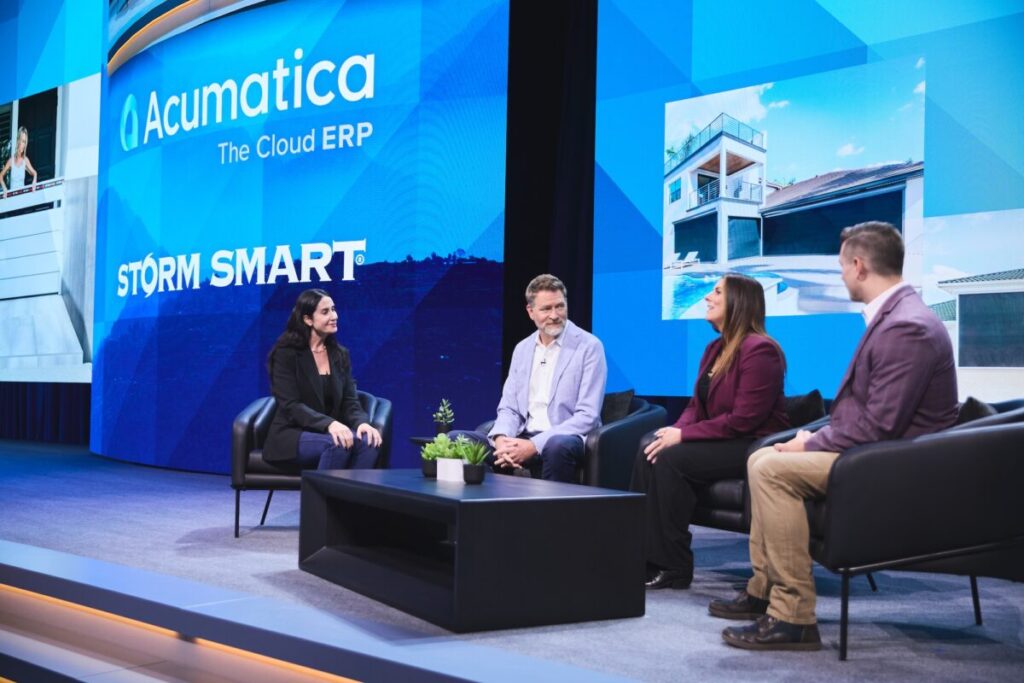
The customer stories did what good Summit customer stories should do: translate platform talk into operational reality.
For Storm Smart (Customer of the Year), CFO Brian Cassell gave a quote that could be pinned to every ERP evaluation checklist: “we now have one version of the truth,” and without that, “no way” they could scale from two branches to seven or launch new products.
For PSI Family Services (Impact Customer of the Year), Chief Advancement Officer Shawn Rubbin described the value in mission-critical terms: reconciling clinical effort with financial reality, seeing cost by program in near real time, and making informed decisions “without compromising care”. And the line that resonated well with the audience: “Technology should never, ever overshadow mission. It should strengthen it.”
8. Community and ecosystem are scaling with the product
Summit 2026 didn’t just showcase software, it showcased an ecosystem that’s starting to look like a growth engine.
The Community Portal now has over 35,000 members, and the Marketplace added over 50 new strategic integrations in 2025, bringing it to more than 500 partners.
9. Acumatica is investing in inclusion and women in STEM
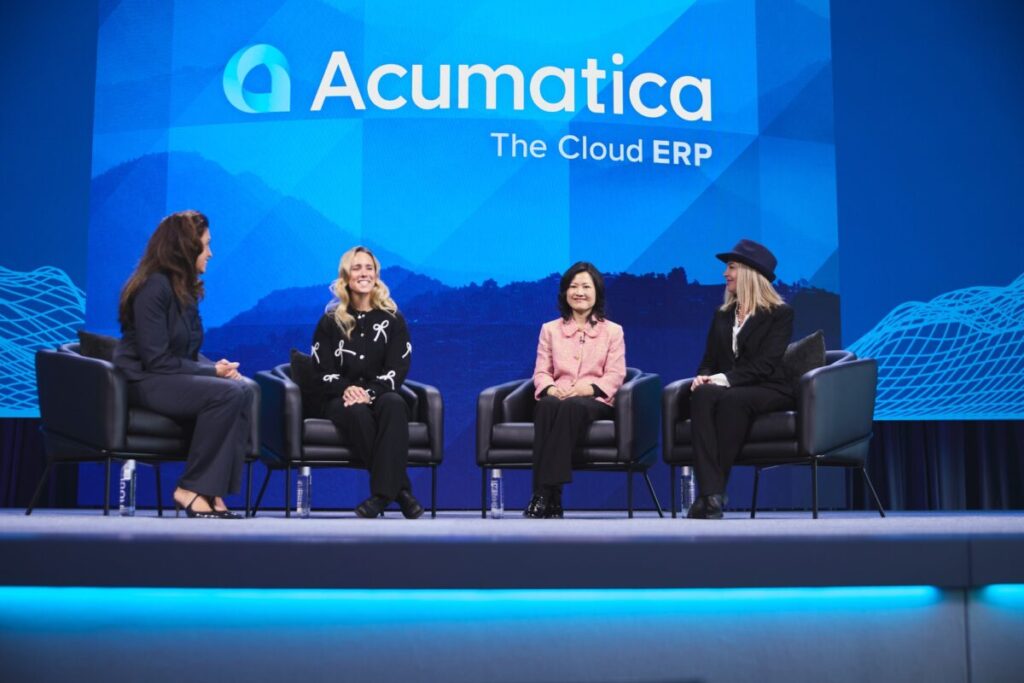
Inclusion wasn’t treated as a sidebar. The Summit programming around women in tech was prominent enough to feel like part of the event’s identity.
The Women in Tech luncheon drew over 600 attendees, with Acumatica leaders highlighting visibility, storytelling, and community-building for women in technology.
In context, it reinforced a broader message: if Acumatica wants a thriving ecosystem of customers, partners and developers, it knows it must invest in the human pipeline that makes that ecosystem sustainable.
10. The roadmap pushes ERP toward an intelligent, composable platform
Finally, the roadmap messaging had two notable layers.
First, the platform direction, proactive ERP, objective-based autonomy, and “engineering for the future,” as Chief Product Officer Ali Jani, put it.
Secondly, a pragmatic architectural point that matters to enterprise buyers: Acumatica isn’t positioning “Acumatica AI” as a single proprietary foundation model. It’s an AI layer inside the ERP. AI Studio is the low-code/no-code tool that designs AI workflows, and an AI Service Gateway routes prompts to the customer’s chosen AI provider and brings results back into the ERP process.
In 2025 R2, Acumatica describes this as bring-your-own-LLM, with customers configuring providers such as OpenAI, Anthropic, AWS or Azure. Acumatica says AI Studio communicates via the Acumatica Secure Cloud as a proxy and that it does not store the customer–provider prompt/response data.
That’s a subtle but important “composable ERP” signal: AI capability as a layer embedded in workflows, but not locked to a single model provider.
Acumatica Summit 2026 made a clean argument: AI-first can still be human-centred, measurable outcomes matter more than demos, industry editions are deepening for hybrid businesses, and the Community/Marketplace engine is scaling alongside the product. If 2025 was about proving “AI belongs in ERP,” Summit 2026 felt like the pivot to proving it can deliver impact now, and do it in a way businesses can actually govern.
You might also be interested in
About The Author

Kihara Kimachia
NEXT UP


