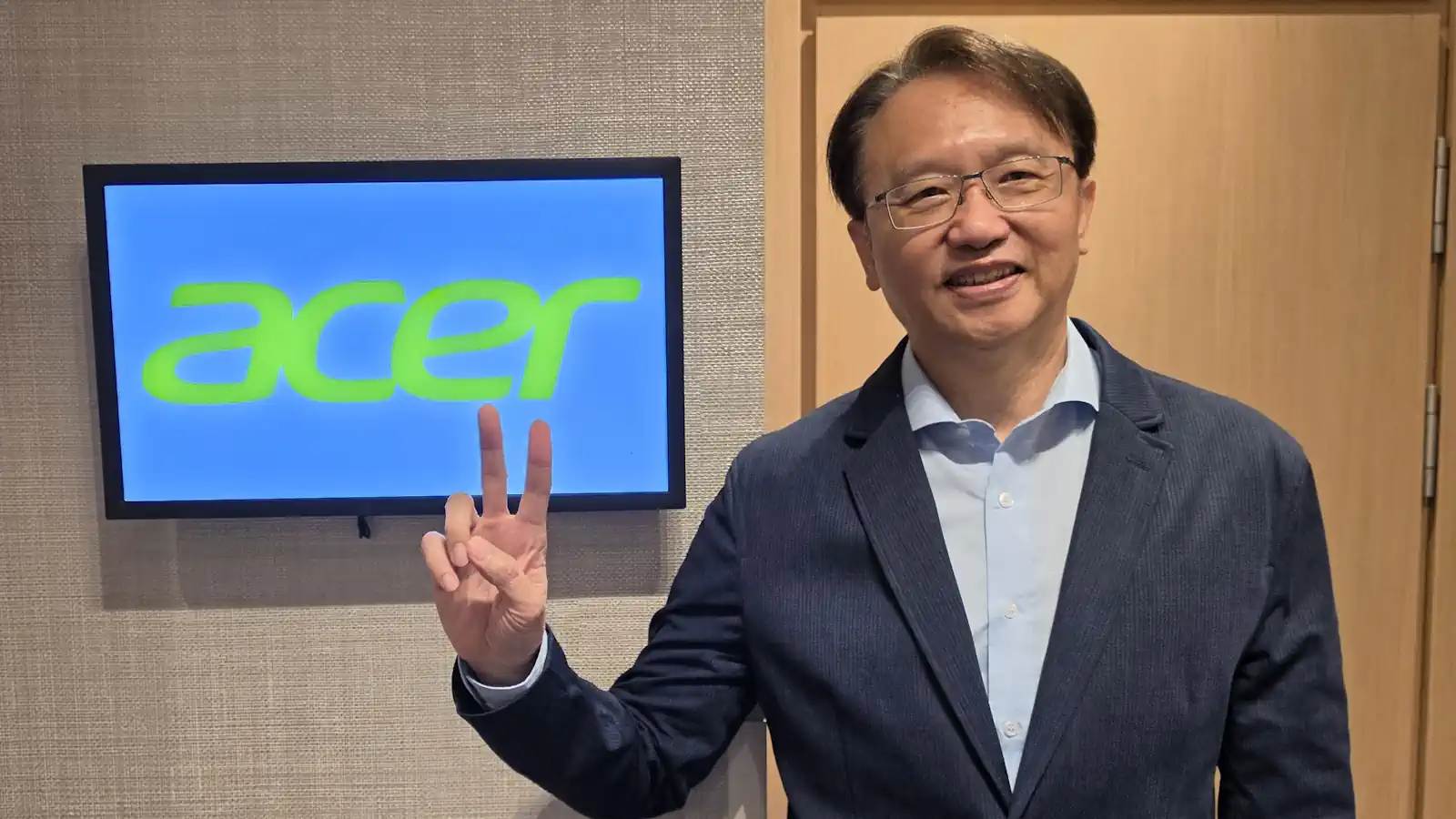
We caught up with Jason Chen in a suitably humble meeting room just before IFA 2026 began (image: TechFinitive)
Interview with Jason Chen, Acer CEO: “I wouldn’t call myself an environmentalist, other than I’m a person that is conscious of our responsibility to the environment”
Jason Chen doesn’t fit the typical profile of a tech CEO. Where others boast, he is humble. Where others talk down to you, he is down to earth. But perhaps most unusually of all, on meeting he strikes you as being a genuinely nice person.
This is something echoed by all the Acer employees I’ve spoken to over the past dozen years since Chen became CEO. At a time when being an approachable guy wasn’t the key required quality. “The first phase, when I came in in 2014, was to turn around, to stabilise the organisation, make the company profitable.” Always a good start.
“The second phase was to think of what else can we do, some initial ideas to make our core business sustainable, and then start to look at what else can we do.” As you will see in this interview, that “what else can we do” turned out to be quite a lot. While you may associate Acer with affordable laptops, it now sells everything from e-bikes to healthcare solutions.
But I wanted to start our interview, which took place just before IFA 2026 in Berlin, with a topic I knew to be close to Chen’s heart: the environment.
Acer’s environmental push
“I wouldn’t call myself an environmentalist, other than I’m a person that is conscious of our responsibility to the environment, that we want to make it better,” he said, when I asked where his passion for environmentalism came from. But that hasn’t stopped him from talking about sustainability in every keynote speech I’ve watched, including the one at IFA 2026.
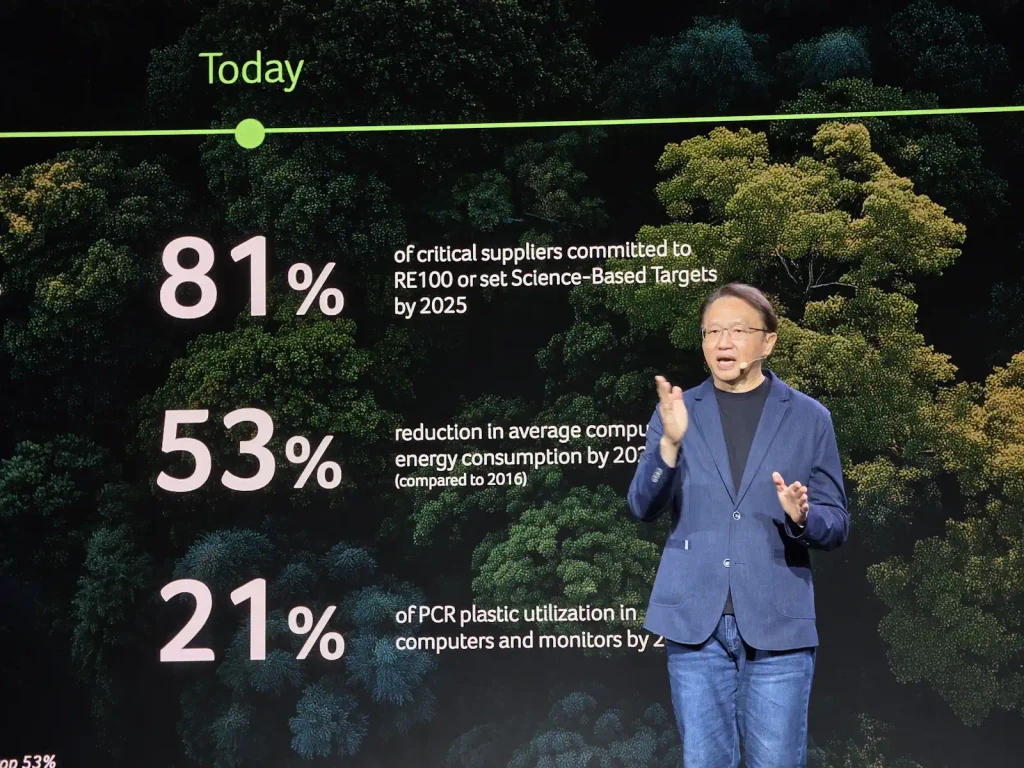
Jason Chen on-stage at IFA 2026 talking about Acer’s sustainability goals (image: TechFinitive)
“In particular, we set a target for ourselves by 2035,” Chen told me. “We want to reach RE100 by 2035, and by 2050, we want to become net zero. And so far the progress has been very good: we actually overachieved our target.”
RE100 means Acer will source 100% renewable energy, with net zero – an ambition long abandoned by other big tech companies – meaning net zero emissions, so that Acer’s impact on the environment is neutral.
To achieve net zero means using as many recycled materials as possible, which Chen helped to make happen by backing the Acer Vero project. This kicked off in 2021 with the Acer Aspire Vero, a 16in laptop that used post-consumer recycled (PCR) plastic throughout the chassis and keyboard.
Now, says Chen, Acer is stepping things up with the all-new Acer Vero 16, announced at IFA. This is “more like a modularised PC that is meant for serviceability, upgradability to prolong the longevity of PC usage,” said Chen.
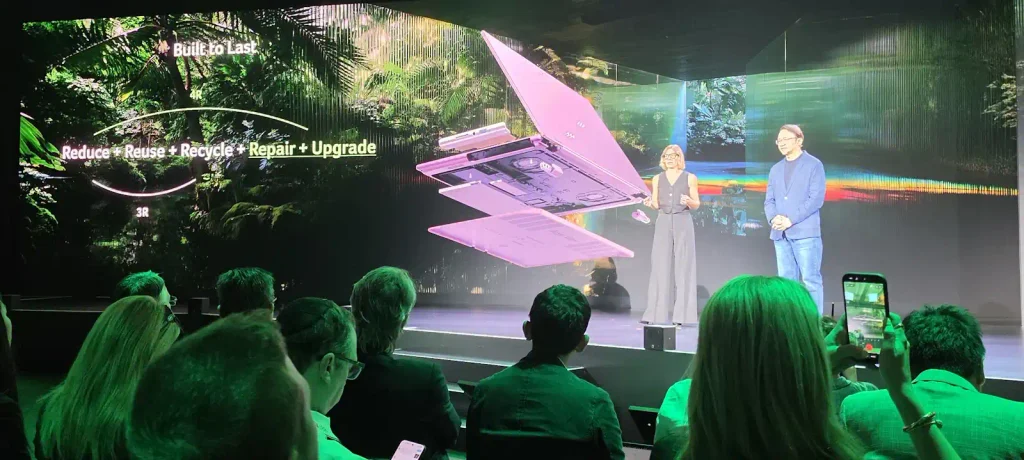
Acer EMEA Vice President Valerie Piau on-stage with Jason Chen at IFA 2026 to launch the Acer Vero 16. It was Piau who first came up with the idea of a chassis entirely made from recycled materials (image: TechFinitive)
Crucially, the Vero 16 is made from 50% post-industrial recycled aluminum and 50% low-carbon aluminum. Equally crucially, it’s designed to be repaired tool-free, with a latch to remove the base and even the hinge being easy to replace.
Why businesses should buy Acer hardware
Chen is realistic enough to know that ease of repair and sustainability are never going to top the list of reasons why businesses buy a laptop. I heard a similar view from Lenovo UK & Ireland’s MD Andy Rhodes when I interviewed him last month. So how is Acer going to persuade businesses to buy Acer rather than, say, Dell, HP or Lenovo?
“Being humble,” he explained. The point being that Acer, through its channel partners, will listen to what your business needs and tailor the offering to match. “And then the serviceability that will be able to provide. As you might know, we have Enfinitec, which is already an independent legal entity that is doing nothing but provide a repair service.”
This is independent, Chen explains, because “when you are talking about a true total solution, it has to go beyond your own device, not just one PC, not just one printer, but it could be a multiple devices networking or added up together. Our serviceability, I think, is a strong point that we will be able to provide to that particular customer.”
New laptops at IFA 2026: Acer Swift Air 16
Plus Acer continues its focus on affordability. It launched several consumer-focused laptops at IFA, including the Acer Vero 16 and the Acer Swift Air 16. The latter is noteworthy as it follows o the heels of the Acer Swift Air 14, Acer’s unofficial answer to the Apple MacBook Neo.
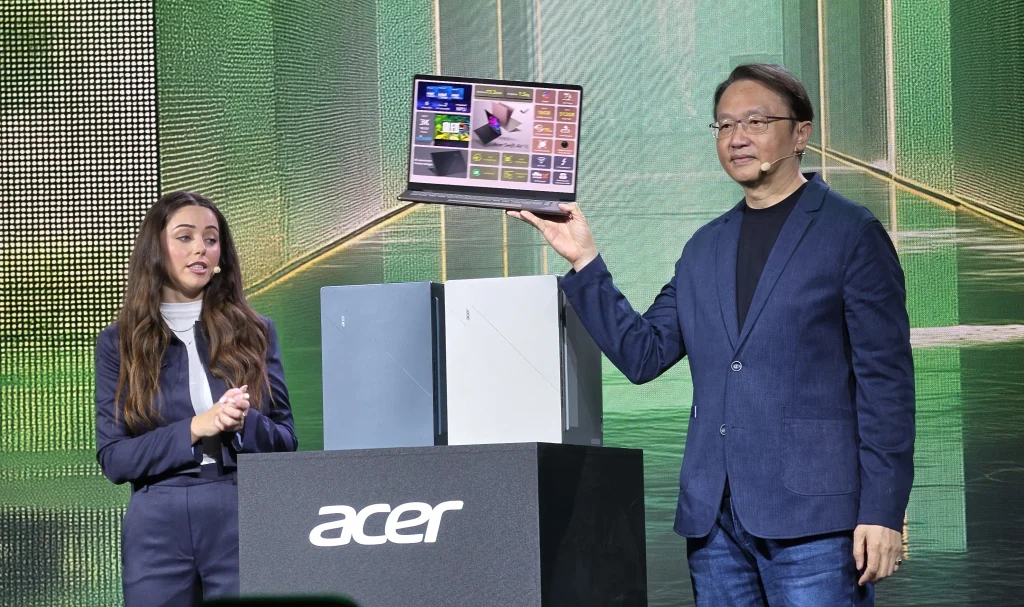
Acer EMEA Marketing Manager Diana Maria Gilca announces the Acer Swift Air 16 at IFA 2026 with Jason Chen (image: TechFinitive)
I’ve spent a week with the Acer Swift Air 14 and it’s a great laptop for the price. To my mind, it would make a great laptop for smaller businesses that don’t need the remote manageability offered by, say, Intel’s vPro technology.
Chen agreed, with caveats. “It all depends on what particular sector [people are in] and what particular applications people are using,” he said. “The Swift Air is designed for consumers as well as prosumers.” For them it could was “a good choice and also a beautiful machine”.
So did he welcome Apple’s entry into the world of affordable laptops? “Well, whether we like it, we we don’t like it, it’s their choice… However, I would say competition keeps people honest, keeps us competitive.”
And did the Neo accelerate the launch of the Swift Air 14, I asked? “It stimulated us,” he said. “It stimulates us to make sure that we watch any competition seriously.”
He added: “We are not in a position that we can ignore Apple or HP or others. We take them all seriously, and then we decide our product roadmap, our lineup that is good enough to compete and to win. That’s what we do.”
In particular, said Chen, he needed to be confident that the Acer product will “win the design, the performance, the price, and what can we differentiate? What about the touch and the feel? Is that good enough quality that people will decide to choose us against our competition?” When he and and the product team are confident, he says, “we roll out the product and we win in the market”.
A new era for Acer
I started this article by mentioning how much Acer had changed since Chen became CEO in 2014. You only needed to watch today’s keynote to see this, with a section dedicated to Acer’s role in healthcare, with an emphasis on bringing technology to markets that currently lag behind. (Click on the video below, which starts at this section.)
But it’s not just healthcare. Acer now has a venture capitalist arm that helps its employees and external companies turn ideas into products and products into IPOs. So far, said Chen, 16 companies had made IPO status.
“We are moving beyond just one particular sector,” said Chen. “We want to open up opportunities for what is possible for the company to achieve, and also for the possible career achievement for our employees.”
He added that Acer now has “16 new CEOs” after those successful IPOs. It sets “a good role model for many middle managers that are suffering from their mid life crisis, saying, ‘What am I going to do? Am I going to have the same job for the rest of my life?'” he said, a smile on his face.
“And they start to think about that. They got depressed, right? So we say, ‘No, that’s not the answer. Think harder. What else can you do for yourself and for the company?’ And we offer that platform, that opportunity to people.”
He gave one example as Winking Studios, which helps games companies such as EA and Blizzard to design and develop new titles. Acer Capital helped turn that from a relatively small company into one that IPO’d on the London Stock Exchange with a market cap of around £66 million.
So, I asked if I was a small company with five employees, could Acer Capital help me? “Well, good luck and try [your business idea] out, and then come back when you have 50,” he said with a laugh.
And if we’ve grown to 50? Then it will “look at what’s possible, what is viable, what extra value that we will be able to contribute to that particular entity to make it successful”. The key, Chen explained, was to work in adjacent sectors to Acer’s existing businesses. Then it could help with areas such as design and supply chain.
So what is Acer in 2026?
Through this interview I had one nagging question building up. What was Acer in 2026? Was it still a computer company?
“It’s still a computer brand, no question. And we appreciate that, we cherish it. People recognise the brand. It has a good awareness. What we try to do is to broaden the brand coverage. On top of that, we try to improve or enhance the brand premium.”
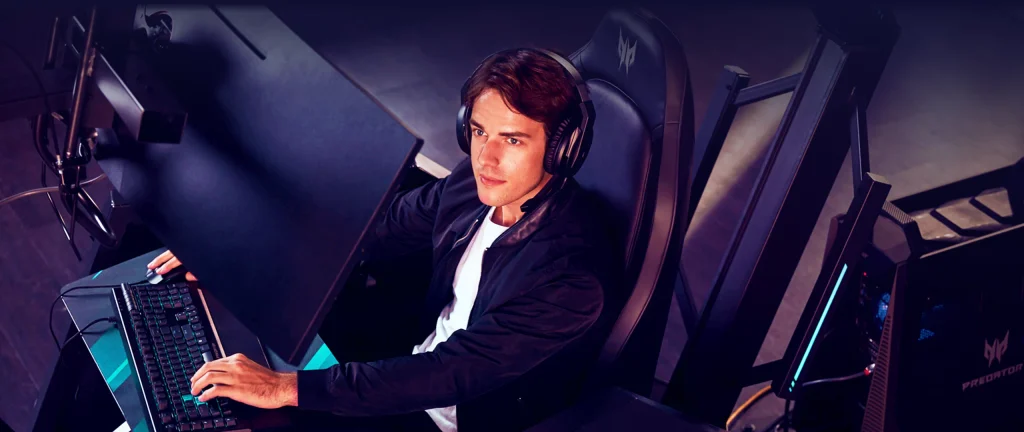
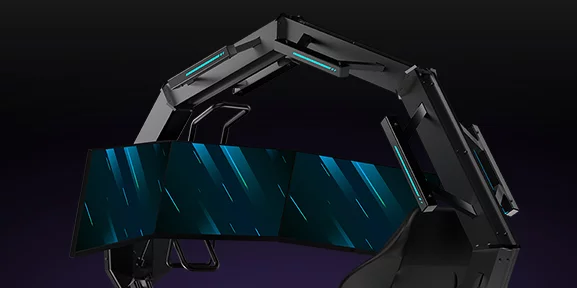
Chen gave two examples for this: the first being the Acer Predator Thronos chair, which sold for $30,000 each. This proved particularly popular in the Middle East, he explained, and it all helped to change people’s ideas of what “Acer” meant.
Gamer in Acer Thronos chair Thronos included three widescreens
“We did the [Predator] 21x,” Chen added. “That is like 10,000 US dollar notebook PC. So we have that happening to bring up the brand premium, the brand perception that Acer can be also doing something very valuable, other than it’s just a cheap PC brand… and then broaden our business definition from computer to computer science to lifestyle.”
Certainly the company has come a long way since its foundation in 1976, with 2026 marking its 50th anniversary. Who knows what Acer products we’ll be buying in 2076…
About The Author
Tim Danton
Tim has worked in IT publishing since the days when all PCs were beige, and is editor-in-chief of the UK's PC Pro magazine. He has been writing about hardware for TechFinitive since 2023.
To provide the best experiences, we and our partners use technologies like cookies to store and/or access device information. Consenting to these technologies will allow us and our partners to process personal data such as browsing behavior or unique IDs on this site and show (non-) personalized ads. Not consenting or withdrawing consent, may adversely affect certain features and functions.
Click below to consent to the above or make granular choices. Your choices will be applied to this site only. You can change your settings at any time, including withdrawing your consent, by using the toggles on the Cookie Policy, or by clicking on the manage consent button at the bottom of the screen.
Functional
Always active
The technical storage or access is strictly necessary for the legitimate purpose of enabling the use of a specific service explicitly requested by the subscriber or user, or for the sole purpose of carrying out the transmission of a communication over an electronic communications network.
Preferences
The technical storage or access is necessary for the legitimate purpose of storing preferences that are not requested by the subscriber or user.
Statistics
The technical storage or access that is used exclusively for statistical purposes.The technical storage or access that is used exclusively for anonymous statistical purposes. Without a subpoena, voluntary compliance on the part of your Internet Service Provider, or additional records from a third party, information stored or retrieved for this purpose alone cannot usually be used to identify you.
Marketing
The technical storage or access is required to create user profiles to send advertising, or to track the user on a website or across several websites for similar marketing purposes.
To provide the best experiences, we use technologies like cookies to store and/or access device information. Consenting to these technologies will allow us to process data such as browsing behaviour or unique IDs on this site. Not consenting or withdrawing consent, may adversely affect certain features and functions.
Functional
Always active
The technical storage or access is strictly necessary for the legitimate purpose of enabling the use of a specific service explicitly requested by the subscriber or user, or for the sole purpose of carrying out the transmission of a communication over an electronic communications network.
Preferences
The technical storage or access is necessary for the legitimate purpose of storing preferences that are not requested by the subscriber or user.
Statistics
The technical storage or access that is used exclusively for statistical purposes.The technical storage or access that is used exclusively for anonymous statistical purposes. Without a subpoena, voluntary compliance on the part of your Internet Service Provider, or additional records from a third party, information stored or retrieved for this purpose alone cannot usually be used to identify you.
Marketing
The technical storage or access is required to create user profiles to send advertising, or to track the user on a website or across several websites for similar marketing purposes.

 Trending