Trending Topics

 Trending
UK’s digital network migration could save billions, BT study claims

Upgrading the UK’s critical services from ageing analogue systems to modern digital networks could deliver a £3 billion net economic benefit by 2040, according to new research commissioned by BT.
The study by Assembly Research modelled the financial, environmental and social impact of moving critical national infrastructure (CNI) sectors away from legacy systems such as the Public Switched Telephone Network (PSTN) and 2G mobile. Aside from comms, the CNI sectors include energy, water, health, local government and emergency services.
Beyond the financial case for migration, the study suggests there are societal and environmental benefits that can be gained by 2040. These include preventing 750,000 unnecessary ambulance trips, while 12 million hours of council staff time would be freed up.
At the same time, the study points out that the migration would save over 600,000 NHS staff hours, and emergency services could cut 280,000 false fire alarms, reducing unnecessary callouts by an average of 54 every day.
The migration would also cut 3.42 megatonnes of carbon emissions, which would be equivalent to powering every home to Birmingham for a year, BT stated.
Meanwhile, the energy sector stands to save £1.4 billion through better demand forecasting and improved outage prevention, while the water sector could generate £771 million in efficiencies through smarter monitoring and lower electricity use.
“This research sends a clear message: delaying the shift to digital carries a real cost to public services, the environment and the wider economy. Legacy systems are becoming increasingly unreliable, and the case for action is urgent,” BT Business CEO Jon James said.
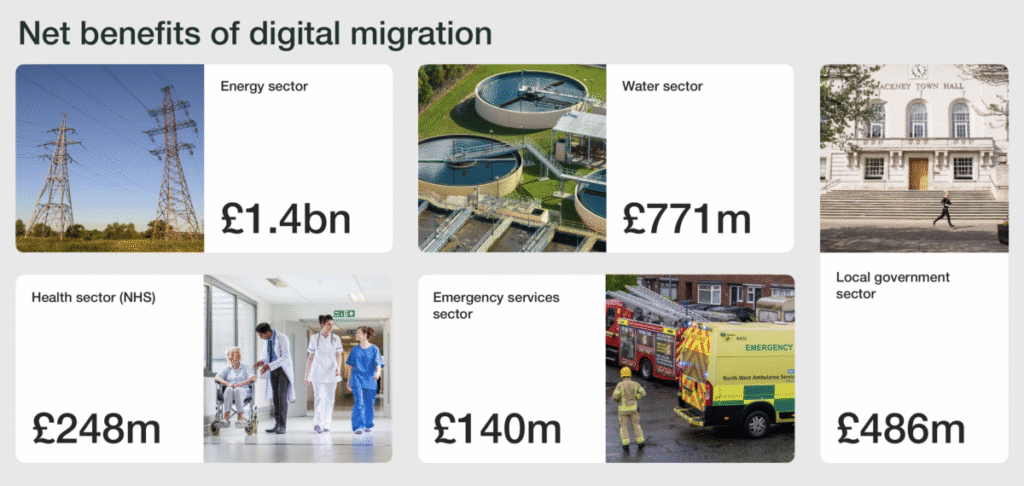
Local governments could save half a billion pounds
Elsewhere in the research paper, BT noted that local governments also stand to gain £486 million by modernising telecare systems and cutting the cost of maintaining ageing analogue equipment.
“For the first time, we’ve lifted the lid on legacy network migration and worked to understand the scope and scale of how key UK industries are still relying on aging fixed and mobile networks,” Assembly Research Founder and CEO Matthew Howett said.
“Our research found that while the energy and water sectors are already well into their migrations, it’s vital that others follow to avoid growing costs and missed efficiencies.”
The PSTN is due to be fully retired in January 2027, with businesses and public services urged to complete their migrations by the end of 2025 to avoid last-minute disruption.
BT said it migrated nearly 300,000 PSTN business lines in 2024, but warned that the UK risks falling behind European peers. Germany and Spain are close to completing their transitions, while Italy, Portugal and France are also pressing ahead.
You might also be interested
About The Author

Aimee Chanthadavong
NEXT UP


