Trending Topics

 Trending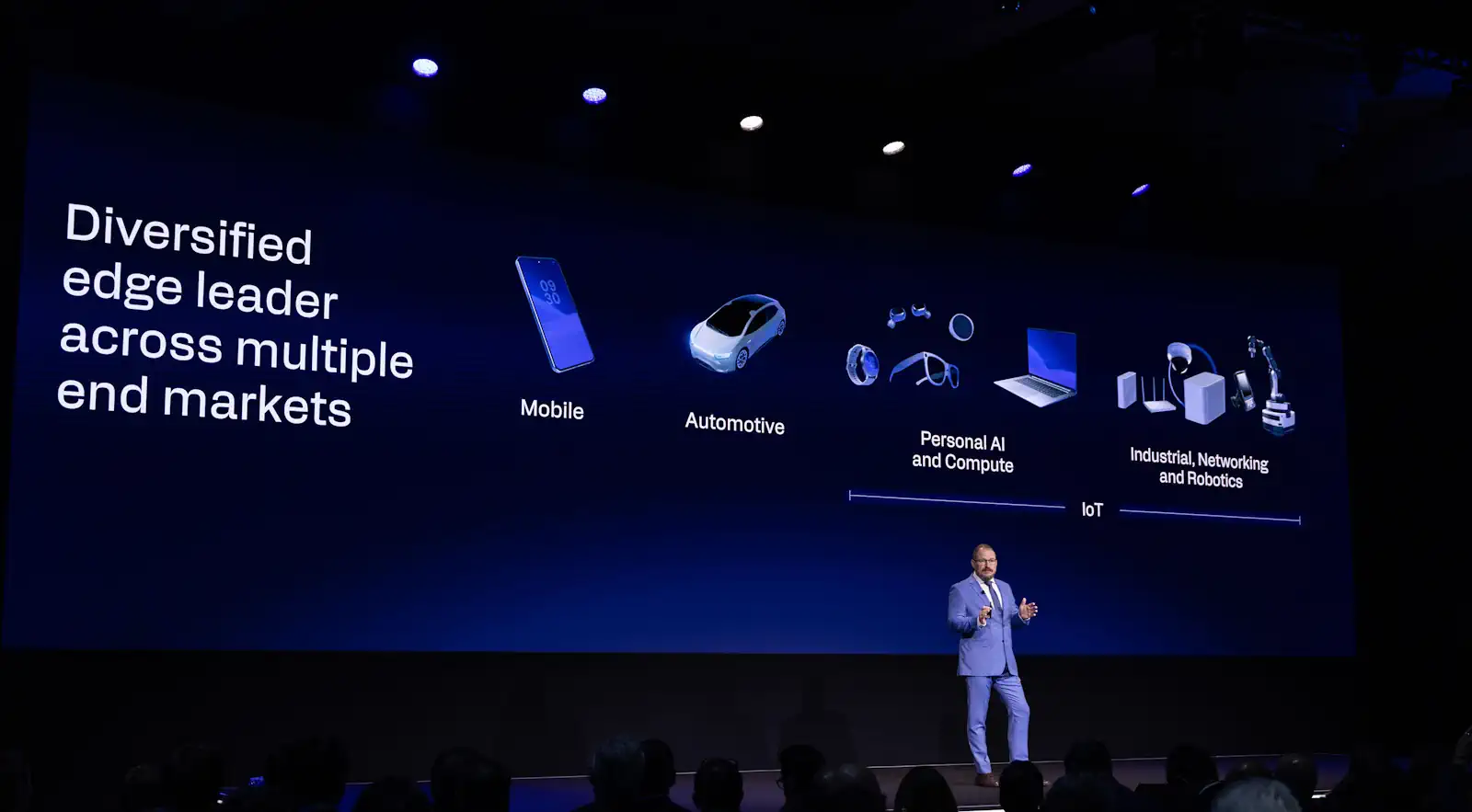
Qualcomm’s diversification pays off with $10 billion quarterly revenue despite challenges

It’s earnings release time for the tech companies, and Qualcomm defied the Wall Street consensus by announcing nearly $10 billion of revenue in Q3 FY26. Its total revenue was $9.947 billion compared to expectations of approximately $9.67 billion.
While those figures were 4% down year-on-year, and led to Qualcomm’s stock (QCOM) to fall by more than 4% in after-hours trading, it shows the importance of diversification as the company shifts its reliance from smartphone revenue.
A drill-down of the numbers reveals the challenges. While revenue was only narrowly down, GAAP net income fell 25% to $2 billion. Non-GAAP earnings per share came in at $2.21, which was narrowly below analyst expectations.
The primary challenge is Qualcomm’s traditional smartphone engine.
Handset chip and component sales revenue fell 20% to $5.086 billion in the quarter, which the company attributes to factors such as memory shortages, rising component costs and weaker demand.
The pressure hit margins as well, with Qualcomm’s chip division, QCT, reporting an EBT margin of 26% compared to 30% a year earlier. The company expects costs across wafer fabrication, packaging, assembly and testing to remain high, and plans price increases from September.
Qualcomm’s automotive business gains momentum
The automotive business is now the most convincing proof of Qualcomm’s diversification. Revenue was up 61% to a record $1.588 billion, marking its 23rd consecutive quarter of double-digit growth.
Combined automotive and IoT revenue was $3.418 billion, an increase of 28% – clearly demonstrating that the company’s push beyond phone chip and component sales is becoming visible in its accounts rather than remaining a slide-deck ambition.
Note that when Qualcomm talks about IoT revenue, that includes sales of its Snapdragon X laptop chips.
Further diversification within the automotive business is seen in the company’s move away from simply selling individual vehicle components to supplying wider compute platforms.
A case in point is the new BMW agreement, which covers digital cockpit systems, advanced driver assistance and automated-driving technologies. While this approach could raise revenue per vehicle, it also intensifies competition with Nvidia, Mobileye and established automotive chip suppliers.
The AI data centre wager
Qualcomm’s longer-term bet is data-centre infrastructure. It forecasts approximately $300 million in data-centre revenue for FY26, $5 billion in FY27 and over $15 billion by FY29. These ambitious management targets hinge on its new Dragonfly Portfolio.
Its recent acquisition of Modular on July 28 also adds an important software layer. The strategic intent is to get developers to deploy AI across cloud, edge, PCs, vehicles and industrial devices without treating its chips as isolated hardware.
An open, hardware-agnostic layer could reduce the developer friction Qualcomm faces when competing, for example, with Nvidia’s mature CUDA ecosystem.
Like the whole tech industry, Qualcomm faces challenges. But if this set of results tells us one thing, it’s the importance of spreading your bets.
Related articles
About The Author