Trending Topics

 Trending
What is Snapdragon Guardian Technology?

When Qualcomm announced its second-generation Snapdragon X2 Elite processors for laptops, it made one fascinating side-announcement: that these new chips would include Snapdragon Guardian Technology. You can view it as a rival to Intel’s vPro, perfect for IT managers who need to manage remote hardware, or as a personal “find and wipe” technology for stolen laptops.
Over the course of the Snapdragon Summit, which Qualcomm invited me to, I tried to get to the bottom of this new technology. When might it arrive? How would it be used? How does it actually work?
Hopefully, this articles provides the answers.
First, what is Snapdragon Guardian?
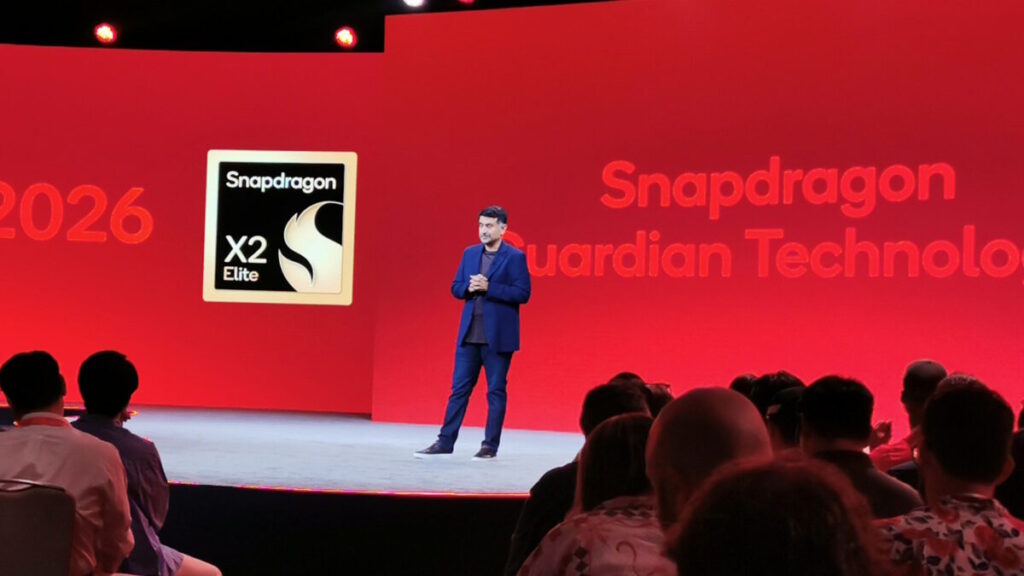
Qualcomm’s Senior Vice President and General Manager, Compute and Gaming, Kedar Kondap first introduced us to the idea.
“Snapdragon Guardian Technology pairs our leading connectivity with new hardware and firmware directly on the chip to cure pain points for consumers, retailers and businesses by giving them control of the device anywhere at scale,” he said during the keynote.
“This transforms enterprise manageability with a fleet of always-connected, always-protected PCs. Administrators can push updates, they can push policies to devices anywhere in the world.”
Just to hammer one point home: Snapdragon Guardian will only be offered with X2 Elite systems. It isn’t a software add-on, but a set of services built around a piece of hardware that’s exclusive to X2 Elite chips.
So, Snapdragon Guardian is only for enterprises?
This made it sound like Snapdragon Guardian would only be for larger organisations, but later statements and articles made it clear that it could actually be used by tiny businesses. Even consumers.
However, this isn’t a simple switch. While Qualcomm is building the technology platform, it’s up to the computer makers – original equipment makers (OEMS) such as Acer, Lenovo and HP – to implement Snapdragon Guardian.
“We are working with OEMs on this,” said Kondap in a Q&A later that day. “You should expect devices available in, I’d say, mid 26 with Guardian Technology enabled.”
How and where does it work?
Similar technologies – Intel’s vPro and AMD’s Ryzen Pro – work over Wi-Fi and Ethernet, but Qualcomm takes a different route. It wants Snapdragon Guardian to work anywhere, so it’s extending its support to “any cellular technology”, said Mandar Deshpande, Senior Director of Product Management at Qualcomm, during a private briefing with UK and German media.
“If we have a thin modem, so as to say which is not necessarily 5G capable, we can still locate, triage and diagnose issues with the PCs,” he added. The only type of connection not supported is physical Ethernet, which makes sense as few Qualcomm-powered devices have built-in Ethernet ports.
Will Snapdragon X2 Plus chips support Snapdragon Guardian?
At CES in January 2026, Qualcomm announced the Snapdragon X2 Plus chips. These are the mainstream processors found in laptops costing around the £1,000/$1,000 mark, whereas Snapdragon X2 Elite chips tend to land in more premium laptops.
The X2 Plus chips support Snapdragon Guardian technology, but will be an option rather than the default. The best way to find out, other than asking your supplier, is to look for clues on remote management. If the PC maker says that out-of-band management is supported then the chip almost certainly includes Snapdragon Guardian.
Snapdragon Guardian: Part of a wider push into business
While Snapdragon Guardian is important, it’s only part of Qualcomm’s push into the business market. IT managers are looking for easy rollouts and management, and that means integration with third-party tools such as Autopilot, SCCM and Microsoft Intune. And, as of mid-2025, that’s the case. A Dell blog from August 2025 covers this in detail.
IT managers should also read Principled Technologies report on deploying Snapdragon to businesses. Its conclusion? “In our hands-on tests, deploying Copilot+ PCs with Snapdragon X Series processors was as fast and easy as deploying AI PCs with Intel Core Ultra processors,” the report states. “This confirms that integrating AI PCs with Snapdragon processors into an environment with Intel CPU-based devices would impose no additional burden on IT administrators.”
Why will it take so long for Snapdragon Guardian to appear?
I asked Deshpande this question during the session. “New technology just has a tonne of effort to make sure that it is commercial, right?” he replied.
“The reason why hardware as a service is not very popular on PCs is because whoever is a service provider is worried. Well, I don’t know where this PC will be. Can I locate it? Track it, disable the hardware. They need to do a bunch of other things so that they feel confident that they can get back that piece of hardware. So to get to that level, there are a lot of underlying blocks that need to be enabled.”
So that’s the commercial reason; there is a technical reason too, Deshpande explained.
“Second is we also have our cloud component to it, where all the services components is sitting in the cloud, plus there is a networking thing, and then then the modem physically has to go through certifications.” The OEM also needs to wrap the service into its offering, so Lenovo must make it part of Vantage for example.
This article was updated on 30 July 2026 with the entries “Snapdragon Guardian: Part of a wider push into business” and “Will Snapdragon X2 Plus chips support Snapdragon Guardian?”
Related articles
About The Author

Tim Danton
NEXT UP


