Trending Topics

 Trending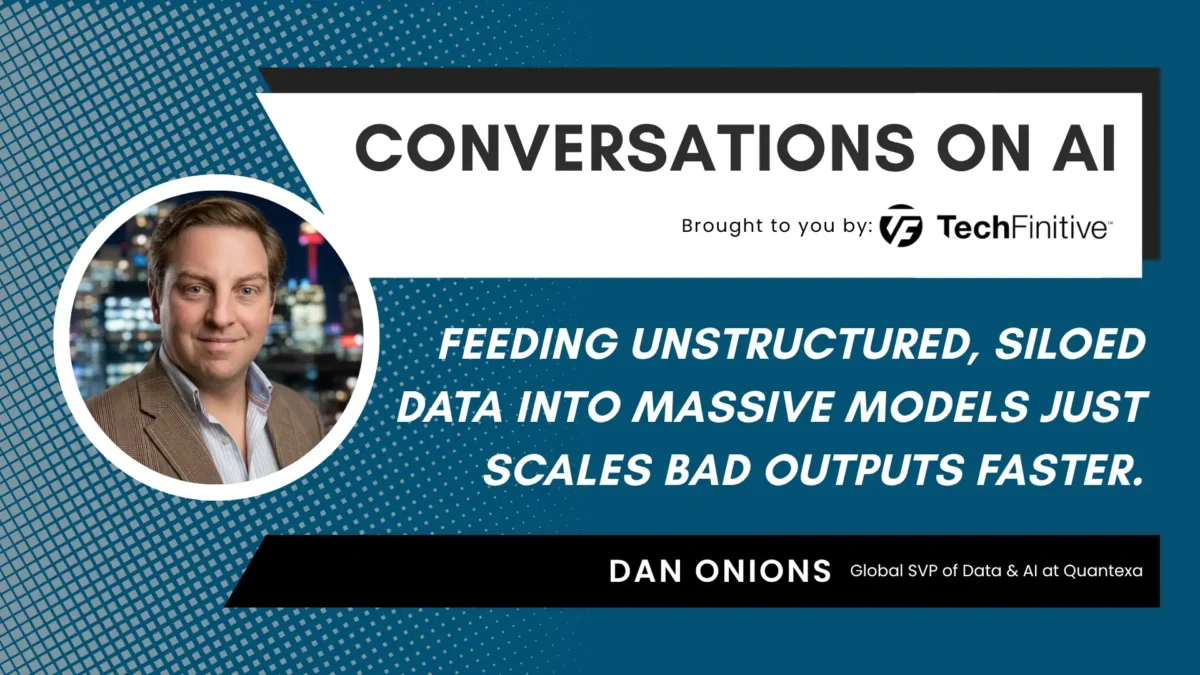
Dan Onions, Global SVP of Data & AI at Quantexa: “Feeding unstructured, siloed data into massive models just scales bad outputs faster”

Two words just kept on coming up in our interview with Dan Onions, Global SVP of Data & AI at Quantexa: trust and context. That makes sense given that this is a core part of his role at Quantexa, whose platform aims to “Put Context Behind Every Decision” to quote its website, but let’s first explain why you should trust Dan. And add some context whilst we’re at it.
He’s certainly had a varied career, including several years providing strategic advice to the UK’s Ministry of defence. Before joining Quantexa, he was the Founder and CEO of the DASH project management startup, and in total has 27 years of experience helping organisations use well-founded data to meet the needs of today’s world. Most recently, that means AI transformation too.
You can hear the learnings in his advice throughout this interview. “Most enterprises have a chronic data problem,” he says, describing “a mess of inconsistencies and inaccuracies that kills trust”. No wonder, when organisations are often relying on record keeping that stretches back over decades.
This is one of the many areas where context is king. “Whether it be a global bank or a local family-owned insurance firm, what differentiates the AI that can be trusted from the rest is a robust context layer,” he says. For example, knowing “a person from their alias, a shell company from its parent, and a relationship from its paper trail”.
As he also points out, many organisations are rushing to deliver AI-based solutions. That comes with real and obvious dangers, especially as we embed AI deeper into our systems. How to avoid the dangers yet deliver the innovation every business needs to succeed? Read on.
What is the biggest misconception enterprise customers still have about adopting AI within business-critical software?
We’re seeing more and more that AI agents don’t know who they’re dealing with, and that’s a major problem.
Enterprise AI is making decisions at machine speed, flagging transactions, approving credit, triggering alerts, without truly understanding the entities involved, since both business names and individual names can appear in many forms.
For example, consider a regional bank. Take the name ‘John Andrew Lewis’: he may appear as J.A. Lewis; John Lewis; Lewis, John Andrew, and so on. Similarly, businesses can appear as their full legal name (Quantexa Limited, for example) or by a heavily abbreviated version (Quantexa, or even Q).
Despite all these discrepancies, the AI acts anyway, and the consequences land on compliance teams, legal budgets, and regulators.
Getting this right starts with giving AI a verified, living map of the world it operates in. One that knows a person from their alias, a shell company from its parent, and a relationship from its paper trail. This piece shows how the organisations getting this right have built that map directly into their AI stack, not bolted it on afterward, and why that architectural decision is what separates agents that can be trusted from agents that need to be babysat.
In enterprise AI, this is the foundation that determines whether investments pay off or blow up.
How is AI changing the role of your customers? Are you replacing repetitive work, augmenting decision-making, or fundamentally changing how people do their jobs?
I see IT leaders across banking, insurance, and healthcare jumping at the opportunity to implement AI to make their lives easier, but many of them don’t know where to begin. Our tools allow them to converse directly with complex networks using plain, everyday language to generate audit-ready reports in seconds.
While customers can confidently base their decisions on the findings of these reports, they’re also kept firmly in the loop to make the final call. This allows them to rely on the accuracy of the data and focus on extracting insights from it to make better business decisions, while saving time and effort.
How do you balance innovation with responsible AI? Where do you draw the line between moving quickly and ensuring customers can trust the outputs?
The industry is moving fast, but leaders need to understand they don’t have to choose between speed and accuracy. By connecting fragmented data into clear, unified pictures before AI models ever touch it, Quantexa’s technology makes decisions based on verified relationships, not wild guesses like others on the market.
For example, one of our customers, an international bank and financial services group, uses our platform to consolidate data, fight financial crime, and drive business growth across global markets. By unifying customer datasets, it replaced four separate legacy tools with a single platform, yielding potential savings of around $5.5 million while enhancing data governance and privacy for over 39 million customers across 62 countries.
Whether it be a global bank or a local family-owned insurance firm, what differentiates the AI that can be trusted from the rest is a robust context layer.
This is critical in light of shifting regulatory expectations. As companies in regulated sectors embrace AI, regulators are transitioning from “Did your AI make the right call?” to “Can you prove what it was actually looking at?” Banks that can’t answer will pay a heavy price when the stakes are highest.
Beyond productivity gains, what business outcome are your customers most excited about when they invest in AI?
The real excitement isn’t about the AI itself; it’s about the smarter, defensible decisions it makes possible.
Most enterprises have a chronic data problem. When data is pooled across systems over decades, it’s often a mess of inconsistencies and inaccuracies that kills trust. Now more than ever, we see that traditional record matching can’t handle this anymore. It fails on sparse data and breaks under the weight of natural variations.
By investing in AI that connects all data into a single, trusted view, organisations solve the remediation headache before it starts. While this is a major productivity gain for teams across the board, it’s even more important from a compliance perspective. Trusted AI helps organizations avoid the costs of satisfying regulators with broken data, and all the wasted time that goes along with it.
If you could give one piece of advice to another SaaS executive planning their AI strategy today, what would it be?
Everyone is talking about generative AI, but the organisations creating the greatest value over the next two years will be those that solve the data problem first. SaaS executives are increasingly recognising that AI is only as effective as the data foundation underneath it. The real race is not to deploy more AI, but to build more trustworthy and connected data.
Over the past year, context has been the latest buzzword across headlines, on conference and summit stages, and in the boardroom. My biggest piece of advice to a fellow executive is that creating a trusted and robust context layer is the first step towards making data operational.
It allows them to derive real value from their data, open the door to ambitious new AI and analytical initiatives, and deliver a true competitive advantage against others lagging behind.
About The Author