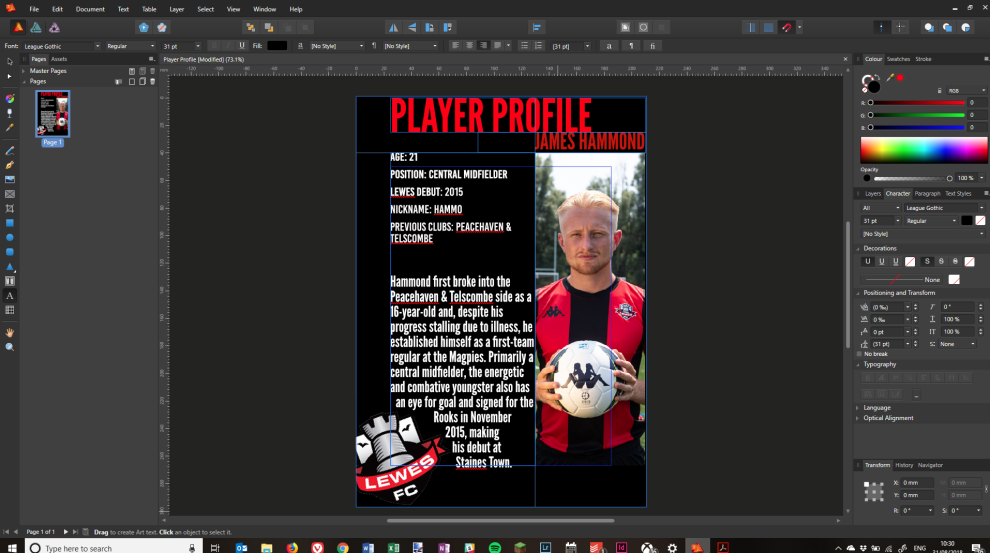
Serif’s Affinity brand has already punctured the notion that professional-grade photo editing and animation tools must cost serious bucks. Now Serif is taking a mighty swipe at another of Adobe’s cash cows: desktop publishing. But is Affinity Publisher a genuine threat to InDesign?
Serif’s Affinity brand is exploiting the fact that Adobe now wants to chain professionals to expensive subscriptions. A month’s subscription to Adobe’s Creative Cloud suite – which includes Photoshop, Illustrator and InDesign – costs around ยฃ50 per month. Serif’s apps, on the other hand, cost less than ยฃ50 as a one-off purchase.
While we don’t know how much Affinity Publisher will cost yet, it’s safe to say it won’t be nearly as expensive as InDesign. But is it as good?
Affinity Publisher: features
If you’ve ever spent any time in InDesign (and I spend half my life in it), then you won’t feel like a fish out of water in Affinity Publisher.
The interface is very similar, the tools are almost identical, and it follows the tried-and-tested method of controls on the left, swatches/panels on the right, content in the middle.
It follows many of the same conventions as InDesign, too. Drag in from the rulers at the top or sides, for instance, and you’ll create a guide to help you line up images and other page elements. You can create master pages that apply the same elements to every page (or selected pages) in a document.
Serif is superb at creating video tutorials for all of its products, and Affinity Publisher is no exception. Even at this early beta stage, there are a dozen or so video tutorials showing you how to perform tasks such as wrap text around images, create a baseline grid or drop tables into documents. Even if you’ve never used InDesign or a DTP suite before, you shouldn’t have too many problems creating documents from scratch.
I created the document pictured at the top of this story in less than an hour, after following a few of the video tutorials.
Affinity Publisher: beta bugs
Like any beta product, there are bugs to be squished. Publisher seemed to lose the fonts in my document when I first re-opened a saved version of the document above, only finding them again when I restarted. And image placement is a little haphazard currently, with erratic performance around photos filling their ascribed frame size.
Still, I’m hugely impressed with what I’ve seen so far. It’s going to take a huge effort to dislodge InDesign as the publishing industry standard. But for folks looking for professional DTP software that doesn’t require them to auction off a kidney on eBay, this could very well be the answer.
Barry has 25 years of experience working on national newspapers, websites and magazines. He was editor of PC Pro and is co-editor and co-owner of BigTechQuestion.com. He has published a number of articles on TechFinitive covering data, innovation and cybersecurity.
To provide the best experiences, we and our partners use technologies like cookies to store and/or access device information. Consenting to these technologies will allow us and our partners to process personal data such as browsing behavior or unique IDs on this site and show (non-) personalized ads. Not consenting or withdrawing consent, may adversely affect certain features and functions.
Click below to consent to the above or make granular choices. Your choices will be applied to this site only. You can change your settings at any time, including withdrawing your consent, by using the toggles on the Cookie Policy, or by clicking on the manage consent button at the bottom of the screen.
Functional
Always active
The technical storage or access is strictly necessary for the legitimate purpose of enabling the use of a specific service explicitly requested by the subscriber or user, or for the sole purpose of carrying out the transmission of a communication over an electronic communications network.
Preferences
The technical storage or access is necessary for the legitimate purpose of storing preferences that are not requested by the subscriber or user.
Statistics
The technical storage or access that is used exclusively for statistical purposes.The technical storage or access that is used exclusively for anonymous statistical purposes. Without a subpoena, voluntary compliance on the part of your Internet Service Provider, or additional records from a third party, information stored or retrieved for this purpose alone cannot usually be used to identify you.
Marketing
The technical storage or access is required to create user profiles to send advertising, or to track the user on a website or across several websites for similar marketing purposes.
To provide the best experiences, we use technologies like cookies to store and/or access device information. Consenting to these technologies will allow us to process data such as browsing behaviour or unique IDs on this site. Not consenting or withdrawing consent, may adversely affect certain features and functions.
Functional
Always active
The technical storage or access is strictly necessary for the legitimate purpose of enabling the use of a specific service explicitly requested by the subscriber or user, or for the sole purpose of carrying out the transmission of a communication over an electronic communications network.
Preferences
The technical storage or access is necessary for the legitimate purpose of storing preferences that are not requested by the subscriber or user.
Statistics
The technical storage or access that is used exclusively for statistical purposes.The technical storage or access that is used exclusively for anonymous statistical purposes. Without a subpoena, voluntary compliance on the part of your Internet Service Provider, or additional records from a third party, information stored or retrieved for this purpose alone cannot usually be used to identify you.
Marketing
The technical storage or access is required to create user profiles to send advertising, or to track the user on a website or across several websites for similar marketing purposes.