Trending Topics

 Trending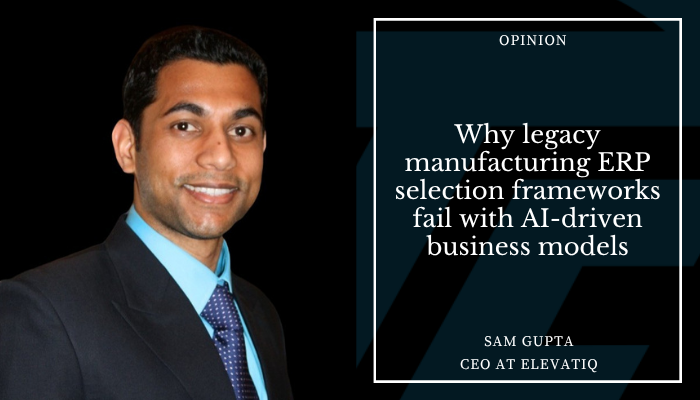
Why legacy manufacturing ERP selection frameworks fail with AI-driven business models

This article is part of our Opinions section, where we invite industry professionals to share their views on the most pressing technology questions of our time.
Here, Sam Gupta, CEO at ElevatIQ, argues that AI is transforming manufacturing, rendering legacy ERP selection obsolete and explains why traditional strategies fail and how to align your approach with an AI-native era.
The rise of AI-driven business models changes how manufacturers interact with their customers, process transactions, and coordinate across manufacturing plants. In my experience, these shifts are not minor (depending on how you define “minor”). They have a substantial impact on most components of business models. As the underlying transaction structure and interactions fundamentally reshape ERP strategy, executives must rethink their target operating model for the AI-native world.
While rethinking might feel like making a New Year’s resolution, the process is more unglamorous, which most executives can barely handle. They struggle even to understand AI at a basic level. Within our client engagements, some executives stated, “AI is a pipe dream.” “Our CFO cringes at any conversations related to AI”. When they ask for AI, they commonly mean analytics or reporting. Generally, the discomfort stems from not having experienced the practical advantages firsthand.
Our smaller clients generally don’t have the same R&D appetite. They are also not the earliest adopter of the technology.
The larger manufacturing clients, on the other hand, are already investing heavily in AI initiatives. As these capabilities mature, it’s likely that they will mandate their use across their supplier networks. These enforced requirements will drive widespread adoption and adjustments by downstream manufacturers and distributors.
As these industry-wide trends gain momentum, some manufacturers–especially those running legacy workloads–might experience the steepest change curve. Why would this happen? Legacy systems and processes weren’t designed for the AI-native world, which most executives wouldn’t be surprised to learn. The newer constraints also demand careful and timely planning and adoption.
Successful adoption requires executives to develop a deeper understanding of the following newer constraints and to align existing constraints.
AI-driven manufacturing business model changes
Customer workflows
Newer channels and shifting traffic. While traditional traffic, such as word of mouth or trade shows, might not be as affected, online sources would need to be replanned. The newer channels also introduce additional processes and interaction models. These changes will collectively require rewiring ERP-centric processes to incorporate new controls.
Interaction with customer agentic processes. What was allowed with human-driven processes may require tighter scrutiny and discipline with algorithm-controlled processes. To increase their efficiency, upstream manufacturing executives will require downstream manufacturers to implement automated processes to interact with customer-agentic workflows.
Customer service agentic processes. Customer service, augmented by agentic processes, is another area for manufacturers, with the potential for immediate returns. These processes will have newer data and training requirements, changing collaboration patterns with downstream systems and processes.
Vendor workflows
Interaction with vendor agentic processes. As vendors deploy agentic processes to improve efficiency, upstream manufacturers will need to adapt their workflows in response to altered interactions and compliance requirements.
Changes to external joint planning data. With increased traceability requirements and the introduction of agentic processes, industry planning datasets will differ substantially, driving changes in supply chain planning across the industry. These shifting datasets would, in turn, require executives to align their business models and planning horizons with the new context.
Internal workflows
Redesigned organizational workflows. With the introduction of agentic processes, AI agents handle some responsibilities that were traditionally performed by human operators. These shifting responsibilities require a complete rewiring of transactions and processes, along with corresponding changes to the ERP strategy.
Changed governance and reconciliation responsibilities. While AI-native technologies provide a great user experience, they introduce downstream reconciliation issues. These issues arise primarily from dataset flattening, which is required for the effective execution of AI-native codebases. While agentic workflows make reconciliation easier through advanced AI technologies, executives must plan for additional reconciliation and governance overhead resulting from data flattening. You must be thinking: do these issues not exist with traditional architecture? They are generally lower due to their tighter data integrity.
Reporting workflows
Increased reporting responsibilities. As AI becomes embedded in core workflows and regulatory requirements evolve, increased sub-processor penetration increases reporting requirements. Requirements that traditional systems struggled with and that newer systems are natively built to handle.
Why these changes require rethinking manufacturing ERP strategy
Traditional ERP assumptions are no longer valid. Manufacturing ERP systems were designed around predictable, human-driven workflows. Business processes were relatively stable (at least with good ERP implementation!) and changed incrementally. Operational controls assumed human approvals and manual oversight. AI-driven business models introduce dynamic, autonomous, and continuously evolving processes.
Operational governance becomes more complex. AI introduces new control risks across pricing, forecasting, procurement, quality, and compliance (not to mention the unknowns no one knows!). Automated decisions require continuous monitoring and exception management. Segregation of duties must extend to AI agents and automated workflows. Compliance requirements become more difficult to manage without robust governance tools.
Reporting requirements expand beyond traditional KPIs. Executives need visibility into AI-driven decisions and outcomes. New reporting dimensions emerge around model performance, automation effectiveness, and operational risk. Regulatory scrutiny may require greater transparency into algorithmic decisions.
ERP integration requirements change significantly. ERP must interact with customer, vendor, and internal agentic systems. Traditional batch integrations may not support AI-enabled workflows. ERP platforms must accommodate rapidly expanding AI-native business models and industries.
ERP selection criteria must evolve. Functional fit alone is no longer sufficient. Manufacturers must evaluate AI readiness, governance capabilities, integration architecture, and scalability. Auditability and control frameworks become primary evaluation factors. The best ERP (the million-dollar question!) may not be the one with the most features, but the one best equipped to support AI-driven business models.
Conclusion
The existing feature-led manufacturing selection frameworks are no longer sufficient in the face of AI-driven business models. These models require overarching architectural maturity, mindset, and discipline–due to the increased complexity of stakeholders’ interactions and their ability to alter the deterministic state.
We have seen this firsthand. Our manufacturing clients who use the “lift-and-shift” approach struggle most with their ERP upgrades.
Using a legacy selection approach for an AI-driven business model is like using “a legacy BOM” with “newer machines.” Clients who can rethink, rewire, and realign their business models are already reaping the benefits. Get rid of legacy practices. Redraw everything as if you were starting from scratch.
An AI-driven business model is a completely new journey. So treat it like one.
About The Author

Ricardo Oliveira
NEXT UP