Trending Topics

 Trending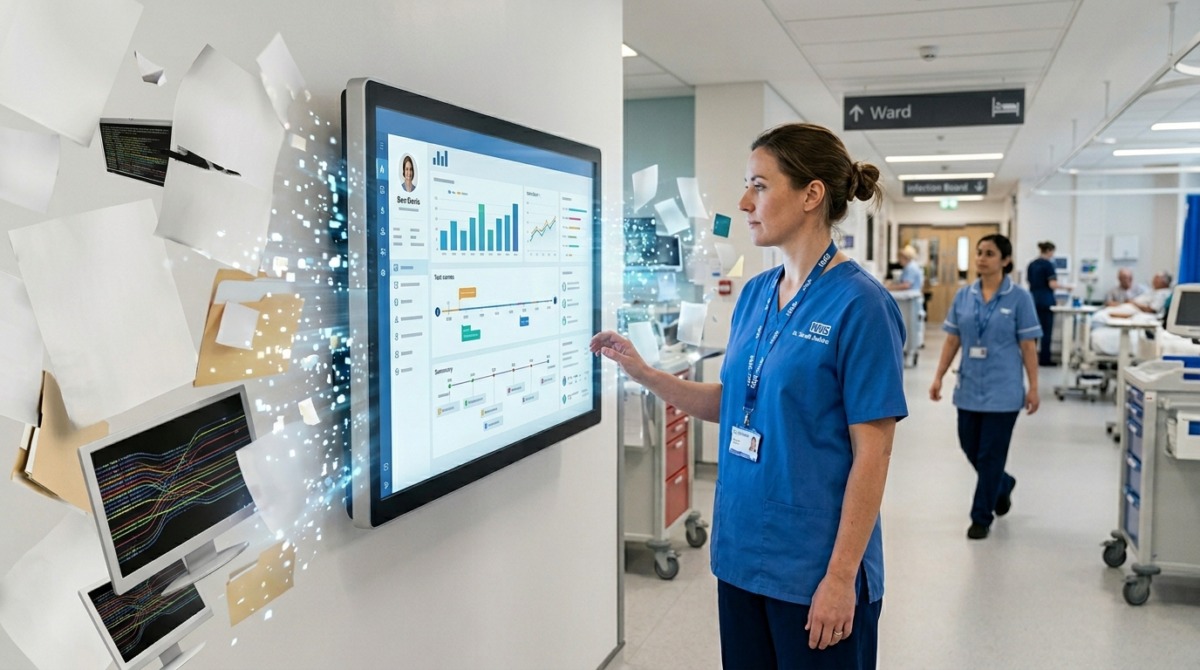
Why digital transformation in the NHS is more than going paperless

This article is part of our Opinions section, where we invite industry professionals to share their views on the most pressing technology questions of our time.
For more than a decade, the NHS has pursued the ambition of paperless care as a marker of digital maturity. From national strategies to local transformation programmes, reducing reliance on physical records has been framed as both an efficiency imperative and a patient safety goal. Yet, despite widespread investment in electronic patient records (EPRs) and digital clinical systems, hybrid information systems remain the norm.
Notes are still scanned, letters arrive externally, historical records sit outside core systems, and many clinicians continue to rely on documents beyond structured digital fields. This is not a failure of digitisation – the NHS has made clear and substantial progress – but a signal that strategies can often underestimate how care is delivered, how information flows across organisational boundaries, and how much clinically valuable data exists outside structured systems.
Digital transformation involves more than technology adoption. It requires alignment with real-world workflows, a comprehensive understanding of information needs, and governance structures that ensure all data is accessible and usable.
Why paper still exists in a ‘digital NHS’
There is a long-held assumption that implementing an EPR will naturally eliminate paper, but this is often unrealistic. The acceleration of EPR adoption has been driven in large part by national policy objectives, funding mechanisms, and the overarching ambition to create fully digital, interoperable care environments. Standardised electronic records were expected to support smoother information sharing, improve operational efficiency, and reduce reliance on physical documentation.
Yet, while EPRs excel at capturing structured clinical data – observations, medications, allergies, alerts, and care plans that fit neatly into predefined fields – they are not designed to manage the full spectrum of unstructured information critical to decision making.
Legacy paper notes, historical correspondence, referral letters, consent forms, clinical imagery, third-party reports, and scanned documentations all contribute context to a patient’s history and risk profile. Without reliable integration of these sources, digital systems exist, but the full record remains fragmented. Frontline teams have little choice but to operate in hybrid environments where essential information is fragmented across platforms, shared drives, scanned repositories, and physical records. Paper persists because these siloed tools frequently do not reflect how information actually flows through care pathways.
Time that could be spent on patient care is consumed by searching through records, chasing missing notes, or requesting historical information – and this is among already pressured workflows. Decisions get delayed, multidisciplinary collaboration becomes challenging, and risk is increasingly heightened when clinicians cannot access the full patient story at the point of care.
But the continued presence of paper should not be interpreted as a failure of digital transformation. Instead, it simply highlights that transformation is incomplete and we have some way to go before we’ve eradicated paper entirely. True digital progress requires strategies that recognise unstructured data as integral to care, embed governance, ensure accessibility, and, crucially, reflect real-world clinician workflows.
Rethinking ‘paperless’ as a measure of progress
Paper, in itself, is not the core problem. We must keep returning to the real issue: whether clinicians can reliably access complete, accurate, and timely information to make safe, better-informed decisions. Reducing paper may be a visible sign of change, but visibility alone does not guarantee information is flowing more effectively or that patient care is improved.
Focusing narrowly on paper eradication risks distracting from the more meaningful indicators of digital maturity, such as accessibility, interoperability, governance, and usability. A digital ecosystem designed around real clinical needs may still receive information in paper form at certain points, but the difference lies in what happens next.
Once captured, information must become usable, searchable, shareable, and securely governed. It must be integrated into workflows in a way that enhances rather than complicates care delivery. In this sense, paper is incidental – the effectiveness of information management and its impact on outcomes is what matters.
Designing governance into the digital record
If the persistence of paper is thought to be exposing gaps in digital strategy, it also brings governance into sharper focus. But governance is as much now about architecture as it is policy. Records exist in multiple formats and platforms with varying accessibility, and unstructured information presents a challenge. Documents, correspondence, scanned records, and clinical imagery do not conform to rigid data models – and without consistent indexing and retrieval processes, these materials remain effectively invisible to clinicians at the point of care.
This is where electronic document management systems (EDMSs) play a distinct and sometimes misunderstood role. While EPRs capture structured clinical data, they cannot capture the context required to build an accurate and complete picture of a patient’s history. EDMSs are purpose-built to ingest, store, index, and surface large volumes of unstructured or semi-structured information. They complement rather than duplicate EPRs, ensuring the broader patient record, including historical and externally generated documentation, is accessible within a governed and searchable framework.
From a risk perspective, this distinction is key. Clinical risk frequently arises not from incorrect data, but from incomplete context. A historic prescribing decision, an external specialist opinion, or documentation of a previous adverse reaction, for example, may reside within archived correspondence rather than in structured medication fields. If this information cannot be retrieved quickly, clinicians may be forced to make decisions without the benefit of the full patient history.
EDMS deployment is most effective when aligned to the patient journey and existing workflows. Understanding how documentation is generated, how it moves across departments, and where friction predominantly exists is critical. Accurate and reliable access to the full record is not an administrative benefit but a clinical necessity.
Looking toward the real milestone
Although paper may persist across the NHS, it should not be viewed as evidence that digital transformation has stalled. Rather, it highlights the limits of strategies that equate digitisation with system deployment alone. Eliminating paper can reduce storage costs and provide visible evidence of change, but it does not instantly resolve fragmentation, governance complexity, clinical workflow, or gaps in access to unstructured data.
Ultimately, ‘transformation’ has to be about how information supports care. It is about ensuring clinicians can see the complete patient story, regardless of format or origin, and requires designing digital ecosystems that reflect the realities of frontline workflows, rather than chasing symbolic milestones. The real milestone is not eliminating paper but building an intelligent healthcare service where every single decision is powered by complete, trusted information.
Related articles
- From digital foundations to full-scale transformation: why 2026 will be a defining year for UK healthtech
- 3 tactics to protect patient data as AI makes a healthcare push
- The forgotten interface: digitising the human-data interaction in healthcare
- From strategy to impact: how the NHS operational backbone enables digital and data transformation
About The Author

Jon Pickering
NEXT UP


