Trending Topics

 Trending
Enhancing user engagement through personalized OTT experiences

In the bustling world of Over-The-Top (OTT) services, “engagement” has long proven itself more than just a buzzword. In reality, it reflects users’ deeper connection with a platform. At the moment, it’s nothing short of the lifeblood of any streaming service, and for good reason: the longer viewers stay engaged, the more opportunities there are to generate revenue through ads, subscriptions and other monetization methods.
What might be less obvious, however, is that engaged viewers are also more likely to become advocates for your service. This reduces the cost of acquiring new subscribers and helps to grow your audience organically.
The profoundness of this seemingly insignificant benefit has been increasingly validated by the industry giants. Netflix, for example, has shifted its focus from merely acquiring new subscribers to maximizing the lifetime value of each user, underscoring the importance of retaining loyal subscribers who provide a steady stream of income.
But what transforms a casual viewer into a loyal follower? Although it’s tempting to immediately point to high-quality content and affordable subscription options, the real answer is more complex than it initially appears.
The role of personalization
A recent meta-analysis synthesizing 40 years of research on the relationship between customer satisfaction and both customer- and firm-level outcomes has confirmed that loyalty behaviours such as retention and word-of-mouth recommendations are strongly associated with customer satisfaction, heavily influenced by customer service. While this assertion might seem somewhat surprising, it is quite logical when considered more broadly.
Nielsen’s The Gauge, a monthly report on TV viewing behaviour in the United States, reveals that streaming services reached a record share of 40.3% of TV usage in the United States in June 2024, leaving cable and broadcast far behind at 27.2% and 20.5%, respectively.
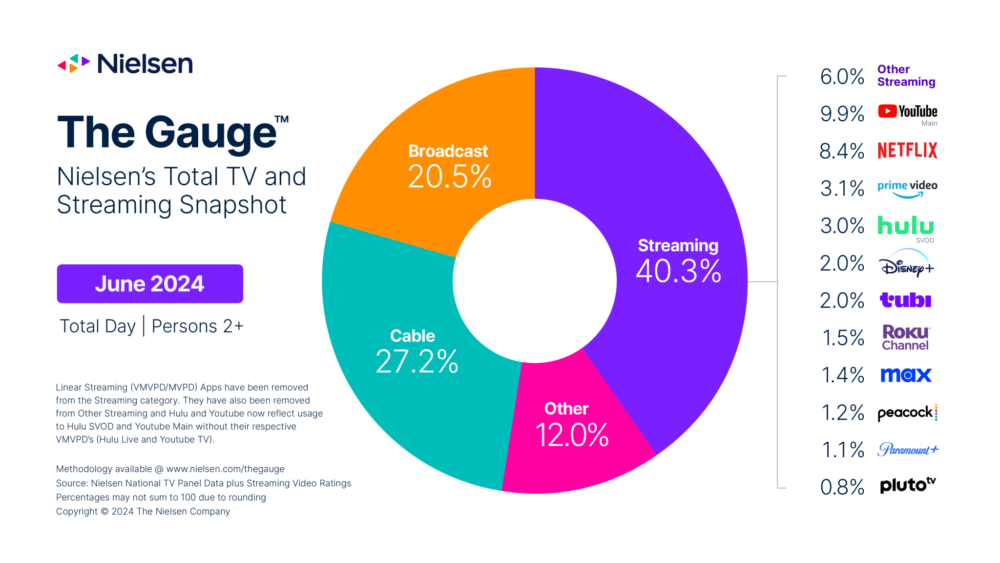
At the same time, key players such as Disney+, Tubi, Netflix and Max have each shown impressive double-digit growth in monthly usage, all thanks to their vast selection of high-quality content.
Hence, it is not surprising that spoiled by a myriad of solid-value options, the competition for viewers’ attention is starting to hinge on factors that go far beyond just the basic service propositions. For instance, a seamless customer experience now protrudes as a key feature for successfully standing out and navigating user engagement, with personalization being one of the most powerful tools at your disposal.
Key strategies for success
Personalization in OTT is all about leveraging data and analytics to tailor content for each viewer. Broadly speaking, this means the user interface is uniquely customized, showcasing content that each person is most likely to enjoy. Personalized suggestions consider individual viewing habits, such as the type of content watched, the time of viewing, and how often they watch.
Naturally, personalization comes in many forms. Giants of OTT streaming services like Disney+, Tubi, Netflix and Max have an exhaustive arsenal of personalization tools, including dozens of basic and add-on features ensuring a person’s screen is meticulously tailored to their profile.
For smaller service providers, such an elaborate scope of tools would likely be financially burdensome and unreasonable to integrate. However, they can still tremendously benefit from a strategic and curated selection of personalization domains that meet their needs. Today, we will look at three must-haves for cementing a solid foundation.
Data-informed engagement
Harnessing the power of data is not just about numbers; it’s about crafting a narrative that resonates with your audience. By strategically using data, OTT platforms can foster deeper connections with users.
Imagine knowing what your audience wants before they do – that’s the magic of data-driven personalization; it’s about turning insights into actions that make users feel seen and valued.
Cross-platform consistency
Gone are the days ruled by gadget scarcity or tolerance to delays or setbacks – in today’s multi-device world, consistency is king. Users expect a seamless experience whether they’re on their phone, tablet, or smart TV. Thus, ensuring that your platform delivers a uniform experience across all devices not only enhances user satisfaction but also builds trust.
Think about it as having a favourite coffee shop that serves the perfect latte every time, no matter which location you visit. How willing would you be to try a different spot, especially when you need a time-sensitive quality guarantee?
Fluid content interaction
Despite a common misconception, finding content is not the end, nor is it the means – it’s just the beginning. The real engagement happens in how users interact with it. From browsing to watching to sharing, every touchpoint should be smooth and effortless.
The goal here is to make the entire process of engagement feel natural and frictionless, keeping users coming back for more.
The impact of personalization on engagement
While the multifacetedness of personalized OTT experiences may indeed feel overwhelming at first, it is worth recalling that laying its foundational level first is the key. Further examination will definitely give you a better understanding of the areas to fine-tune, while the basis will already work in your favour, mesmerizing your viewers with spot-on experience and rendering them to come back for more.
The goal is to boost user engagement by making the viewing experience more relevant and enjoyable. When viewers feel that the content is tailored to their preferences, they are more likely to spend more time on the platform, explore different types of content, and return more frequently. This not only increases engagement but also drives revenue through more ad interactions and subscription renewals.
Besides, personalization can enhance user experience throughout their entire customer lifecycle, whether they are regular users or not. In other words, successfully utilizing it may determine who ultimately gains and keeps the audience’s attention.
More articles by Andrew Bunten
About The Author

Andrew Bunten
NEXT UP