Trending Topics

 Trending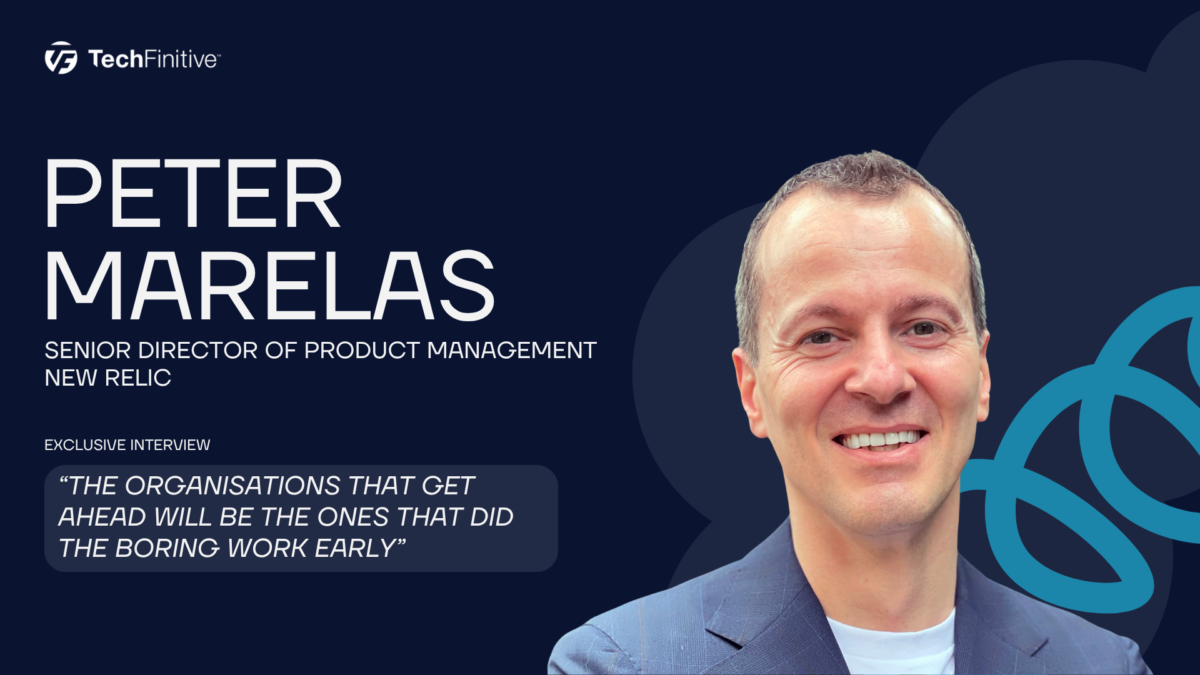
Peter Marelas, Senior Director of Product Management at New Relic: “The organisations that get ahead will be the ones that did the boring work early”

AI is becoming increasingly capable of reasoning, acting and making decisions on behalf of organisations. Yet for Peter Marelas, Senior Director of Product Management at New Relic, the biggest obstacle to getting value from that technology may have little to do with the AI models themselves.
As businesses race to adopt increasingly sophisticated models and autonomous agents, the quality of the environment those systems operate in is becoming a critical differentiator. Fragmented data, disconnected systems and incomplete visibility can give AI plenty of information to work with, but not necessarily the right information. The result is a system that can confidently reach the wrong conclusion or, in the case of an autonomous agent, act on it.
Marelas argues that organisations have therefore been looking at the AI equation from the wrong end. Rather than continually searching for the next model, businesses need to focus on the less glamorous work of connecting systems, improving data quality and developing a reliable understanding of how their environments actually operate. “The people getting real leverage from AI treat it less like a vending machine and more like a conversation, exploring a subject with it first, stating not just what they want but why, and asking it to explain and verify its own reasoning”, he mentions at one point. Indeed.
During our conversation, Marelas argues why businesses need to rethink how they interact with AI, the foundations required before organisations can safely give agents greater autonomy, and why a single, connected view of an IT environment could become more valuable than the choice of AI model itself. He also explains where AI is already delivering tangible results in IT operations – and why organisations should resist scaling autonomous agents before they have fixed the data and visibility problems underneath them. Full interview below.
Many organisations are focused on choosing the latest AI model, yet you’ve argued that the real differentiator is the environment those models operate in. Why do you think businesses are paying so much attention to the models themselves while overlooking the importance of data quality and system visibility?
Choosing an AI model feels like a decision made once and ticked off; that’s the easy part.
Consistently feeding the model quality data is an ongoing process that cuts across every team, and drags problems into the open that people have spent years quietly working around. It’s far more appealing for a business to tell itself the next AI model will solve all their problems rather than admit the thing holding it back is the mess underneath. If an AI system is only fed fragmented, disconnected data, it will confidently spit out the wrong answer. Give it a clear, connected picture of how the business actually runs, and it can be trusted to act.
When everyone can buy the same AI model, it’s not the model itself that gives a company an edge over the competition; it’s the environment it’s dropped into. And that environment can’t be bought, it has to be built.
You’ve suggested we’ve misunderstood how to work with AI, treating it like a vending machine rather than a conversation. How should business leaders rethink the way their teams interact with AI to get consistently better results?
The vending machine AI habit is everywhere. Users punch in a request, and expect a finished answer to drop out. When it doesn’t, they decide the tool isn’t up to the job. The teams getting real value out of the models treat AI interactions more like a conversation: they explore the problem with the model, they state not just what they want but why they want it, and they ask it to explain its reasoning and check its own work before acting on anything.
For a business leader, the shift is less about the technology and more about the habits teams build around it.
AI is increasingly moving beyond recommending actions to taking them autonomously. What technical and organisational foundations need to be in place before businesses can trust AI agents to make operational decisions without human intervention?
Trust is earned in a very specific way. A business doesn’t hand an agent control over the entire system with blind trust, the agent needs to prove itself by reaching the right conclusion, over and over again.
Before an agent acts unsupervised, there has to be guardrails with clear limits on what it’s allowed to do. Letting an agent act without a human in the loop means deciding, in advance, what the business is willing to answer for when no one is watching. Organisations should do this by treating autonomy as something an agent earns in stages, advising first, then acting within tight boundaries, then earning more room as it proves itself, rather than a switch that gets flipped the day a new model lands.
In IT operations, AI is already helping teams sift through thousands of alerts to identify the root cause of incidents. Where have you seen AI deliver the greatest operational improvements today, and where do you think expectations have run ahead of reality?
The clearest win today is being able to cut through noise. When a banking app stalls or a checkout fails, the engineers responding are often buried under thousands of alerts with no clear sense of what actually broke. AI has genuinely changed that, it sifts the noise, correlates signals across systems, and points to a likely cause in a fraction of the time it used to take. That’s real, it’s happening now, and it’s made response times meaningfully faster.
As organisations deploy more AI agents across different parts of the business, how can they ensure those agents are working from a consistent, reliable view of their environment rather than making decisions based on incomplete or conflicting information?
This is where it gets genuinely hard, and it’s a problem worth thinking about now before you have dozens of agents running. One agent working off flawed data is a contained problem. Ten agents, each drawing on their own slightly different version of the truth, is chaos, because they won’t just make bad calls individually, they’ll make conflicting ones, and organisations will spend more time reconciling what their AI told them than they would have saved by deploying it.
The answer isn’t more agents or better models, it’s a single, connected view of the environment that they all draw the same reliable picture of how the business actually operates, rather than each agent acting on its own. In practice that means doing the integration work most organisations keep procrastinating on before scaling up the number of entities making decisions for the organisation.
And agents also need to be self-aware. If the environment doesn’t contain the information it needs it should know when to abstain rather than confabulate a response.
Looking ahead over the next three to five years, do you think the competitive advantage in AI will come from building better models, or from creating better data environments and operational workflows? What should technology leaders be prioritising today to prepare for that future?
Competitive advantage will come from creating better data environments. Leaders should be prioritising the groundwork. Cleaning up data, connecting systems and building a real-time knowledge graph of how IT is interconnected with business operations. None of it makes headlines or signals transformation on its own, but it is what determines whether all the AI ambition turns into something dependable, or an expensive experiment that is not sustainable in the long term. The organisations that get ahead won’t be the ones that picked the cleverest model. They’ll be the ones that did the boring work early, while everyone else was still shopping for models.
About The Author

Ricardo Oliveira
NEXT UP


