Trending Topics

 Trending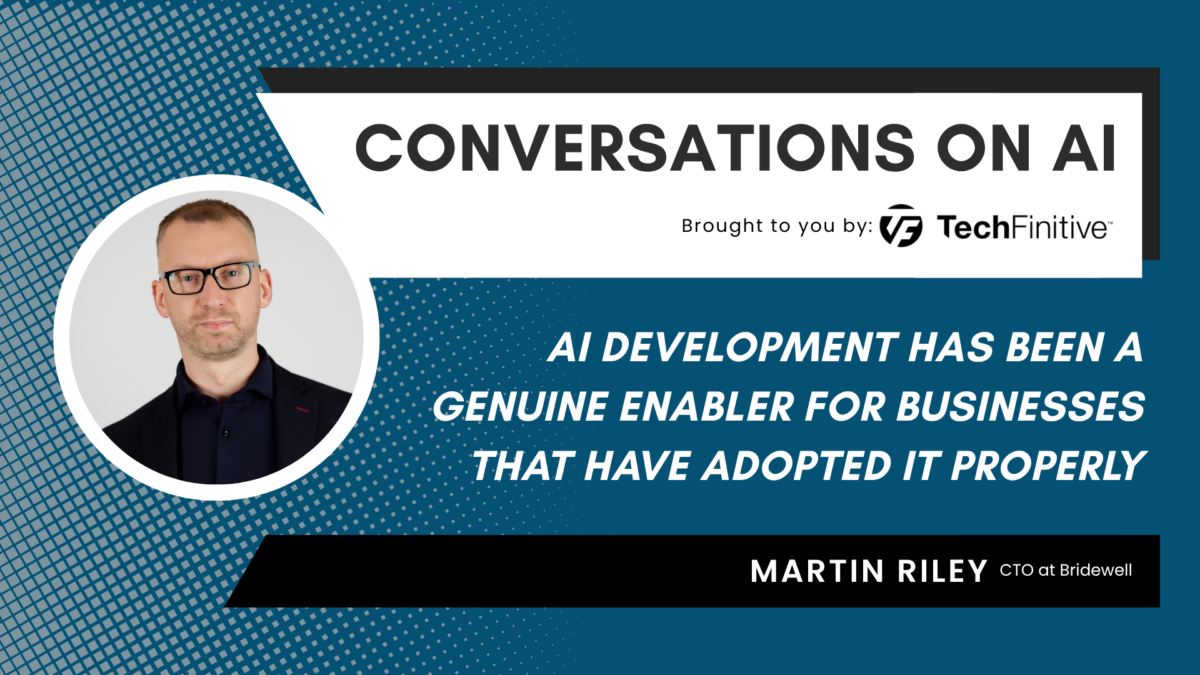
Martin Riley, CTO at Bridewell: “AI development has been a genuine enabler for businesses that have adopted it properly.”

Martin Riley has spent his career working with technology and security in equal measure, and never have the two felt so connected. As CTO and Board Director at Bridewell, which protects Critical National Infrastructure (CNI) and organisations that require the highest standard of cyber security, we’re delighted to welcome him to our new Conversations On AI series.
Martin has already seen how AI has changed the way security teams function, with the greatest shift coming from its ability to remove the repetitive grunt work that traditionally consumed analysts’ time. At Bridewell, he told us, some alert times have fallen from “58 minutes down to 9”. This is drastically changing how an analyst can focus their time.
Rather than replacing workers, says Martin, AI is allowing them to focus their time on “directing and reviewing work,” placing emphasis on professional judgement and engineering.
Martin talks about what he calls a glass-box principle, meaning that “the human must be able to see the evidence, the steps and the confidence behind it”.
But the real promise of AI lies beyond productivity and toward proactivity, he believes. As automation reduces the response time, teams can redirect their capacity towards “maturity, telemetry coverage, detection engineering, intelligence and security engineering”. That’s the outcome organisations should now be buying into, allowing additional focus on the work that can reduce risk before an incident occurs.
As AI creates new opportunities for security teams, it’s forcing businesses to rethink where they invest their time and resources. With that in mind, we decided to start by asking Martin how he’s witnessed technology changing priorities over the past 18 months.
How has AI changed your company’s product roadmap over the past 18 months? Were there projects you accelerated, delayed or abandoned altogether?
We have been researching the use of AI since Q4 2023. The step change came with the frontier model releases in Q4 last year from OpenAI and Anthropic. Those capabilities let us expedite activity and pull forward initiatives we had deliberately parked while we waited for the models to catch up.
We have not abandoned anything. We have changed the priority of our investments, which is a different thing. Agentic workflows, built on frameworks we have tested and proven, now sit ahead of the broader process automation and engineering improvement work we would otherwise have funded. That work still has value. The business impact is simply less than the alternative now in front of us.
The roadmap runs on two tracks as a result. The first is service delivery, where the target is efficiency in how we operate. The second is capability, building services that were not commercially viable before.
The less visible work has mattered most. We have spent considerable time building robust frameworks for AI-assisted development to support our existing technology teams. That is not about enabling vibe coding. It is about ensuring engineers ship code that is testable, reviewable and secure, at a pace the business can absorb.
If you were launching your company today with AI available from day one, what would you build differently?
I would look at SaaS products very differently. Many have become bloated mammoths of a platform. They require heavy customisation and significant cost even to meet the simplest requirements. You end up paying for surface area you will never use.
So I would design an architecture and application estate to a minimal specification from day one, at very little cost. AI development has been a genuine enabler for businesses that have adopted it properly. Doing it well is not easy. Out of the box experiences and model capability keep improving, but you still need to invest in the process and frameworks around them to produce reliable code, run it as a service, and scale beyond a single developer.
Inference must be managed. Observability and commercial tracking of token usage would be at the forefront of my mind from the first line of code, not retrofitted once the bill arrives. Most organisations can tell you what their software costs per user. Very few can tell you what an AI-enabled process costs per execution, and that number moves.
I would also treat identity for non-human actors as a founding design decision. Agents need credentials, scope, revocation and an audit trail in the same way any employee does.
How is AI changing the role of your customers? Are you replacing repetitive work, augmenting decision-making, or fundamentally changing how people do their jobs?
We are blending all three, and the third is the one that matters.
We have removed repetitive work from our people and freed them for higher value activity. Security triage for some alert types has moved from 58 minutes down to 9. That is not a marginal gain. It changes what an analyst does with their day.
We have also changed how they operate. Agents now work alongside analysts and guide decisions rather than replace them. The analyst moves from processing a queue to directing and reviewing work. That is a different skill set. It demands people who can challenge a conclusion rather than accept one, and who understand enough of the underlying telemetry to recognise when reasoning has gone wrong.
For that to work, the reasoning has to be visible. We hold to a glass-box principle. If an agent reaches a conclusion, the human must be able to see the evidence, the steps and the confidence behind it. Trust is earned progressively, capability by capability, with the human retaining authority over anything that changes a customer environment.
The end state is that our people spend their time on judgement, engineering and improvement rather than repetition.
What has been the hardest challenge in bringing AI capabilities into your products? Technology, data quality, customer trust, regulation, pricing or something else?
Confidence and engineering.
Asking an AI a question or giving it an instruction is easy. Ensuring it handles that request as expected, with a high degree of confidence, at high availability, and with security that meets the regulatory requirements of our Critical National Infrastructure clients, is the hard part.
We have done extensive research not just on models but on agentic patterns, architectures, agent flows and RAG, to maximise performance. Evaluation is a permanent workstream rather than a milestone. You cannot claim confidence in an output unless you can measure it repeatedly against a known set.
Data sovereignty and GDPR are not well addressed by some frontier model providers, so engineering overhead exists to integrate them into a regulated service. Sovereignty is not the same as residency, and for CNI clients that distinction is material.
Availability is the point people consistently underestimate. One frontier model provider’s status page shows API availability of 99.4% as I write this. That is over four hours a month of downtime. If your operation carries strict SLAs, or the process is critical, that becomes an engineering concern long before it becomes a procurement one. You design for the failure of the model provider, not the success of it.
There’s growing discussion around AI agents replacing traditional software workflows. Do you see the future as applications becoming collections of intelligent agents, or will conventional interfaces remain central?
Using agents to replace traditional software workflows has been invaluable in reducing the technical complexity of making things work. It comes at a cost.
Data and process quality diverge over time. If every execution is a fresh act of reasoning, you get a slightly different answer, a slightly different shape of output, and no reliable way to compare last month with this month. That is fatal in security operations, where consistency and trending are the product.
Agentic development has matured quickly, and that changes the calculation. Rather than using an agent to perform the workflow, we use development loops to build the system that handles it. Data schemas and contracts live in the application, so repeat processing maintains process and data quality. Agent reasoning is then leveraged where it is genuinely required, not everywhere, because sometimes reasoning is needed and often it is not.
The byproduct is that we reduce dependency on the model provider and manage operational token cost at the same time. Determinism is cheaper as well as more reliable.
Conventional interfaces will remain central. People need somewhere to see state, compare, approve and intervene. The interface is where accountability lives, and accountability does not transfer to an agent.
How do you balance innovation with responsible AI? Where do you draw the line between moving quickly and ensuring customers can trust the outputs?
For us this has been a multi-year roadmap, and that is precisely why we can now be more innovative. We have built the frameworks and patterns that let us respond quickly to business demand or to a change from a model provider. The governance creates the speed, it does not remove it.
Those frameworks are practical rather than theoretical. We have a defined agentic development process. We have architectural patterns for how agents are designed, managed and operated. We have also built internal guilds of technical champions, which lets the wider business self-serve and develop, but do so in line with our best practice and using tools we already support. That is how you scale adoption without losing control of it.
The line itself sits at authority. We move fast on analysis, enrichment, hypothesis and drafting. We move deliberately on anything that makes a change. Those actions stay under human authority with a clear audit trail.
Trust is not a launch feature. It is demonstrated repeatedly, and it is lost in a single bad output that nobody can explain.
Beyond productivity gains, what business outcome are your customers most excited about when they invest in AI?
Becoming proactive rather than reactive.
Many of our customers consume managed security services across security operations. Historically that work is dominated by reactive process, responding to events that have already occurred in an environment. That is necessary and it will not disappear, but it is a floor rather than a ceiling.
AI moves capacity out of that reactive layer. When triage and enrichment no longer consume the day, the same team can focus on maturity, telemetry coverage, detection engineering, intelligence and security engineering. That is the work that reduces risk rather than processing the consequences of it.
We are working with a UK utilities operator, a Critical National Infrastructure business that wants to move quickly. They measure mean time to respond, and they are actively pushing towards rapid containment supported by agentic and automated capability. That is the shape of the ambition now. Not better reporting on incidents, but a materially shorter window between something happening and it being contained.
The outcome they buy is measurable risk reduction. Efficiency is simply what pays for it.
About The Author