Trending Topics

 Trending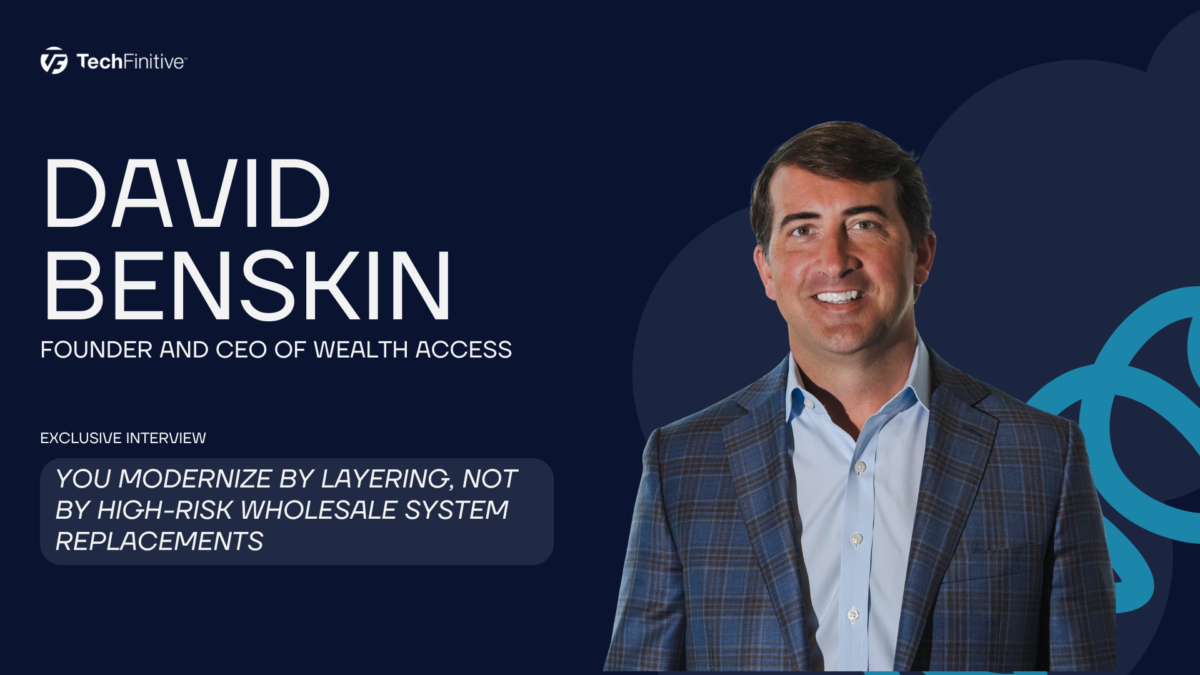
David Benskin, Founder and CEO of Wealth Access: “You modernize by layering, not by high-risk wholesale system replacements”

Artificial intelligence has quickly become the banking industry’s latest technology priority. Financial institutions are investing heavily in AI-powered assistants, automation and customer experiences, all with the promise of improving efficiency and delivering more personalised services. Yet beneath the excitement lies a more fundamental challenge: many banks still struggle to bring together the fragmented customer data that AI depends upon to produce reliable insights.
Years of digital transformation, acquisitions and the adoption of specialist fintech platforms have left many financial institutions with customer information spread across multiple disconnected systems. While each application may perform its own role effectively, the lack of a unified view of the customer continues to hinder decision-making, limit personalisation and make modernisation projects more complex than many organisations anticipated.
David Benskin understands this challenge from both sides. Before founding Wealth Access, he spent more than a decade as a financial advisor at Merrill Lynch, where he experienced first-hand how disconnected systems made it difficult to build a complete picture of client relationships. That experience led him to establish Wealth Access, a company focused on helping financial institutions unify fragmented data and unlock what it describes as “Connected Intelligence”.
In this interview with TechFinitive, Benskin explains why data integration remains one of banking’s biggest unresolved technology challenges, where AI is genuinely delivering value, why modernisation doesn’t have to mean replacing legacy systems, and how unified data is becoming a competitive advantage for financial institutions looking to grow in an increasingly digital world.
You spent more than a decade inside Merrill Lynch before founding Wealth Access. Looking back, what were the biggest technology challenges that banks consistently underestimated, and have those challenges fundamentally changed over the past decade?
The biggest challenge was integration. Banks consistently underestimated how hard it is to connect the disparate systems they already own. I lived this reality firsthand at Merrill Lynch. We had genuinely good technology, but from a client’s point of view, the experience was fragmented because none of those systems were connected underneath. I was managing around 50 families, and close to half of my week was spent manually assembling each client’s picture across custodians, statements, and spreadsheets.
The second thing they underestimated is that data is a strategic asset in its own right, not just a passive byproduct of whatever system produced it.
Have the challenges changed? The symptoms have gotten worse, not better. Over the past decade, banks have added more systems, not fewer – layering on cloud platforms, fintech point solutions, and unique tech stacks from M&A activity. Each new system was meant to solve a specific problem, but each one quietly deepened data fragmentation across the organization.
What hasn’t changed is the root cause. Most institutions still heavily invest in a new front-end experience while leaving the connective layer underneath completely broken. You simply can’t put a modern experience on top of disconnected data and expect to see the whole financial story.
Many financial institutions have invested heavily in digital transformation, yet data often remains fragmented across multiple systems. Why has creating a single, trusted view of customer data proved so difficult, and what are the biggest mistakes organisations continue to make?
It’s because every system in a bank was originally built to own its isolated version of the customer. The trust platform has its client record. Brokerage has another. Core banking has a third. Each one is internally consistent, yet none of them agree. Then you add M&A, and suddenly you have two or three of everything.
Generating a single, trusted view isn’t a data storage problem, which points to the first mistake organizations make. They assume that if they pour millions of data points into a data lake, operational clarity will emerge. It won’t. A data lake gives you all your fragmented data in one massive repository with still no agreement on who the client actually is. One of our bank clients tried that route first and accurately called it “the backwards approach.”
The second mistake is believing you have to rip and replace your infrastructure. You don’t need to tear out the legacy systems that keep the lights on. Instead, you need a governed overlay architecture that sits cleanly above them to unify and normalize data across the institution into a true universal client record.
The third mistake is treating data unification as purely technical. It’s deeply organizational. Leadership has to own the definition of “one client” across business lines that have spent years optimizing for themselves. Without that shared organizational alignment, every data transformation project stalls.
AI has become the latest priority for many financial services organisations. In your view, where is AI genuinely delivering value today, and where are banks falling victim to hype rather than solving real business problems?
My rule is simple: data foundation before AI, always. Your intelligence layer is only as good as the data you feed it. If your trust, brokerage, and banking systems don’t agree on who the client is, your AI will deliver fragmented answers to fragmented questions – just at a faster speed and with a false sense of confidence.
That’s where most of the market hype lives right now. Institutions are rushing to buy AI before they’ve done the unglamorous, foundational work of unifying their data. It’s the business equivalent of putting a brilliant analyst in a room filled with contradictory files and expecting a reliable answer.
Where AI is genuinely delivering value is much more practical and human-centered. It gives valuable time back to your teams. When I was an advisor, half my week was lost chasing down and assembling data instead of serving families. AI that seamlessly surfaces the next best action, automates routine workflows, and routes simple requests to self-serve frees your best people to focus on the deep, personalized conversations that require human judgment. In wealth and banking, the relationship is still the ultimate differentiator. AI’s real job is to make those humans faster and better informed, not to replace them.
The institutions winning with AI are the ones that did the data unification work first. When you see the whole story, you can truly serve the whole person.
Financial services is one of the most heavily regulated industries. How can organisations modernise legacy technology while maintaining security, compliance and customer trust, particularly when introducing AI into critical workflows?
You modernize by layering, not by high-risk wholesale system replacements. A unified data layer that sits above your existing systems represents a far lower risk and delivers a much faster time to value. You aren’t altering or disrupting the systems of record; you’re connecting them to unlock shared intelligence.
Compliance actually becomes an operational asset when you approach integration in this way. A single, governed data layer gives you control over access, lineage, and auditability that you can’t achieve when a single client exists across eight disconnected systems. Data fragmentation is an inherent compliance risk. Unified data connection is a powerful compliance asset.
When it comes to deploying AI in critical workflows, the golden rule is maintaining a “human in the loop” design. AI is incredible at surfacing deep insights, making smart recommendations, and preparing documentation. But in a fiduciary and regulated context, a human professional must always make the final decision. That distinct boundary protects the client, safeguards and the institution, and remains non-negotiable.
At the end of the day, customer trust is built on clarity and responsiveness. I saw it in the 2008 financial crisis, and we saw it again during the pandemic, when my wife was on the phone with small business clients trying to save their livelihoods. The financial institutions that can see their clients clearly, understand their full context, and move with agility are the ones that earn trust when it matters most. Modernization should always be designed in service of that human connection.
Banks have traditionally viewed data as a compliance requirement or reporting asset. Do you think that’s changing, and what distinguishes organisations that are successfully turning data into a competitive advantage from those that continue to struggle?
It’s changing rapidly, and the competitive gap between institutions that understand this and the ones that don’t is widening by the day.
For a long time, financial data lived under compliance and reporting. It was something you maintained because you had to. The institutions pulling ahead now are the ones that treat unified data as critical infrastructure for growth – the same way they would value physical branches or top-tier advisors. It’s an active revenue driver, not a cost center.
Look at the math: Most regional and community banks are sitting on massive wealth management opportunities right inside their existing retail databases that they literally cannot see. If you can increase wealth management penetration among your existing banking customers by just one or two percentage points, you can generate upwards of $20 million or more in non-deposit fee revenue for a mid-market institution. The opportunity is already inside the building; you simply can’t act on what you can’t see.
What fundamentally distinguishes the winners is that they measure the right thing. It’s easy to count siloed accounts. It’s much harder to measure whether you’re seeing each client as one whole person across every touchpoint they have with you. The institutions turning data into a true competitive advantage have stopped asking basic questions about the isolated ROI of date cleanup. Instead, they are embracing a unified client view as the foundation everything else is built on.
Looking ahead over the next three to five years, what technology shifts do you believe will have the greatest impact on banks and wealth management firms, and what should IT leaders be doing today to prepare?
Three major shifts are going to redefine the financial landscape.
First, AI will rapidly shift from an isolated IT experiment to an embedded organizational reality – but only at institutions that did the work of building a connected data foundation first. Everyone else will find themselves stuck running pilots that never scale.
Second, market consolidation is accelerating. With intense pressure on regional and community banks, data integration capabilities will become a core competency layer over the next five years. The forward-thinking institutions that treat their data layer as M&A-ready will absorb acquisitions in months instead of years. We’ve already seen this play out: when an acquiring bank and its target can effortlessly bridge their data pipelines, the integration is practically done before the deal closes.
Third, client expectations have officially caught up to consumer technology. The exact same people who trust you with their wealth are also shopping on Amazon and using frictionless modern apps. They expect the same level of simplicity, immediacy, and personalized insight from their financial institutions, and they will absolutely leave the ones that fail to deliver it.
My advice to IT and digital transformation leaders today is simple: Build the connective layer before you chase AI. Get your data house in order. Choose a flexible platform infrastructure that can seamlessly absorb whatever system or technology comes next, because another one always does. And push data ownership up to the enterprise level, out of the individual business lines.
The financial institutions that thrive over the next decade will be the ones that proactively connect their data, their people, and their purpose. That work starts now, not after the next acquisition.
About The Author

Ricardo Oliveira
NEXT UP


