Trending Topics

 Trending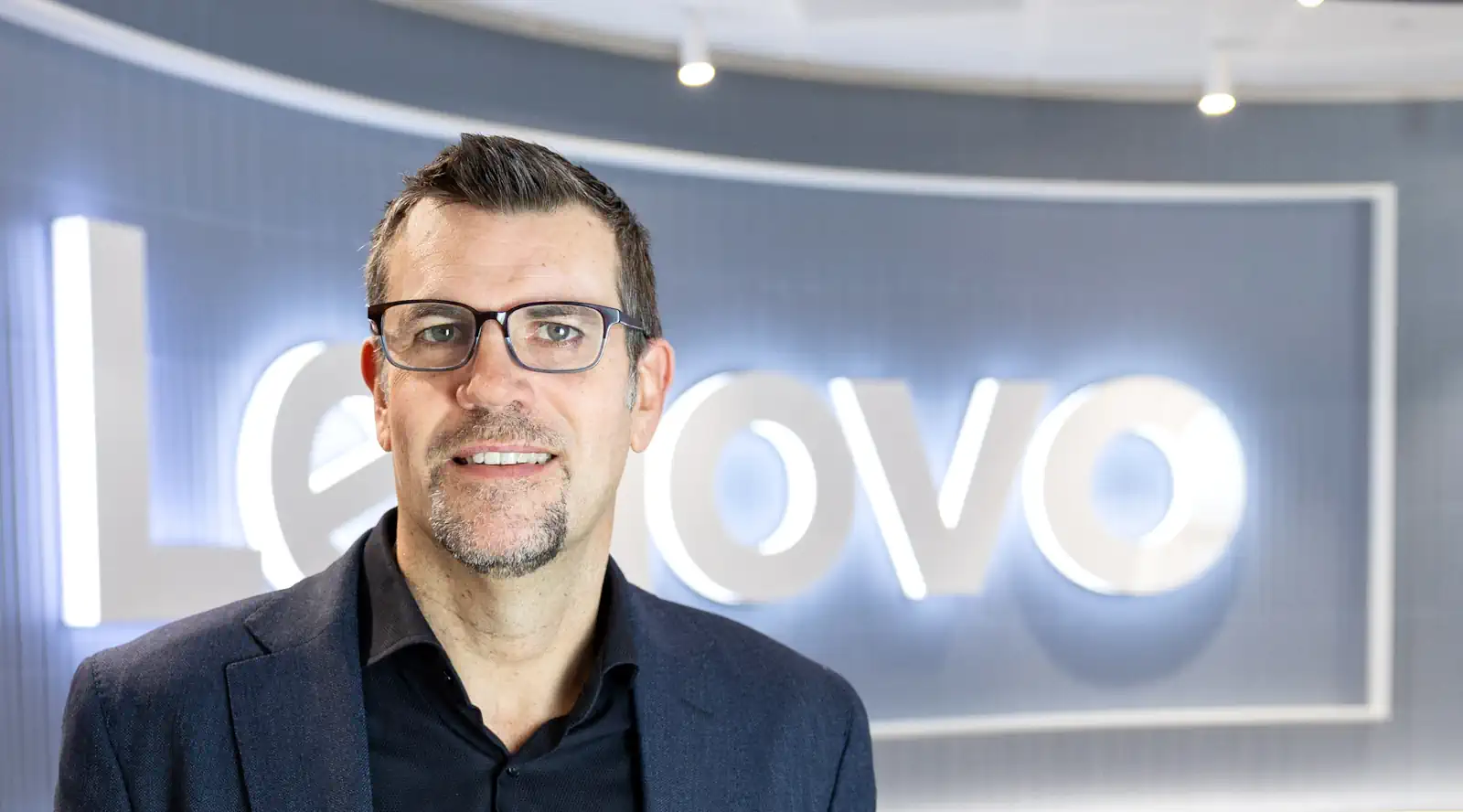
Interview with Andy Rhodes, Lenovo UK & Ireland MD: “Many customers don’t know the second-hand value of their assets…we’re really trying to help”

The strongest quarter in Lenovo’s history. Record-breaking revenues across the board. An even more successful World Cup campaign than Spain’s. No wonder the Managing Director for Lenovo UK & Ireland, Andy Rhodes, was looking chipper last Friday when we caught up over Teams.
“Not a bad time to come back,” he said, and while Andy was referring to the sunny weather those words could equally have applied to Lenovo’s sunny results. What a time to return to the UK, having spent two decades in the USA in senior roles at HP and Dell.
And it’s clear that Andy is a man on a mission. He’s even using Lenovo’s much heralded hybrid AI to help him achieve this.
Lenovo’s Qira: Part of the hybrid AI vision
I found this out by accident, as I was initially asking about Lenovo Qira. This is Lenovo’s local AI service launched with huge fanfare at CES Las Vegas in January this year. I had yet to see it appear in any Lenovo products, so I was a little sceptical that it had actually arrived.
“I use it on a day-to-day basis,” said Andy, explaining that he was using a Lenovo laptop that supported it. Others include the latest Intel-powered Yoga Pro 7i, Yoga Slim 7i Ultra and ThinkPad X1 Carbon Gen 14 laptops.
“When I came back to work for Lenovo, I really wanted to focus my time on five things,” he said. “Five things only. I wanted to spend time with customers, with our channel partners, developing my team, building our brand in the UK. And then you have to run the business, right?”
Each week, he shares his calendar with Qira and checks if he’s keeping to those five priorities. “I ask it, ‘Did I spend my time on those things? How much time did I spend on each of those elements?’ And it learns over time what is a customer visit, what is a channel organisation.”
Whilst he also uses Qira for simpler tasks – such as finding files on his drive – he sees this as just the start. “I’m looking forward to these other use cases coming out, and to be able to move from device to device [such as from Lenovo laptop to Motorola phone], which is very important for me given that I’m very, very mobile.”
Rise of local AI: A false dawn?
For Qira to work on your laptop, you need an AI PC. By which the industry generally means a laptop with a sufficiently powerful NPU (neural processing unit). Microsoft attempted to make this easier to understand with its Copilot+ PCs branding: if you buy a laptop with a Copilot+ PC sticker then you know it has a fast NPU.
But AI PCs, and Copilot+ PCs, have faced criticism as we await all the use cases that Andy alludes to above. While I didn’t put it quite so bluntly to Lenovo UK & Ireland’s MD, is this all a fuss about nothing? When are these use cases actually going to arrive?
“Many large corporates are developing their own local [AI] models where they do want to run them more and more on the PC,” Andy replied. He couldn’t give any examples, he said, because it would be breaching privacy agreements, but assured me that Lenovo is working with large customers on their development.
One driver for this is to keep private data away from the cloud, but there’s also the matter of “tokenomics”: the rising price of delegating AI tasks to frontier AI models where every interaction uses tokens. And tokens equal cash.
“We’re seeing more and more [organisations] today who are actually building out those models and running them locally on their devices [to save money]”, Andy said. “They understand that the days of free AI in the cloud, or the fact that frontier AI has all of the privacy and security issues that come along with it, especially in certain use cases like pharma and others. So they are building their models, and they’re pushing it down to the PC.”
This is probably a good time to reshare the video I took at Computex, where chipmaker Qualcomm demonstrated the difference in price for a project that relies solely on frontier AI versus one that delegates much of the work to the AI PC.
How to face unpredictable RAM prices part 1: Buy new, buy now
One theme from Lenovo’s results is how well the company is doing in all sectors. To my surprise, it even posted an 80% increase in sales of its tablets. “Given the price of PCs…. going back to tablets is a viable alternative,” explained Andy. “Tablets are very viable [laptop replacements], especially with keyboards and things like that.”
While that’s an option for consumers, commercial customers are sticking with laptops. Once again, this is a high-growth area for Lenovo, perhaps I suggested because the company – along with every other PC maker – was telling customers that RAM prices are going ever higher. Buy now, IT teams, or you’ll be paying an extra chunk on top next year.
“We are advising our customers that if they’re waiting for prices to come down, that’s not going to happen anytime soon,” said Andy. “The inflationary environment might continue. It might not be at the same steepness, but there will be an inflationary environment, especially on memory and maybe on CPUs over the next couple of years still.”
He even suggests that Lenovo may have suffered by being too transparent, too early. “I think we were the first to go out with that message because of the prowess of our supply chain,” he said. “We saw it early… and we immediately went to our customers and said, ‘Be prepared for this’. In fact, we took a little bit of a bloody nose on it at first because we were, in many cases, the first to go to our customers and tell them that. And they’re like, ‘Well, we’re not hearing that from others’. And then our competition caught up.”
How to face unpredictable RAM prices part 2: Know your assets, buy smart
Buying early isn’t an option that all organisations can choose, so what other advice does Lenovo have for IT buyers, I asked? Advice that hopefully doesn’t involve directors adding 20% to their budget.
“I think there are a lot of ways that customers can cope with this inflationary environment,” Andy replied. “One is asset recovery. Many customers don’t know the second-hand value of their infrastructure assets, whether it’s a PC or a server, and so we’re really trying to help recoup that.”
How might that work for a typical organisation? “It’s never one answer, and that’s why [we sit] down with a customer, understanding their whole fleet of devices and the personas of the employees.”
One option is to shift a laptop from one person to another. “We have software that enables the IT director to look across the devices, use data sources like Workday to map with job profiles, and then look at performance data and say, ‘We know that this job profile requires this type of device. These users don’t have it, and therefore are suffering.'”
While others do have a device but aren’t using its high-end features, he explained, so you can shuffle products between people.
The aspect of asset recovery is to turn that into money. An IT director may be refreshing “30% of my fleet on a three-year cycle, whatever it is, and now because of those inflationary devices, I can actually just sell back to Lenovo my old devices that have an economic value in the marketplace, whether that’s for harvesting parts or refurbishing.”
Another option is to move from “a CapEx to an OpEx environment”, Andy added. “So I think there isn’t one answer. There is a more consultative dialogue with the customer, and then exposing them to all the capabilities we have, not just in Lenovo, but through our partner network.”
It’s the circular economy, stupid
To steal and bend a phrase from Bill Clinton’s 1992 US presidential campaign, it’s no longer just about the economy. When it comes to facing rising costs, it’s the circular economy.
When it comes to commercial laptops, the circular economy begins with making products that are easy to repair and update. And then providing the parts. At the end of a laptop’s life, you must then be able to recycle it and ensure that valuable components and materials are easy to reclaim.
It’s an area of strength for Lenovo’s commercial wing, less so for its consumer-facing laptops (our sustainability expert, Lee Grant, runs a repair service and has lost a great deal of hair attempting to source spare parts IdeaPads). But here, let’s simply applaud Lenovo for its work with iFixit to make its ThinkPads more repairable.
Has there been much customer reaction to the more repairable designs, I asked? “There are customers that are absolutely choosing those devices over and above [others], and the sales are accelerating for them,” he said. “It’s not every customer, as always. Some say, ‘Oh, I like that’, and they still buy what they have [before]. But there is definitely a growing adoption.”
And what about spare parts? “That’s part of the planning of those products and how we deliver them to market,” said Andy. “That’s one of Lenovo’s key strengths in supply chain. On the Gartner Supply Chain Top 25, we [just] moved up from number eight to number five in the world.
“I think that’s a testament to how we get the right parts at the right place at the right time for the right customers. I actually believe that when you think about this repairability, serviceability, upgradeability element of more modular PCs going forward, you can’t even entertain that without that global supply network.”
With that, like a seven-year-old laptop, our time was up. And I still had roughly 20 questions left to ask, so don’t be surprised if you see another interview with Andy Rhodes, Lenovo UK & Ireland MD, later this year. There is a lot still to cover.
About The Author