Trending Topics

 Trending
Exclusive interview with Kira Boyko, Product Line Director, on Intel Clearwater Forest: “You’re going to see a 750 kilowatt reduction and then 3.5x performance”

Last week, Intel provided more technical information on both Panther Lake and Clearwater Forest – or Xeon 6+. During the event in Arizona, I stole 20 minutes with Kira Bokyo, the Product Line Director of E-core Xeon Products, to find out about Clearwater Forest in particular.
In this interview, we cover what drove the demand for the new line of Xeon 6+ processors, who they’re aimed at and the role of the 18A process. Plus the thorny topic of sustainability.
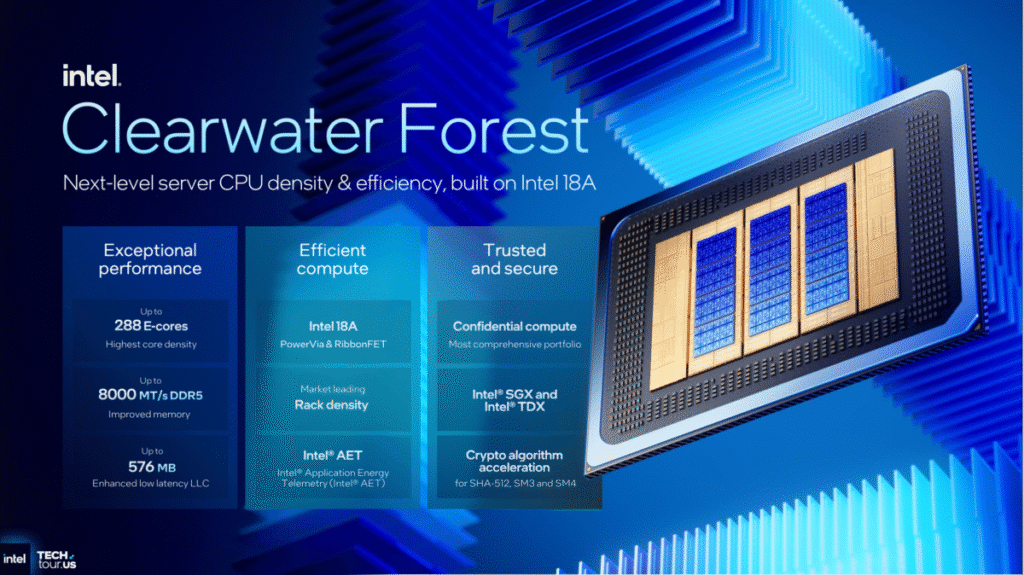
I cover Clearwater Forest in detail separately, but the TL;DR is that this chip is primarily for telcos who need high levels of compute but with an emphasis on efficiency. It will be called Intel Xeon 6+ and has twice the core density of the Intel Xeon 6 E-core parts: up to 288 cores in a single chip.
They’re being built on Intel’s all-new 18A process in an Arizona fab I visited shortly after interviewing Kira. As we spoke, on 30 September, early samples were making their ways to partners, with full rollout in first half of 2026.
Demand and supply: Intel Clearwater Forest
Intel is attempting to reinvent itself, with repeated mentions of “New Intel” during the presentations (there were also many patriotic calls about being made in the USA). One of New Intel’s themes is that it’s there to listen to customers, to create products that meet their demands. A point echoed by Kira Bokyo in her answer to my question about where the demand for Clearwater Forest came from.
“When we started building it, we first reached out to our customers and partners and said, what do you want? So OEMs [equipment makers such as HPE] and CSPs [cloud service providers] and 5G core telco networks,” said Bokyo.
They heard two requests in particular. “First, we want the highest performant product on the Xeon roadmap, which is a little bit irregular, because if you’re familiar with our E/P-core breakdown, usually P-core is the highest performance. So, okay, you want that out in E-core, sure. And then, on the efficient side, they still wanted to maintain the best performance per watt.”
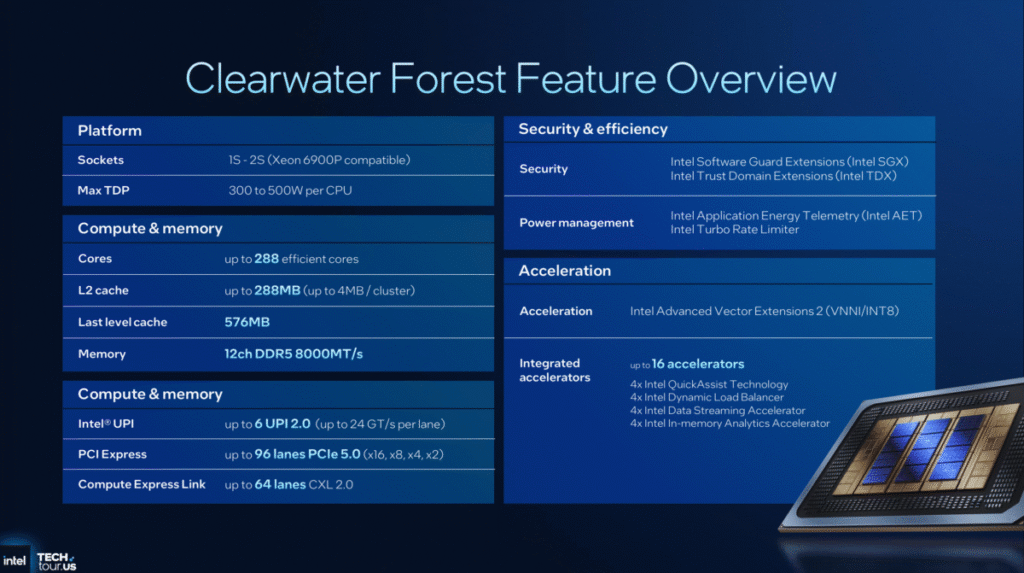
The other prime request came from OEM partners, such as Dell and HPE (not that these companies were named). “[They] really wanted to be socket compatible with the first release, so the 6900P series,” said Bokyo. “That is because they wanted to focus on getting time to market faster, having to do minimal validation.”
Based on these demands, Intel took the original Xeon 6 E-core design, which went up to 144 cores, and designed it for “socket compatibility with the top-of-stack P-core. And so with that, we got the 6+.”
Role of the Intel 18A process
As Xeon 6+ E-core, or Clearwater Forest, is the joint-first product being built on Intel’s much-improved 18A process, I was curious to know how the project came together.
“When we’re defining products, we look across all of our options on the table, whether it’s Intel, whether it’s external, we look at our cores, we look at which processes we can select from,” said Bokyo.
“It’s really a mix-and-match process to see when do our customers need this product to hit, and then where can we take the best from all of these to combine to create the best product in that timeframe?”
On this occasion, there was only one answer: Intel Foundry and its upcoming 18A processor. “For Clearwater Forest, we decided to have that be 100% Intel based on the timing and what could be delivered in that window.”
I tried to draw out whether this was a nerve-racking time with so much hanging on 18A delivering on time. “I think anytime you’re on a new process, it’s always very exciting to see what are you really going to get out of it, and when is the timing going to hit,” said Bokyo, in what I think we can agree is a skilfully diplomatic answer. “And we’ve been very happy with the relationship with Foundry and their ability to execute, and have been delighted with the process.”

Impact of Lip-Bu Tan, Intel’s new CEO, and the number of SKUs
Lip-Bu Tan only became CEO of Intel in March 2025, but I asked if he had any role or impact on the rollout of the Xeon 6+. “Not specifically for this product,” said Bokyo. “I would say that it falls under his strategy, as well as being very workload-centric from a development process. And that’s something you’ll see with E-core, since it’s focused on very specific markets.”
In particular, whereas some Xeon product lines have dozens of SKUs (that is, different versions of the same product, usually with different numbers of cores to hit different price points), that’s not the case with Xeon 6 E-core. Bokyo anticipates that the Xeon 6+ E-core will have a similar amount of variety as the first iteration, so with eight or nine different SKUs.
The big difference is that where the Xeon 6 E-core topped out at 144 cores, that will be the starting point for the Xeon 6+ E-cores. The top version will have 288 cores.
Intel’s claim of 8:1 consolidation
One of Intel’s big claims is that customers can replace eight five-year old servers based on Xeons with a single Xeon 6+ server. It sounded too good to be true, so I asked Kira Bokyo to talk me through it.
“So that’s an example of a customer who might have a data centre that’s built out with I believe 70 racks and 1,400 servers,” she began. A genuine customer, I asked? “No, it’s an example,” replied Bokyo, ” we don’t speak specifically on which customers.”
Back to the example. “That was Xeon or second generation Xeon. Usually we see five-to-seven-year refreshes, so that’s why we went with that timeframe. If [this customer] was going to consolidate onto Clearwater Forest, they could jump down to 20 racks and 180 servers.”
The customer could then build out the rest of their data centre with their chosen mix of more powerful servers, perhaps based on Xeon P-cores, to deal with intense, bursty tasks.
“The other important thing with consolidating down to Clearwater Forest is you’re going to see, I think it’s a 750 watt reduction, and then it’s 3.5x performance. So they’re going to be able to offer their customers more with less, so better TCO, and then build out to make more profits on other server demands.”
Who might do this? Bokyo pointed to “customers especially in the AI space who are interested in doing this, and they’re actually going to be running more storage on this reduced space”.

Sustainability vs energy efficiency
I ended the interview with a question about sustainability. This was a word that used to be writ large in presentations from big tech companies, but there has been a not-so-subtle switch to energy efficiency.
In particular, I pointed out that sustainability had barely been mentioned during Intel’s presentations, other than to talk about what it was doing to make its fab in Arizona as environmentally sound as possible.
“You probably heard it [sustainability] in the first day,” said Bokyo, “more so on the fab water sustainability process versus the actual products.” Absolutely, I agreed. But that’s not going to have a worldwide impact.
“To your point, that makes me think of the new feature that we’re actually releasing with Clearwater Forest, which is called Intel AET. It’s application energy telemetry, and we are kind of talking about it more from an efficiency perspective, but it is absolutely sustainability from the efficiency perspective as well where it’s going to allow our end customers to be able to follow a workload on a per-thread basis as it moves from core to core.”
That means the “the customer can then orchestrate where they want it to run for optimum energy efficiency, right? Which is absolutely going to have help with their TDP and just overall energy needs to reduce the impact and help with sustainability.”
Related articles
About The Author

Tim Danton
NEXT UP


