Trending Topics

 Trending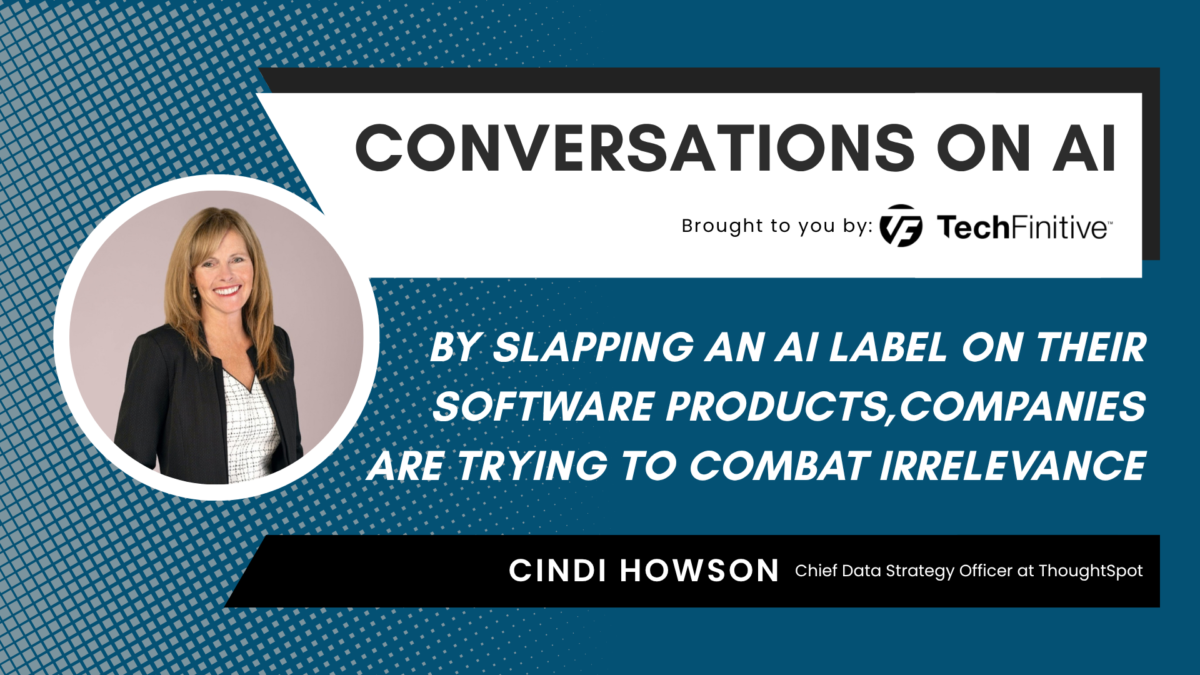
Cindi Howson, Chief Data Strategy Officer at ThoughtSpot: “By slapping an AI label on their software products, companies are trying to combat irrelevance”

Cindi Howson has quite the CV. Before becoming the Chief Data Strategy Officer at ThoughtSpot, she was a Gartner Research Vice President and Lead Author for the Analytics and BI Magic Quadrant, Critical Capabilities, Data for Good, and IT Score Maturity Assessments. If that isn’t enough, prior to Gartner she founded BI Scorecard and wrote a series of successful books.
Then we come on to everything Cindi does now. Top of the list is Chief Data Strategy Officer at ThoughtSpot, where she advises clients on how to become a data-driven podcast. If that’s not enough, she’s also the host of The Data and AI Chief podcast. All of which means we were delighted she had enough time to take part in our Conversations on AI interview series.
You won’t be surprised to discover that Cindi doesn’t hold back either. “By slapping an AI label on their software products, companies are trying to combat irrelevance but, in doing so, fail to recognise that a label doesn’t create value,” she told us. “Driving impact requires rethinking which tasks an AI agent can assume, where we still need humans in the loop.”
She later adds on the need to tell the difference between products that deliver “genuine enterprise value and those simply bolting on AI features”. And if there’s one running theme through our interview, it’s the importance of the business asset that underpins everything: data.
“[At] the core of what we do we’re empowering customers to leverage enterprise data in entirely new strategic ways,” Cindi explains. And, just in case any CFOs are reading this, ways that will also directly improve your bottom line.
But no matter what your job title, we recommend you read the full interview to reap the benefit of Cindi’s insights.
Everyone says AI is transforming software, but where do you believe the industry is still overestimating its impact and where it is underestimating it?
AI is transforming software and improving developer productivity. But the SaaSoalypse is overrated. AI allows companies to build solutions faster, but it does not remove the common issues of domain understanding, scale, and maintenance.
At the same time, companies are underestimating the extensive change management and upskilling needed across teams to reap the benefits of AI. Since modern agentic AI operates probabilistically and can take autonomous actions, adopting it represents a fundamental cultural and operational shift that requires team-wide collaboration not just IT and data teams. Organisations have an opportunity to reimagine entire workflows, but the majority are more comfortable using AI to automate existing processes.
The enterprise leaders who successfully scale AI beyond small pilots are those who recognize that technology alone is insufficient. Achieving sustainable value requires a balanced approach: investing heavily in a trusted data foundation with clear business semantics, while simultaneously upskilling their workforce, elevating leadership AI literacy, and transforming internal processes.
Many SaaS vendors now describe themselves as “AI-powered.” What actually separates companies creating real customer value from those simply adding AI features?
SaaS vendors describing themselves as “AI-powered” are trying to catch up to competitors that were early adopters of AI. By slapping an AI label on their software products, companies are trying to combat irrelevance but, in doing so, fail to recognize that a label doesn’t create value. Driving impact requires rethinking which tasks an AI agent can assume, where we still need humans in the loop. We have a generation of software solutions designed for humans, whereas now we are shifting to software designed for AI agents with human oversight. In order for AI agents to scale with trust, there needs to be guardrails and a context layer to ensure accuracy.
There is an existing gap between genuine enterprise value and those simply bolting on AI features. Many SaaS providers fall into the trap of shiny new demos that provide chatbots powered by probabilistic AI, creating more risk of hallucinations and lacking the necessary business context to be helpful to teams. Customers looking for the most ROI shouldn’t overlook the underlying data foundation. The real difference is found in the way models can translate raw data into deterministic knowledge and responses, allowing AI agents to operate in workflows safely and effectively.
Value-driven software doesn’t force users to learn complex prompts or sift through static dashboards. Rather, it embeds conversational intelligence directly into everyday decision-making, shifting teams from manual reporting churn to proactive, real-time business action.
What is the biggest misconception enterprise customers still have about adopting AI within business-critical software?
The biggest misconception enterprise customers still have when adopting AI into business-critical software is assuming that success is simply a model problem. The real challenge in moving from a demo to AI that can optimise workflows is context. Often leaders think that plugging a more sophisticated LLM in as quickly as possible will make AI magically understand their business-specific language.
Companies need a semantic layer and context layer that unites enterprise data and business definitions into well-rounded recommendations. If organisations don’t take control of their existing context gap, AI will continue to operate at half-capacity, struggling to meet demands in accuracy, security and real ROI.
How is AI changing the role of your customers? Are you replacing repetitive work, augmenting decision-making or fundamentally changing how people do their jobs?
AI is fundamentally changing how our customers do their jobs by shifting them from operational mechanics to strategic decision-making. Because our customer base spans across industries, the impact varies, but at the core of what we do we’re empowering customers to leverage enterprise data in entirely new strategic ways.
By connecting agentic and conversational AI directly to a company’s operations, there are both productivity improvements and hard business benefits such as revenue growth, fewer inventory stock outs, higher customer NPS [Net Promoter Score, an indication of customer loyalty and satisfaction]. This enables non-technical business leaders across departments to easily access critical metrics, analyse complex trends, get alerted to outliers and receive recommended actions, all using simple language.
By eliminating the manual friction of building extensive reports or waiting on data, teams can replace hours of repetitive analytical work, allowing them to focus on higher value problems.
This ultimately translates into long-term strategic execution, turning everyday data access into a continuous engine for business growth.
How do you balance innovation with responsible AI? Where do you draw the line between moving quickly and ensuring customers can trust the outputs?
Balancing rapid AI innovation with responsible deployment requires treating accountability, trust and transparency as foundational rather than as an afterthought. Without guardrails, AI deployments only create more work for teams that must verify and correct outputs. This is why speed isn’t the only goal, but it should complement trust and safety frameworks. At ThoughtSpot, our semantic and context layer helps us achieve levels of at least 95% accuracy which, paired with human feedback and oversight, can help organisations reach a new level of confidence in their tech. Every generated insight is explained in business terms with full transparency to the underlying SQL and steps in reasoning.
A more deterministic framework anchored by semantic and context layers is crucial to ensuring customer trust in outputs. A model’s output is only as good as the underlying context, making hallucinations an ongoing risk that needs proactive guardrails like feedback loops and team oversight. Ensuring that AI and its capabilities are trusted goes hand in hand with feeding the model context that can eventually be granted more and more autonomy.
If you could give one piece of advice to another SaaS executive planning their AI strategy today, what would it be?
For a SaaS executive formulating an AI strategy, my biggest piece of advice would be to first understand what is your moat. What is the one core problem you are trying to solve for which you have deep domain expertise and and build for that.
Executing an AI strategy can be complex, and many leaders underestimate the multiple phases it takes, including a focus on the technology as well as a focus on change management. Both of these are necessary to build a culture that embraces this new way of working along with its operational changes and supports its development.
More interviews
- Rafael Narezzi, CEO and Co-Founder of Centrii: “We need to grow the sector to meet energy demand, but that growth has to come with responsibility”
- Harry Nisbet, General Manager at Marketing Signals: “Shadow AI isn’t just a security issue, it’s a £64m cost problem”
- Dan Clarke, President of IntraEdge Products & Solutions: “More than anything today, AI is fundamentally changing the way we do business”
About The Author