Trending Topics

 Trending
Unit4 ERPx shows cloud ERP has moved from experiment to infrastructure

Five months after Unit4 disclosed its 100th Unit4 ERPx go-live, the milestone looks less like a vendor achievement and more like a market signal. The customers named, including the Elizabeth Glaser Pediatric AIDS Foundation, Dutch local authority Gemeente Delft and consultancy Epical, point to where cloud ERP is gaining traction fastest: organisations that run on people, projects, grants and public accountability, rather than products and inventory.
Why Unit4 ERPx matters now
The public sector has never lacked reasons to delay ERP modernisation. Legacy systems may be expensive and awkward, but they are familiar. Cloud migration, by contrast, raises hard questions around data sovereignty, integration, procurement risk and change fatigue.
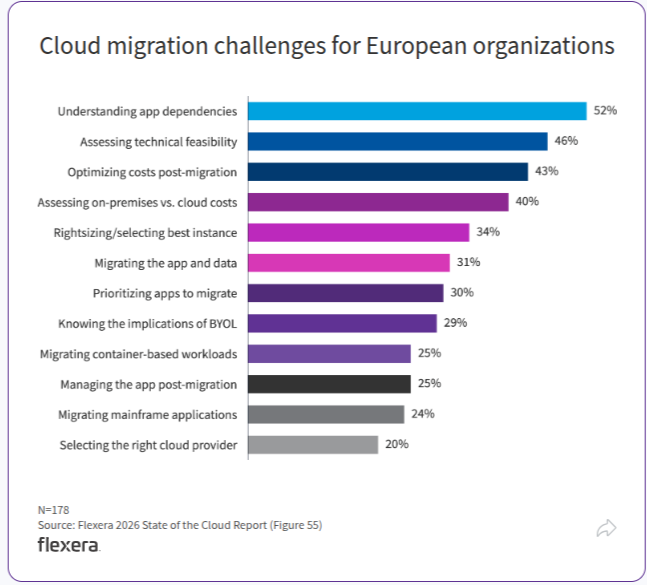
That makes Unit4’s timing more about migration maturity than market size. Flexera’s 2026 State of the Cloud Report, based on a survey of 753 cloud decision-makers and users, found that 73% of organisations now operate hybrid cloud estates. But in Europe, the main barrier is still execution risk: 52% of respondents cited understanding application dependencies as their top cloud migration challenge, followed by assessing technical feasibility at 46% and post-migration cost optimization at 43%. For public sector ERP teams, that maps neatly to the real anxieties around payroll, finance, grants and procurement integrations, systems where a rushed cutover can quickly become a service-delivery problem.
That helps explain why Unit4’s milestone still matters months later. As we noted in our analysis of Unit4’s €1B ambition, the company’s challenge is not simply selling cloud ERP. It is converting migration momentum into predictable, low-friction execution for public sector, non-profit and professional services customers.
The holdouts are waiting for proof, not promises
For many councils, universities and public agencies, the real question is no longer whether cloud ERP works. It is whether the migration can happen without derailing services, budgets or compliance obligations.
That is where Unit4’s wider activity becomes relevant. Alongside the ERPx milestone, the company said it delivered more than 20,000 hours of AI learning for employees and achieved C5 Type 1 attestation, adding another security and compliance signal for European buyers.
The timing also fits broader ERP trends. Our ERP predictions for 2026 highlighted AI, governance and public sector personalisation as key themes, while its interview with SAP’s Neil Gardner warned that ERP programmes can stall when results remain invisible for too long.
What public sector leaders should take from this
The practical takeaway is straightforward.
Cloud ERP is becoming operational infrastructure, not a transformation side project. But the winners will be the organisations that treat migration as a staged operating model shift, not a software swap.That means prioritising clean data, integration planning, security assurance and measurable service improvements. As seen in our coverage of large-scale SAP Cloud ERP transformation at PwC, scale is possible. The harder task is making cloud ERP feel manageable for institutions that cannot afford disruption.
About The Author

Kihara Kimachia
NEXT UP


