Trending Topics

 Trending
End of tax year 2026: How UK accountants are preparing for Making Tax Digital for Income Tax

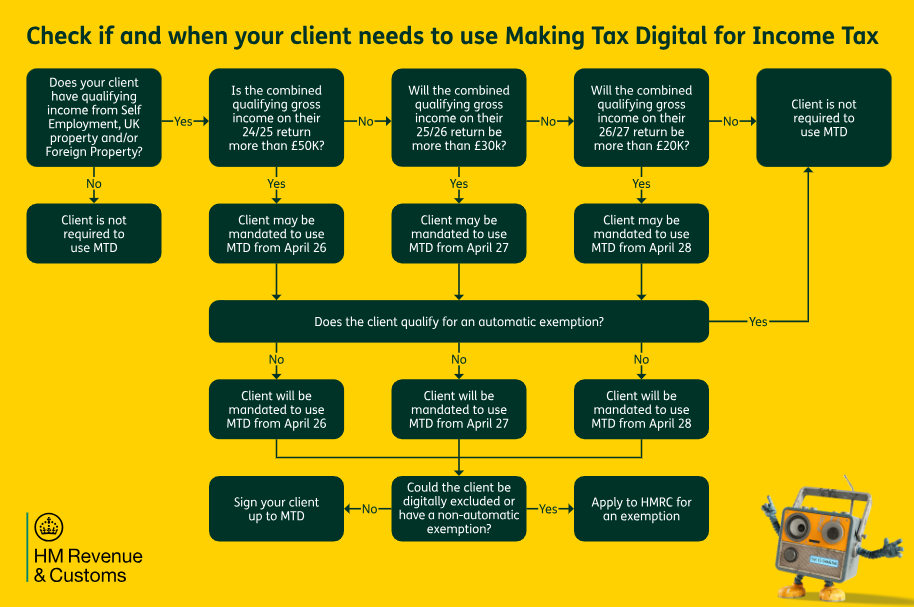
As the 2025/26 tax year closes, Making Tax Digital for Income Tax is moving from policy discussion to operational reality for UK accountants. From 6 April 2026, sole traders and landlords with qualifying income above £50,000 must keep digital records, send quarterly updates to HMRC and use compatible software rather than relying on a once-a-year Self Assessment rhythm.
HMRC expects around 780,000 to sign up from April 2026. A further 970,000 are due to follow from April 2027 when the threshold falls to £30,000. That makes this year-end more than a compliance checkpoint. It is the point where firms have to decide whether their clients, workflows and software stack are actually ready.
A compliance deadline that changes the accounting workflow
For accounting practices, the significance of MTD for Income Tax is not just the imminent arrival of another HMRC deadline. The whole underlying reporting model is changing.
To reiterate, that means affected taxpayers, or their agents, must:
- Use software to create, store and correct digital records of self-employment and property income and expenses
- Send quarterly updates
- Submit the tax return through compatible software by 31 January after the tax year ends.
HMRC will write to taxpayers it identifies as in scope, but it also makes clear that responsibility still sits with the taxpayer to check whether they need to join and be ready in time.
There is a small amount of breathing room, but not much. HMRC says taxpayers won’t receive penalty points for late quarterly updates during the first 12 months. However, late tax return penalties still apply.
In practice, that means firms do not get a free pass. They get a short transition window in which process discipline matters just as much as software selection.
Why accountants are starting with client triage
HMRC’s own agent toolkit points practices to a straightforward first step: review the 2024/25 tax return to identify clients with combined gross self-employment and property income above £50,000, because those are the clients who will enter the regime first on 6 April 2026.
But that initial filter is only the start. Firms also need to determine whether a client has multiple income sources – including separate self-employment, UK property income or foreign property income – because that affects how many quarterly submissions may be needed.
That is why the smartest firms are treating MTD preparation as a portfolio management exercise rather than a tax admin task. They are segmenting clients into groups:
- Digitally confident businesses already using cloud bookkeeping
- Clients who can survive with a spreadsheet-led setup and bridging software
- Clients who still operate on paper and will need far more support.
Software readiness is about flexibility, not ideology
One of the more useful realities in HMRC’s guidance is that there is no single approved operating model. Compatible software can be an all-in-one bookkeeping platform that creates digital records and handles submissions, or it can connect to existing records through bridging tools.
HMRC explicitly says businesses can use software that connects to spreadsheets or other accounting tools, as long as the overall setup can meet the digital record-keeping and submission requirements.
That matters because many firms won’t want to force every client onto a full cloud accounting platform overnight. Some will. Others will keep spreadsheets where they still make commercial sense, especially for simpler landlords or transitional clients, and use bridging software to remain compliant.
The point is not whether spreadsheets disappear in 2026. The point is whether the handoff between records and HMRC is digital, repeatable and audit-friendly.
This is also where vendors such as Sage enter the conversation. Sage is positioning its MTD tooling around digital record-keeping, bank feeds, receipt capture, tax summaries and quarterly submissions, while also pitching directly to accountants managing client compliance at scale.
For firms with a mixed client base, the attraction is less about marketing language and more about reducing friction between year-round bookkeeping and HMRC reporting.
The biggest challenge may be client behaviour
Technology, however, is only half the story. HMRC’s agent guidance says practices should assess each client’s digital capability and flags that MTD will be a major change for those with limited technical knowledge or paper-based records. That is likely to be the real bottleneck. Quarterly reporting isn’t just a filing requirement. It demands a new client habit: capturing records continuously rather than reconstructing them at year-end.
That shift could also create a more valuable role for accountants. HMRC argues that quarterly updates and in-year estimates should give businesses a clearer view of cash flow and tax liabilities throughout the year. If firms can get clients onto cleaner, more timely records, MTD could open the door to more advisory conversations around planning, budgeting and profitability rather than simply more compliance admin.
For now, though, the immediate task is simpler and harder at the same time: identify who is in scope, decide what software model fits, and get clients into a digital rhythm before 6 April 2026.
About The Author