There is no question that Enterprise AI has moved well beyond the experimentation phase. But where it has moved into the business is a harder question.
In a recent report titled “The Reckoning: Aptean’s 2026 State of AI in Business Report”, Aptean notes that while 98% of organisations are using or implementing AI, only 46% say the technology is integrated into, or is essential to, core workflows and decision-making. The remaining majority are still in the wide middle ground between an interesting pilot and a dependable operational capability.
This distinction is critical.
A company can deploy a chatbot, automate document summaries, or give employees an AI assistant and truthfully claim to be using AI. That does not mean AI is helping to plan production, improve forecast accuracy, detect inventory anomalies, or make better purchasing decisions.
The real work begins when the technology interfaces well with the systems that run the business.
The integration tax
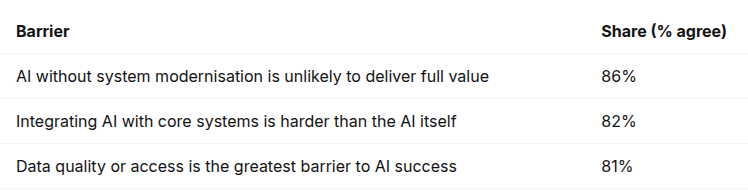
Aptean’s research found that 82% of respondents consider integrating AI with core business systems more difficult than the AI technology itself—meanwhile, 81% identified data quality or access as their biggest obstacle to successful implementation.
Those figures are not surprising.
Most organisations lack one clean, accessible store of operational data. They have ERP systems alongside CRM applications, spreadsheets, warehouse platforms, supplier portals, legacy databases and custom integrations built over many years. AI has a way of exposing those weaknesses quickly.
A general-purpose AI tool can produce a useful answer from a prompt. But it cannot reliably support a demand-planning decision without access to trusted sales history, inventory data, supplier lead times, and current production constraints.
The model is only part of the equation.
Why vertical AI has an advantage
Aptean’s study argues that industry-specific AI performs better because it is closer to the data, terminology, workflows and key performance indicators that define a particular business. Organisations using vertical AI outperformed those relying solely on general-purpose tools across seven of eight operational KPIs measured, according to the company.
However, there is an important qualification. Vertical AI is not a shortcut around poor data or fragmented systems. It may lower the integration burden, but it cannot eliminate it.
AI transformation is often presented as a choice of models, vendors and use cases. In practice, it is also about data cleanup, integration planning and defining processes well enough for automation to make sense.
None of that makes for a flashy product demonstration.
It is, however, what separates an AI pilot from an operational capability.
About The Author
Kihara Kimachia
Kihara Kimachia is a seasoned technology writer and journalist with more than 20 years of experience. He's a contributor at TechFinitive where he covers Enterprise technology and has written for publications such as TechRepublic, eSecurity Planet and The Epoch Times.
To provide the best experiences, we and our partners use technologies like cookies to store and/or access device information. Consenting to these technologies will allow us and our partners to process personal data such as browsing behavior or unique IDs on this site and show (non-) personalized ads. Not consenting or withdrawing consent, may adversely affect certain features and functions.
Click below to consent to the above or make granular choices. Your choices will be applied to this site only. You can change your settings at any time, including withdrawing your consent, by using the toggles on the Cookie Policy, or by clicking on the manage consent button at the bottom of the screen.
Functional
Always active
The technical storage or access is strictly necessary for the legitimate purpose of enabling the use of a specific service explicitly requested by the subscriber or user, or for the sole purpose of carrying out the transmission of a communication over an electronic communications network.
Preferences
The technical storage or access is necessary for the legitimate purpose of storing preferences that are not requested by the subscriber or user.
Statistics
The technical storage or access that is used exclusively for statistical purposes.The technical storage or access that is used exclusively for anonymous statistical purposes. Without a subpoena, voluntary compliance on the part of your Internet Service Provider, or additional records from a third party, information stored or retrieved for this purpose alone cannot usually be used to identify you.
Marketing
The technical storage or access is required to create user profiles to send advertising, or to track the user on a website or across several websites for similar marketing purposes.
To provide the best experiences, we use technologies like cookies to store and/or access device information. Consenting to these technologies will allow us to process data such as browsing behaviour or unique IDs on this site. Not consenting or withdrawing consent, may adversely affect certain features and functions.
Functional
Always active
The technical storage or access is strictly necessary for the legitimate purpose of enabling the use of a specific service explicitly requested by the subscriber or user, or for the sole purpose of carrying out the transmission of a communication over an electronic communications network.
Preferences
The technical storage or access is necessary for the legitimate purpose of storing preferences that are not requested by the subscriber or user.
Statistics
The technical storage or access that is used exclusively for statistical purposes.The technical storage or access that is used exclusively for anonymous statistical purposes. Without a subpoena, voluntary compliance on the part of your Internet Service Provider, or additional records from a third party, information stored or retrieved for this purpose alone cannot usually be used to identify you.
Marketing
The technical storage or access is required to create user profiles to send advertising, or to track the user on a website or across several websites for similar marketing purposes.

 Trending