Trending Topics

 Trending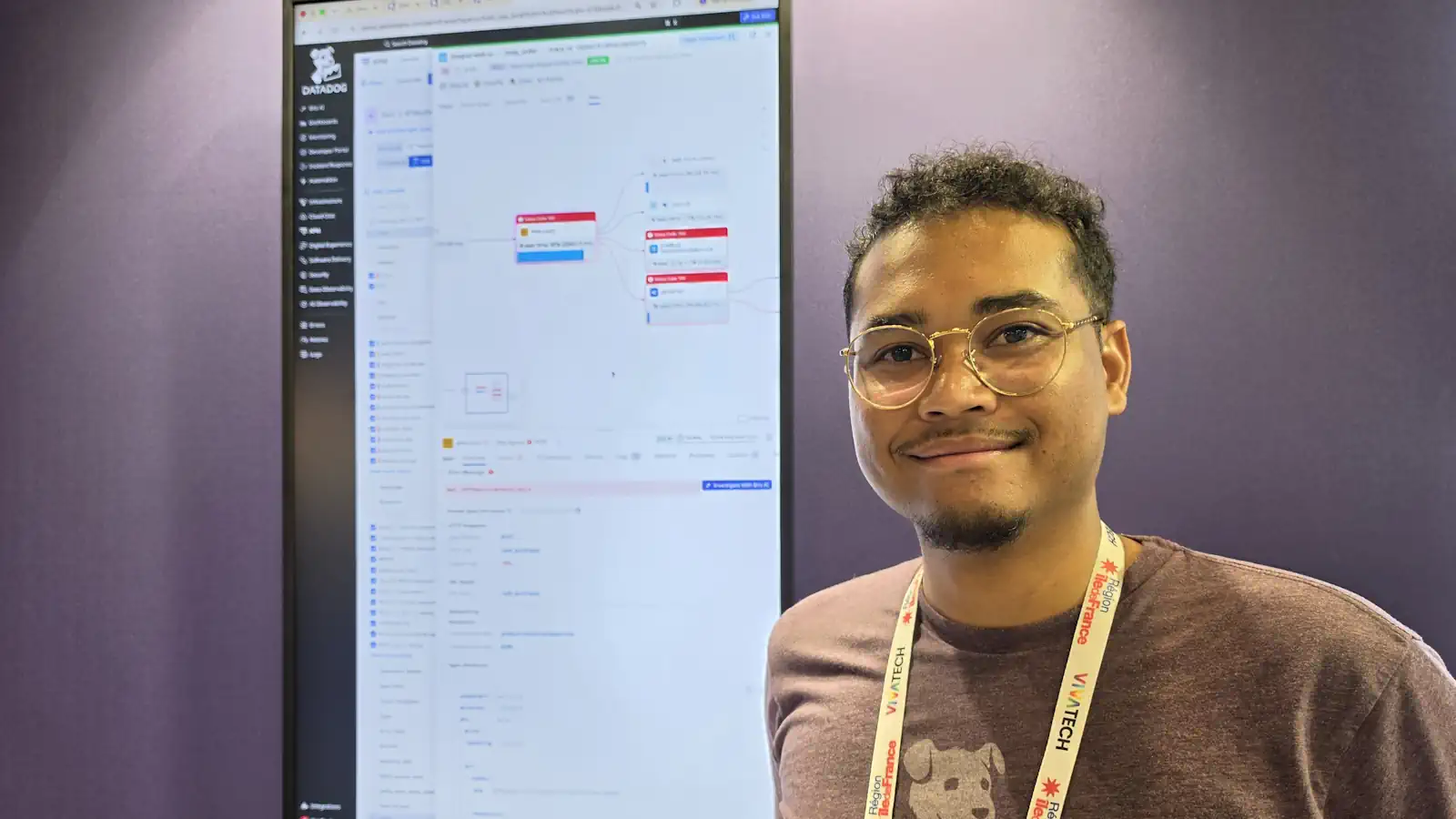
How Datadog aims to unite your dataset silos

What do you do if your CEO and CTO are arguing over data? Call in Datadog. That’s the message we heard from the company’s Raphaël Jaurès at VivaTech 2026, who started our discussion by explaining the root problem Datadog is trying to solve.
“More often than not, companies will work in silos,” said Raphaël. “You will have the operation team working in their silos, the technology team working in their silos, the security team working in their silos, marketing as well working in their silos on different datasets.”
This the problem Datadog aims to solve through a unified platform that allows “every line of business to work in the same platform with the same dataset, so that they can make informed decisions”.
Example Datadog customer: SNCF
We asked Raphaël for a good example of a customer who had solved real-world problems using Datadog, and he immediately turned to the French railway operator SNCF. (Click here for the full case study.)
“They were using 11 different tools to monitor their website, to monitor the health of their machines, to monitor the health of basically every piece of infrastructure they own,” he said.
“So that is the servers, that is the web app you use to book your train tickets, for instance. And they replaced all those 11 tools with just one tool, Datadog, which they use to monitor everything. This makes [SNCF] much, much more efficient, because it’s a unified data platform, and a managed platform as well.”
Website monitoring
Raphael wouldn’t be drawn on which exact tools had been replaced, but mentioned that one broader example would be the various website monitoring tools.
“You can have a tool dedicated to the demographic analysis, to understand how your users are using your website. You then have another tool to do search optimisation. Then you will have another tool to connect your logs, and another to monitor all the health of your machines – and you have another tool to do security.”
With Datadog, he explained, that reduces to just one tool. But it also makes it simpler to measure the impact of a deployment that a developer is working on; because you can jump easily from one source of telemetry to another, it makes it easier to predict the impact of that deployment.
“We can measure the impact across the databases,” said Raphaëk. “For instance, is the new code change making a x percent of increase in the latency in launching the website. You get all of that information on the same platform.”
Datadog’s roots
As is so often the case, Datadog came about because its founders were struggling with a problem and couldn’t find a tool to solve it. So they decided to create it themselves.
“Datadog is an American company, but founded by two French people,” said Raphaël. Those two people being Olivier Pomel and Alexis Lê-Quôc, now CEO and CTO respectively.
“It was founded 15 years ago, and we started small by being just an infrastructure platform,” he said. That was followed by “exponential growth and new projects every year.
“For instance, when I joined two years ago, we had 650 integrations, being able to pull telemetry from third parties like AWS, GCP [Google Cloud Platform], Alibaba Cloud, this kind of telemetry. Now we have more than 1,000 integrations.”
This reflects the changing markets Datadog’s customers operate in. “For instance, when OpenAI was created, our customers started to use it, so we started to create integrations to bring new tools. For instance, so that they can monitor the LLMs.
“Security also became a big topic a few years ago. So we started doing new security projects, because all the major security tools you have on the market, they rely on the same source of telemetry which our customers already have in Datadog.
“So basically, security is just adding a new layer on top of all the telemetry which is already in Datadog in the first place.”
How does a company know that it needs Datadog?
To finish, I asked about the warning signs companies should look for. The ones that tell them that they need a tool like Datadog.
“If you have two teams fighting each other over assessing the current state of business,” said Raphaël. “If one team is saying, ‘Hey, the website is down’, and the other team is saying ‘No, it’s fine’, that’s usually when there is discrepancy in the data source. So that’s where you should get a unified observability platform.”
This, he explains, goes back to why Datadog was created in the first place. “One [Datadog founder] was the COO, the other was the CTO. They were friends but their teams were constantly fighting each other, because the one team would say it’s fine and the other team would say it’s broken.
“So they realised at some point that they would need an observability platform to unify these sources of telemetry, and they also realised that they were not the only CTOs and CEOs fighting each other constantly. Every company has this kind of problem, so they figured out that they could market this solution, and that’s where Datadog came from.”
This article was updated on 3 July with the correct number of tools (11) that Datadog replaced for SNCF.
About The Author

Tim Danton
NEXT UP


