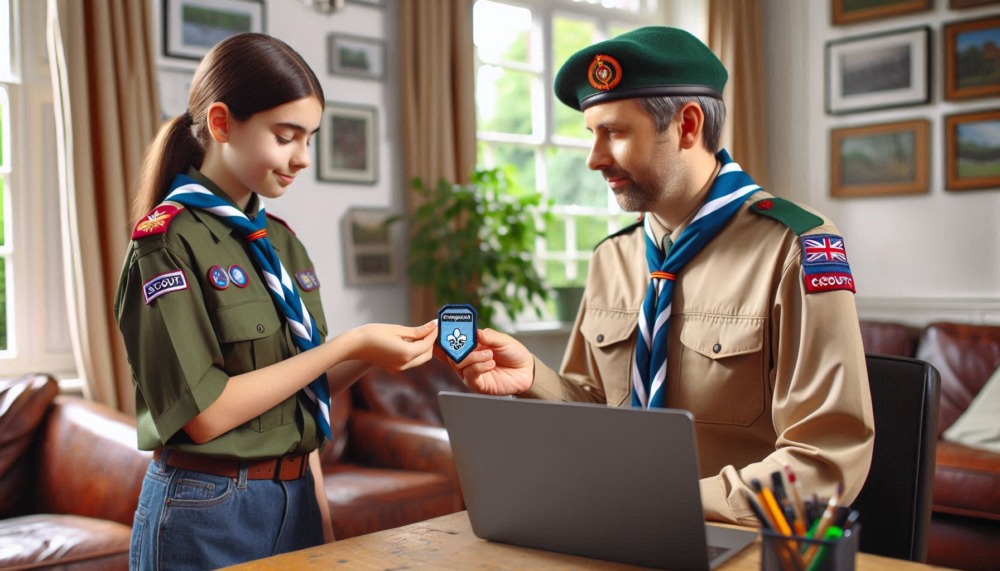
Education is vital to drive real change in how cybersecurity risk is understood and mitigated. The earlier age that education starts, the better. So, when I saw that the UK’s National Cyber Security Centre (NCSC) had created new Digital Citizen badges that can be awarded to Scouts between the ages of eight and 14, to say I was overjoyed would be an understatement.
These are exactly the kind of ages, the kind of young minds, that we need to get engaged with cybersecurity. And making it both fun and a challenge with a viable reward upon completion is the perfect way to engage them.
The Scouts motto is, famously, “Be Prepared”. However, head to the Scouts homepage and youโll discover that this is expanded as a mission statement to “preparing young people with skills for life”.
And if you head to Digital Citizen area in the Scouts site you’ll discover that this is no gimme.
Just some of the activities suggested to earn a Digital Citizen badge (image: Scouts website)
Scouts Digital Citizen badge
To earn the Digital Citizen badge, Scouts will need to develop four new skills, decided in partnership with the NCSC:
creating a strong password
spotting a phishing email
understanding the key principles of cybersecurity
understanding the importance of data backups
As Sarah Lyons, Deputy Director for Economy and Society at the NCSC, said: “By equipping Scouts with essential knowledge about online safety, we help ensure they can protect themselves against cyber threats and make informed choices in an increasingly digital society.”
This is not only vital in their personal and school life but beyond as they break into the world of work.
“In 2024, it’s just as important to know how to keep your data safe as it is to work in a team or navigate using a map,โ said Sally Milner, Scouts Partnership Manager. Although Iโd query the map navigation part if Iโm anything to go by; smartphones and satnav mean that Iโve long since forgotten more than I ever knew about longitude and latitude.
However, the point stands: cyber skills are transferable from the Scouts to the classroom to the working environment. The sooner we get the “stay secure” message across to our youth, the better the chances of them eventually helping to mitigate risk in the workplace.
โWe need to see more initiatives like this where children are taught from a young age about online safety,โ said Mark Robertson, CRO of Acumen Cyber. โJust like cycling proficiency exercises in school, children need to be proficient in the online world as well.
“I hope this initiative encourages more schools to replicate the efforts made by the Scouts.โ
With four decades of experience, Davey is one of the UK's most respected cybersecurity writers and a contributing editor to PC Pro magazine. He is also a senior contributor at Forbes. You can find him at TechFinitive covering all things cybersecurity.
To provide the best experiences, we and our partners use technologies like cookies to store and/or access device information. Consenting to these technologies will allow us and our partners to process personal data such as browsing behavior or unique IDs on this site and show (non-) personalized ads. Not consenting or withdrawing consent, may adversely affect certain features and functions.
Click below to consent to the above or make granular choices. Your choices will be applied to this site only. You can change your settings at any time, including withdrawing your consent, by using the toggles on the Cookie Policy, or by clicking on the manage consent button at the bottom of the screen.
Functional
Always active
The technical storage or access is strictly necessary for the legitimate purpose of enabling the use of a specific service explicitly requested by the subscriber or user, or for the sole purpose of carrying out the transmission of a communication over an electronic communications network.
Preferences
The technical storage or access is necessary for the legitimate purpose of storing preferences that are not requested by the subscriber or user.
Statistics
The technical storage or access that is used exclusively for statistical purposes.The technical storage or access that is used exclusively for anonymous statistical purposes. Without a subpoena, voluntary compliance on the part of your Internet Service Provider, or additional records from a third party, information stored or retrieved for this purpose alone cannot usually be used to identify you.
Marketing
The technical storage or access is required to create user profiles to send advertising, or to track the user on a website or across several websites for similar marketing purposes.
To provide the best experiences, we use technologies like cookies to store and/or access device information. Consenting to these technologies will allow us to process data such as browsing behaviour or unique IDs on this site. Not consenting or withdrawing consent, may adversely affect certain features and functions.
Functional
Always active
The technical storage or access is strictly necessary for the legitimate purpose of enabling the use of a specific service explicitly requested by the subscriber or user, or for the sole purpose of carrying out the transmission of a communication over an electronic communications network.
Preferences
The technical storage or access is necessary for the legitimate purpose of storing preferences that are not requested by the subscriber or user.
Statistics
The technical storage or access that is used exclusively for statistical purposes.The technical storage or access that is used exclusively for anonymous statistical purposes. Without a subpoena, voluntary compliance on the part of your Internet Service Provider, or additional records from a third party, information stored or retrieved for this purpose alone cannot usually be used to identify you.
Marketing
The technical storage or access is required to create user profiles to send advertising, or to track the user on a website or across several websites for similar marketing purposes.