Trending Topics

 Trending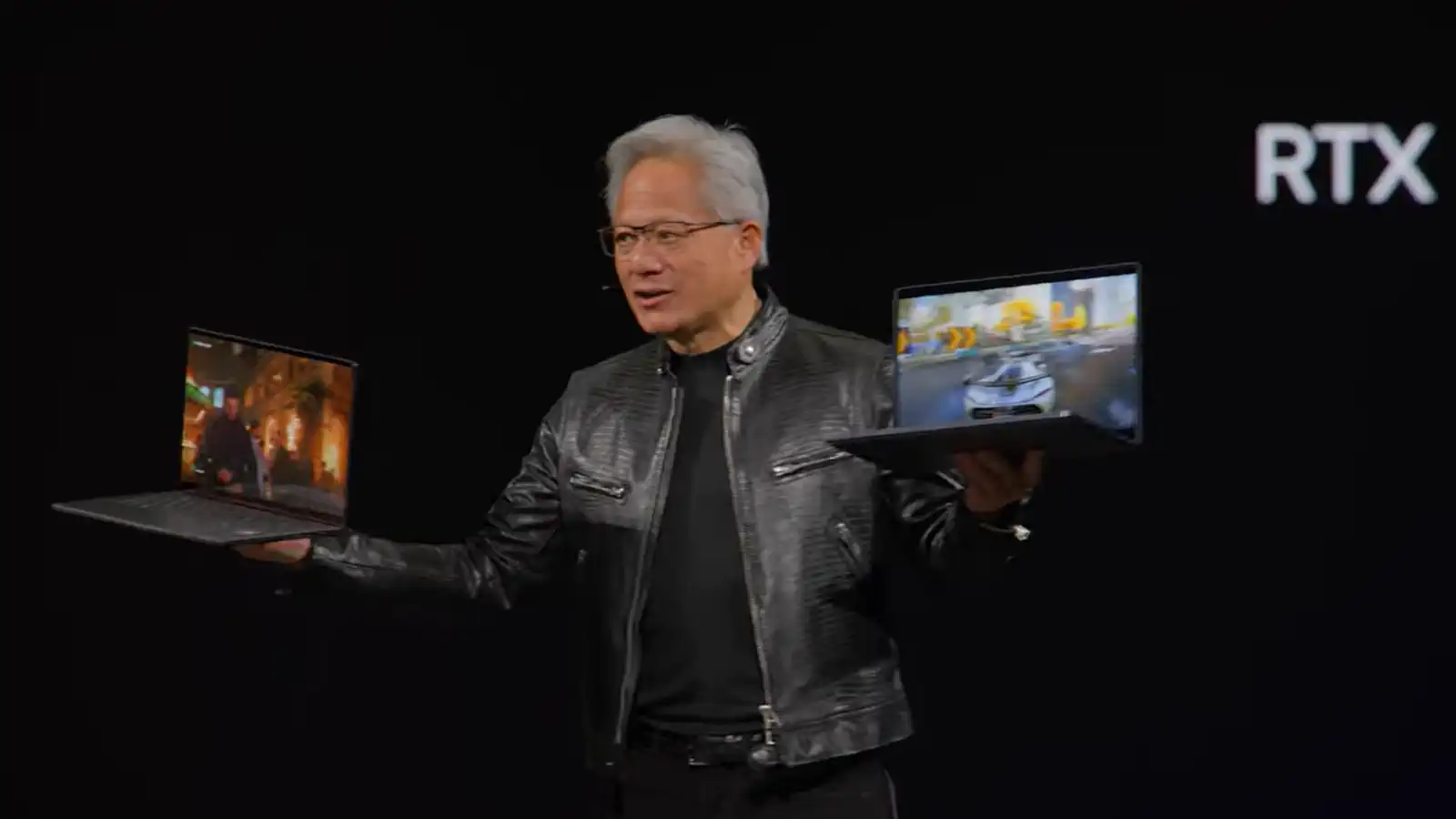
3 things businesses need to know from Nvidia’s Computex 2026 keynote

Nvidia CEO Jensen Huang kicked off Computex 2026 with a sonic boom of a bang this morning by claiming that it is going to reinvent the PC in exactly the same way that Apple reinvented the phone.
“Remember, 15, 20 years ago, we used to have an idea called a phone,” said Huang during the two-hour keynote speech. “Today, when you think about your phone, the one thing you don’t do with it is make phone calls. You do just about everything else. So that phone means something very different to you than a phone of the past.
“I am certain that what is going to happen here is that the PC ten years from now, and the PC you think about today… is going to be completely different,” he said. “Here’s my theory. [Just as] many houses have home theatres, lawnmowers, dishwashers, I can totally imagine that someday there’s an AI supercomputer in your house.”
Naturally, an AI supercomputer that will be running on Nvidia silicon. It’s no coincidence that Huang also announced RTX Spark, an AI-focused chip that will run Windows. More of that later in this article.
Huang’s vision is that rather than our current idea of a PC that you sit in front of, clicking and typing, in this future world the PC will be “running all of your agents, it’s running all of your assistants, and it’s doing all kinds of things for you all the time”.
But that’s the future, one that sets the direction of travel for Nvidia and perhaps the entire PC industry. Against that backdrop, here’s a run-through of five immediate announcements that we think businesses, enterprises and large organisations should take note of.
AI supercomputer on every enterprise desk

While Huang’s vision of an AI supercomputer in every house seems a little distant, it has already announced an AI supercomputer for every desk in an enterprise. This echoes Bill Gates’ successful prediction, made in 1993, of a computer in every home.
The enterprise AI supercomputer in question is the Nvidia DGX Station for Windows. Based on the Nvidia GB300 Grace Blackwell Ultra Desktop Superchip (Nvidia is not afraid of superlatives) it can pack up to 748GB of memory and provides up to 20 petaflops of FP4 performance.
You can also pair it with Nvidia’s professional workstation GPUs to create a compelling graphics and AI workstation.
“As enterprises scale AI agents across their organisations, they need AI infrastructure that can connect directly to the applications and workflows that power their business,” said Chris Marriott, VP of Enterprise Platforms at Nvidia. “DGX Station delivers supercomputing-class AI directly into Windows, where millions already design, engineer, research and create every day.”
Nvidia takes on AMD, Intel and Qualcomm with RTX Spark for Windows
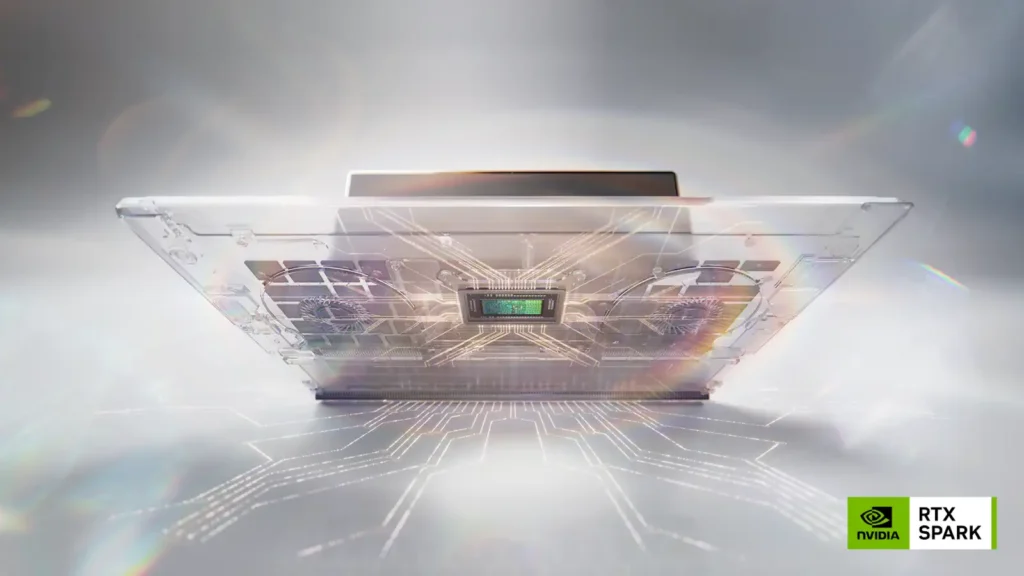
So that’s high-powered desktop workstations covered. Nvidia also announced RTX Spark for Windows, with the promise of laptops that can do it all. By that, it means that they can play games and run Windows applications just like any current laptop. But it will also be able to run local AI agents more smoothly, Nvidia claims, because everything developers currently need will be embedded onto the single RTX Spark chip.
They will come with up to 128GB of unified memory, with more RAM always welcome when running large language models. You’ll almost certainly need this much to meet these claims from Nvidia: “RTX Spark lets [users] render ultralarge 90GB+ 3D scenes, edit 12K 4:2:2 video, generate 4K AI videos [and] run 120B-parameter LLMs with up to 1 million tokens context using agents locally.”
Nor are gamers forgotten. When Huang held two laptops on stage, they were running the latest James Bond game and Forza Horizon 6 smoothly. Here, the RTX Spark’s 6,144 CUDA cores will certainly help.
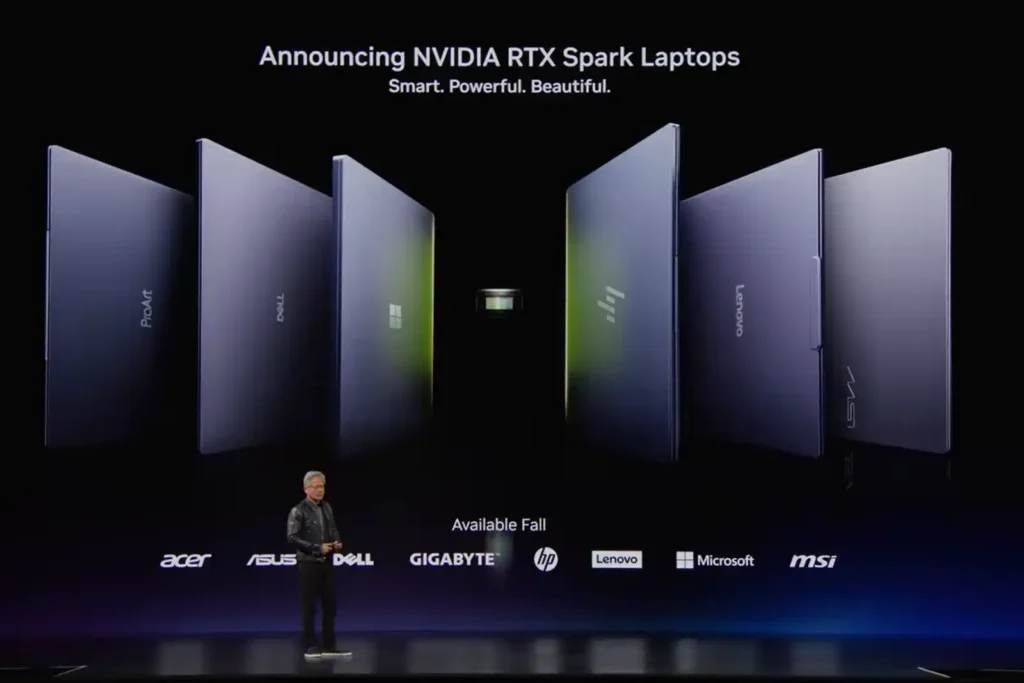
On-stage, Huang said that Nvidia RTX Spark laptops would be available this autumn. And it appears to have the backing of all the main laptop makers, with a backdrop showing (rather dull and grey) laptops from Asus, Dell, Microsoft, HP, Lenovo and MSI in the background.
More AI tokens thanks to Nvidia Vera, “the CPU for agents”
Finally, let’s talk about agentic AI. With all the noise about power consumption, Nvidia (and the whole industry) is keen to promote the idea of energy efficiency for all the AI that’s happening in huge data centres. At Computex 2026, that showed itself when Huang announced that Nvidia Vera CPUs were now in full production.
“AI agents will be the largest users of computing,” said Huang. “Vera is the first CPU designed for that future – built to run agentic AI at hyperscale with extraordinary performance, efficiency and programmability.”
In particular, Nviidia claims that Vera CPUs can complete tasks 80% faster than their x86 (from AMD and Intel) counterparts. And that means more tokens per watt, which means more profit for the companies running these huge compute resources.
“Oracle Cloud Infrastructure [OCI] is rapidly scaling AI infrastructure to meet surging demand for training, inference and agentic AI,” said Mahesh Thiagarajan, Executive Vice President of Oracle Cloud Infrastructure.
“By deploying Nvidia Vera CPUs, OCI will support high-throughput reasoning and data processing workloads across next-generation AI environments.”
Computex 2026: What’s happening
So that’s quite a start to Computex 2026, which doesn’t officially launch until tomorrow. TechFinitive is on the ground at the event to report back from the biggest news for business technology. Including this first-look review of the Acer TravelMate P6 14 AI (2026).
About The Author