Trending Topics

 Trending
Virtual reality brings advanced medical training to Uganda

A new partnership between a Welsh startup and the University of South Wales (USW) is bringing VR technology to Ugandan clinicians.
USW’s Centre of Excellence in Mobile and Emerging Technologies (CEMET) and VR firm Goggleminds are building a VR simulation to help healthcare staff practise managing paediatric cases.
According to the CEO of Goggleminds, Azize Naji, the pair are hoping to create a VR training centre in sub-Saharan Africa, where access to healthcare staff in general can be incredibly limited. There are on average 0.2 physicians per 1,000 people in sub-Saharan Africa, compared to 4.3 in the European Union, according to the World Health Organization.
Uganda has seen several VR medical training projects in recent years.
Last year, a UK-Ugandan project gave Ugandan doctors and medical students training on general, obstetric and trauma surgery via VR, with the pilot finding “strong appetite” for the tech among surgical trainees.
Meanwhile, Uganda’s oldest seat of higher learning, Makerere University, has established a VR lab for training medical students and healthcare staff.
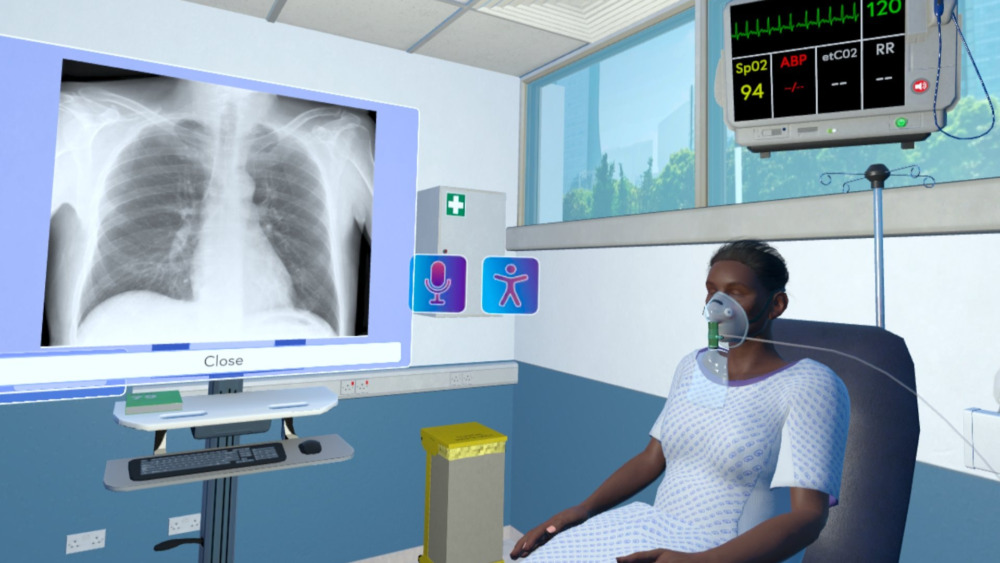
VR training for doctors and students
Virtual reality is increasingly being used to train doctors and medical students, providing medics with a way of practising their skills on digital patients.
For example, medical students can use VR to fine-tune their communication skills with simulated patients in virtual hospitals or GPs’ clinics, while doctors can learn new procedural skills or how to manage more complex cases in a controlled environment.
Goggleminds already offers VR airway training, allowing healthcare professionals to learn how to manage a blocked tracheostomy (where a tube is inserted into the front of the neck to create an artificial airway) and more general training on common medical emergencies for healthcare teams.
It also provides virtual clinical skills training for medical students, including managing wounds, catheterising and reviewing a patient’s charts, images and observations.
The medical training ‘metaverse’ market is expected to top $3 billion this year, according to Precedence Research, and grow to nearly $34 billion by 2034. The Middle East and Africa accounted for 2% of the market in 2023, the analysts said.
More news
About The Author

Jo Best
NEXT UP


