Trending Topics

 Trending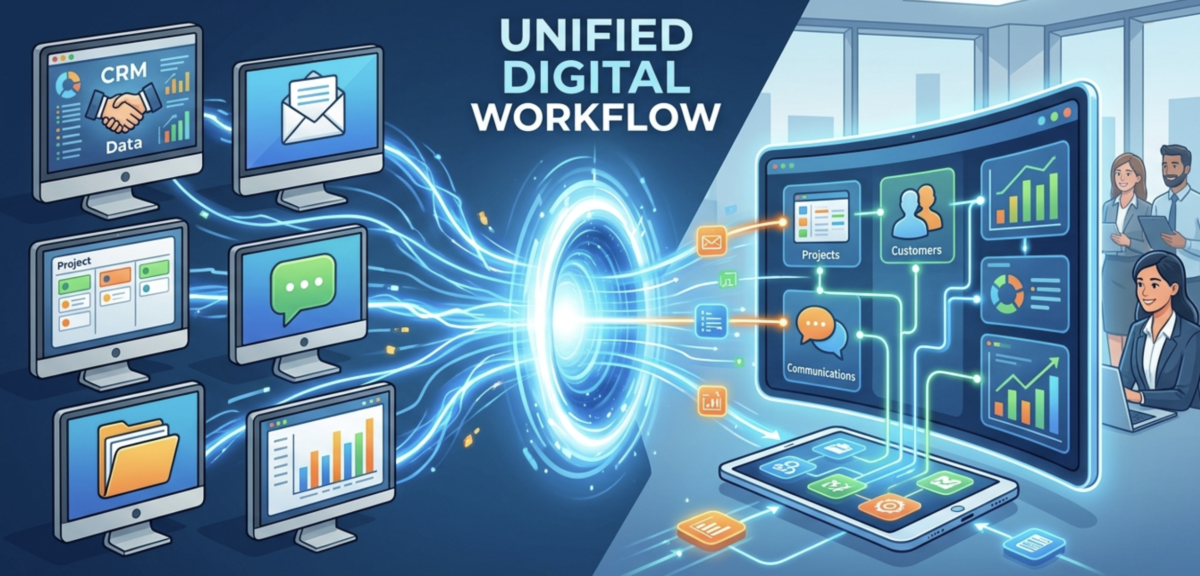
App-switching workflows are out, productivity is in

This article is part of our Opinions section, where we invite industry professionals to share their views on the most pressing technology questions of our time.
Modern enterprises run on an ever-expanding stack of tools: CRM systems, finance platforms, HR software, document repositories and collaboration apps. Each one promises efficiency. Each one solves a specific problem. Oftentimes, when these systems are blended together, new problems arise.
Workflows don’t just live in one place
Because of this, employees are forced to navigate multiple platforms to complete routine tasks, creating a fragmented, continually interrupted work experience. What looks efficient at the system level becomes inefficient at the workflow level.
Consider something as common as a contract approval process. It might begin in a CRM, move to email for internal review, get edited in a document tool, tracked in a spreadsheet, and ultimately stored in a repository. At each step, the user shifts context, reorients themselves and manually carries information forward.
On paper, it works. In practice, every step is friction-filled
Across enterprise environments, I’ve seen this pattern play out repeatedly. A sales team delays closing deals because the latest contract version is buried in an email thread. A finance team spends hours reconciling numbers across systems that should already be aligned. Operations teams build manual checkpoints just to ensure nothing gets lost between tools.
Individually, these moments feel small. At scale, they compound into a systemic drag on productivity.
The productivity toll: Why context matters
The real issue with app-switching isn’t just time but context.
Every time someone leaves one system to continue a workflow in another, they lose the full picture. They have to reconstruct it: What’s the latest version? Who owns the next step? Is this data current? Did anything change since the last update?
This constant context rebuilding slows decision-making and increases the likelihood of mistakes.
The impact becomes even more pronounced in document-heavy processes:
- Contract approvals stall due to version confusion or unclear ownership
- Claims processing slows when supporting documentation is incomplete or difficult to locate
- Financial reporting requires manual reconciliation across systems, increasing both effort and risk
Because of this, it’s common for teams to spend a fair amount of their contract cycles tracking down the correct version of a document. Not negotiating terms. Not reviewing risk. Just finding the right file.
Some organisations even risk failing compliance audits, not because processes weren’t followed, but because documentation was scattered across systems and couldn’t be easily verified.
These are natural outcomes of workflows that don’t have a single source of truth.
When context is fragmented, productivity suffers. When productivity suffers, so does reliability.
Embedding workflows directly in systems of record
To address these challenges, enterprises are shifting toward a different model: embedding workflows directly within their systems of record, such as their CRM, ERP, or other core operational platforms.
Instead of moving information between tools, the work itself happens in the same environment as the data. This is a subtle shift, but it changes everything.
When workflows are embedded, there’s no need to manually transfer data between systems. Context is preserved at every step, users operate from a single, unified view, and processes become inherently more consistent.
The benefits are immediate and measurable:
- Reduced context-switching: Employees stay within one system to complete end-to-end workflows
- Fewer errors: Eliminating manual handoffs reduces duplication and inconsistencies
- Built-in auditability: Every action is automatically captured within the system
- Scalable standardisation: Processes can be replicated across teams without introducing variability
We’ve seen organisations reduce document turnaround times by more than 50% simply by eliminating the need to move between systems. Not by working faster, but by removing unnecessary steps.
This is where automation begins to deliver its full value, not as a layer on top of fragmented processes, but as a core part of a unified workflow.
Operational benefits beyond productivity
While productivity gains are the most visible outcome, the broader impact of embedded workflows is operational.
- Consistency improves. When workflows are standardised and executed within a controlled environment, there’s less room for variation. Teams follow the same processes, regardless of geography or function. This is especially critical in regulated industries, where deviations can introduce risk.
- Auditability strengthens. Every action, approval, signatures is captured automatically. Organisations no longer need to piece together records from multiple systems. Instead, they have a complete, traceable history of how work was performed.
- Scalability becomes achievable. As organisations grow, complexity typically grows with them. But standardised, embedded workflows allow companies to scale without adding operational overhead. New employees can be onboarded faster. New processes can be introduced without reinventing the wheel.
In short, embedding workflows doesn’t just make work faster but more reliable.
AI’s role without adding complexity
AI has enormous potential to improve enterprise workflows. But how it’s implemented matters.
Too often, organisations introduce AI as a separate layer: another tool, another interface, another place where work happens. This approach adds to the very complexity they’re trying to reduce.
A more effective model is to embed AI directly within existing workflows.
In this context, AI becomes an enhancer, not a disruptor:
- Documents can be automatically classified as they enter the system
- Complex documents can be quickly summarised
- Workflows can route documents to key stakeholders based on content or priority
- Inconsistencies can be caught in real time, before they become issues
Because these capabilities operate within the workflow itself, they enhance productivity without introducing additional complexity or requiring employees to switch contexts.
The result is a quieter form of intelligence—one that improves outcomes without increasing cognitive load.
That’s the difference between AI that adds value and AI that adds noise.
Strategic takeaways for enterprise leaders
For enterprise leaders, improving productivity isn’t about adding more tools. It’s about designing better workflows.
Here are a few practical steps to get there:
- Map your highest-friction workflows. Start with processes that span multiple systems—contract management, onboarding, approvals, and reporting. Identify where handoffs occur and where delays or errors are most common.
- Consolidate around systems of record. Ask a simple question: Where does this data actually live? Then design workflows that execute within that system, rather than around it.
- Eliminate unnecessary handoffs. Every time work moves between systems, there’s a cost. Reduce those transitions wherever possible. If a step doesn’t need to happen in a separate tool, it shouldn’t.
- Standardise before you automate. Automation amplifies whatever process it’s applied to. Make sure your workflows are consistent and well-defined before layering in automation or AI.
- Embed AI where decisions happen. Instead of deploying standalone AI tools, integrate intelligence directly into workflows. Focus on improving decision-making, not creating new work destinations.
- Prioritise auditability and visibility. Design workflows so that every action is captured automatically. This not only supports compliance but also provides insights for continuous improvement.
- Measure outcomes, not activity. Track metrics like cycle time, error rates, and completion speed—not just usage. Productivity gains should be tangible and tied to business outcomes.
The organisations that get this right aren’t the ones with the most advanced tech stacks. They’re the ones that make their technology work together in a cohesive, intentional way.
Productivity without friction
The future of enterprise productivity isn’t defined by how many tools an organisation deploys. It’s defined by how effectively those tools work together.
When workflows are fragmented across systems, even the best technology struggles to deliver meaningful gains. But when workflows are embedded directly into systems of record, organisations can eliminate unnecessary friction.
The result is a fundamentally different way of working:
- Decisions happen faster
- Errors become less frequent
- Accountability is built in, not bolted on
Productivity, in this model, is no longer about doing more. It’s about removing what gets in the way.
When workflows are set up this way, scaling doesn’t come with the same level of friction. Change is easier to manage, and complexity is less likely to spiral.
At that stage, the focus shifts. It’s no longer about how many tools you have, but whether people can actually get their work done without jumping through hoops.
More articles by Anand Narasimhan
About The Author

Anand Narasimhan
NEXT UP


