Trending Topics

 Trending
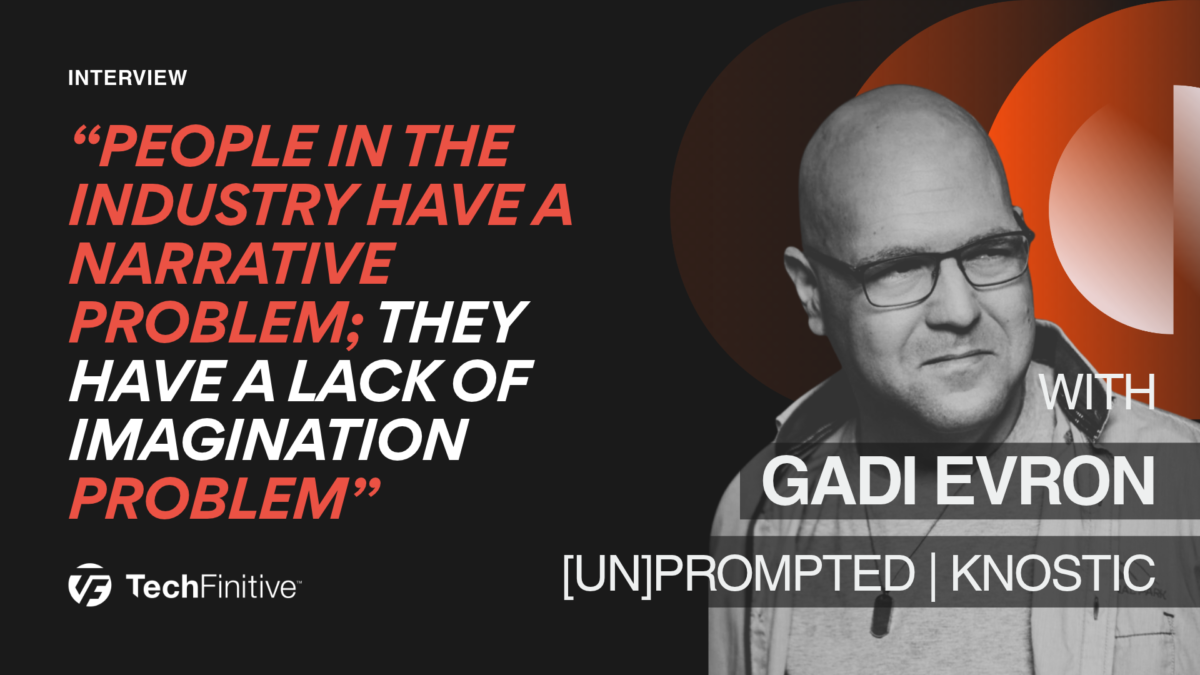
Gadi Evron: “People in the industry have a narrative problem; they have a lack of imagination problem”

As the [un]prompted AI security conference kicks off in San Francisco, Iain Thomson talks to its founder and why such information sharing has never been more vital
Gadi Evron started his life in security as a lead analyst in the Israel Defence Forces’ famed Unit 8200, doing signals intelligence and hacking. He then moved to managing the nation’s computer emergency response team (CERT), and was the Founding Chairman of the Cyber Threat Intelligence Alliance (CTIA).
He’s now in business on his own and launched many organisations, including his most recent – dubbed Knostic – which is focused on enterprise use of AI agents safely. He told us that he prefers working with smaller, tightly knit groups of security folks, but this year branched out into [un]prompted, because sometimes you need a lot of people to get together and share knowledge.
You’ve had over a quarter of a century in the security industry, but what is it that got you into the AI field now?
About a year and a half ago or so, I came out on LinkedIn with Heather Atkins, Google’s VP Security Engineering, and we were warning people that an AI apocalypse is going to happen. Not because we’re smarter than others in the field, but because we’re deeply into this.
And pretty much nobody believed it. One person said, “I don’t see it, but I trust these people, so I want to think about it.” Now, if you ask people, have vulnerabilities been democratised through LLMs, like through research? And they’ll say, “Yes, absolutely.”
“What about exploitation? They’ll say, well, yes, but we’ve seen what happened this week. But then you ask them, well, did you believe the vulnerability thing is happening?
We constantly have this thing about narratives that we just need to conquer. And as humans, it’s just so hard to constantly be in innovative mode, constantly challenge our assumptions and feel uncertain. It’s just we’re not built for that, and everything is moving very, very fast this year.
There have been some horrific headlines about agents going rogue. Some of them are overblown, but some of them definitely are not. What’s your take and are security folks getting the support they need from CISOs and management?
It really depends on the company. You can see that boards get it now. They are asking about agent security, right? At the same time, people who sit on boards are not stupid people. They are pretty well informed. What breaks the barrier from practice to the board level is the New York Times and CNN and so on and so forth.
And the first time that happened was with Mythos. Yeah, it’s not that people didn’t discover vulnerabilities with LLMs before that, but Mythos broke that barrier. And the second time was Hugging Face.
I think Hugging Face was truly a wake-up call because people in the industry have a narrative problem; they have a lack of imagination problem, where we are trained ourselves for decades to be about: “Is it in my log? Have I seen it before? If not, it’s not real. It could be FUD or marketing people trying to sell to me?”
Whereas now with AI, we need to be trajector-oriented. We can’t afford to see it in our logs. So we got warned for the first time by Anthropic on November 25 that the tunnel attacks are happening. All of a sudden everybody is aware, but they’re still saying, “Well, that was the model that broke through. We haven’t seen it happen in two months.” Now we see it happening every day.
In March you organised the first [un]prompted. How did that come about and were people keen?
Honestly, a few things. Number one, it was time for a physical get-together. We needed a community.
We started originally by creating this online Zoom session. session. Yeah. People would go on weekly for five minutes and just show what they did. It could be a complete failure. It could be something useful for them at home. It could be something useful for the kids. Something useful to work with security. But they would just share, usually no slides, and people would just learn from each other.
And at some point, we noticed what we had. and everybody was talking the same language, and we felt a new community was forming somewhere between security and AI. At the same time, it seemed like the world was taken over by marketing. Nobody knows what’s real, what’s not real, and we really need to.
With the first con happened we’d thought only 200 people would be coming. That became 700 people, and three weeks before the con. People then became 700 people, and two weeks before the con, we actually moved to a different location, and then we had 800 more people registering. For this conference we’ll have 1,000 people on site, and another 800 attending virtually.
We have a lot of FOMO for not being on it; those who were on site, and it just turned out to be a huge success right at the right moment in time, where people come in and say it feels like they’re learning. People actually wanted to go into talks, they’re meeting friends, and they’re excited again. It almost feels like the early days of DefCon and Black Hat.
What do you think the impact of the agent revolution is going to be on employment within the security industry? Is it going to be downsizing, or people just going to have to learn new skills?
I don’t want to be a doomer. I think it’s a very boring choice, the most consequential and interesting era in history. I’m honestly a huge optimist, but I’m also a realist.
I understand a lot of people all around are going to lose their jobs or need to reskill, and then do it again. And that’s a really hard issue, which is bigger than security. It’s a societal issue, and I would have answers for it.
I do believe that the hacking world has always innovated and changed itself, no matter what happened. And we have an opportunity to help society as a whole, really, to make sure that people don’t become redundant when jobs potentially do.
I don’t know if we’ll lose our jobs, but they certainly will not look the same here. And more important than that, for right now, we don’t yet have technologies that are truly AI-native on the defensive side, like we’re doing on the attacker side. People are still our moat, and making sure people use agents and secure these agents still makes us faster.
More interviews by Iain Thomson
About The Author