Trending Topics

 Trending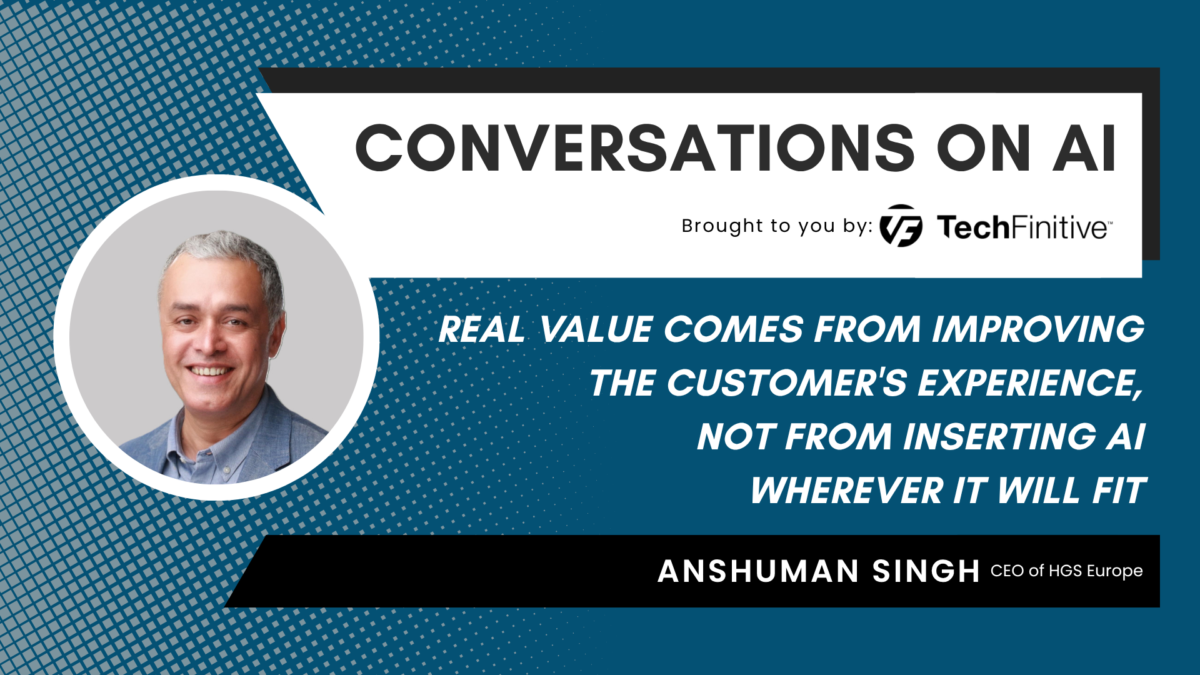
Anshuman Singh, CEO of HGS Europe: “Real value comes from improving the customer’s experience, not from inserting AI wherever it will fit”

Anshuman Singh has spent over 25 years helping businesses navigate the challenges that come with technological advancements. With experience spanning customer service, data and cloud, he knows how to face a wave of change head on: one where AI is beginning to influence not only how businesses are working, but what they are able to offer to the consumer. Today, as CEO of HGS Europe, that’s exactly what he’s focused on.
We’re delighted to welcome him as our seventh interviewee in our Conversations on AI series.
For Anshuman, one of the advantages of having spent so long in the tech industry is the ability to look beyond predictions. Instead, he’s focused on where genuine change is happening.
When it comes to AI, he believes there has been too much focus on speed over direction. While there has been plenty of talk about coding becoming automated, Anshuman argues that the disruption is “imaginary” in its timing. While the technology may be moving quickly, the evidence of its impact on productivity is far less cut and dry.
That gap between what AI can demonstrate versus what it can reliably deliver is something Anshuman is particularly interested in. He believes that the industry is underestimating the value of work that is less visible, but often more important to how businesses operate below the surface. “The firms quietly working,” he points out, “are compounding their advantage while everyone else builds another demo.” While the technology may be impressive, the surrounding systems need time to catch up before it can be said to have true benefit.
That practical approach also shapes much of Anshuman’s view of responsible AI. He believes that the right balance between innovation and caution depends on how much an organisation can afford to get wrong. In his own words: “‘move fast and break things’ is a rational strategy when you are small and nobody knows your name. Once you are an established brand, the same behaviour has a different cost, because the thing you break is trust that took decades to build.”
So, how much can AI be said to be truly changing the world of software? We decided to dive straight in, asking Anshuman where the industry is overestimating the impact of AI, and where it is still missing the bigger picture.
Everyone says AI is transforming software, but where do you believe the industry is still overestimating its impact and where is it underestimating it?
The overestimation of AI transformation has almost entirely been about speed, not direction. Around a year ago, the consensus view was that coding would become largely automated and that entire layers of technology roles would simply cease to exist. Markets took that seriously. Analysts pointed out that application services make up somewhere between 40 and 70 percent of revenue at the large firms, so the arithmetic looked frightening. Yet, I find the disruption to be imaginary and instead question the timetable – and the evidence on the timetable is quite striking.
Research from MIT found that about 95 percent of pilots produced no measurable profit & loss impact. Even the coding story is murkier than the headlines suggest. A controlled trial with experienced open-source developers found that they took 19 percent longer with AI assistance, while believing afterwards that they had been 20 percent faster. The truth is we still don’t have a reliable public figure for the impact of AI on real engineering throughput. However, what we do have is a consistent, rather humbling gap between how fast people think they are and how fast they are in reality. The reason the timetable slips is never the model. It’s the unglamorous part of the stack; data foundations and legacy systems.
My favourite example is airline disruption management because it distinctly separates the easy problem from the hard one. AI can call a passenger, explain that their flight is cancelled, understand from tone and context whether they want a refund or a rebooking, and do it in eleven languages at three in the morning. That’s the easy part now. The hard part is writing the change back into a reservation system whose lineage runs to Sabre in the early 1960s – still built around transaction-processing conventions and command syntax from that era – wrapped in layer upon layer of newer interfaces. AI can speak beautifully, but it still needs context that only experienced agents can provide.
The same MIT work found the strongest returns were in back office and document-heavy functions – the sort of work that never appears in a keynote. Reconciliation, claims, exception handling, document classification, and knowledge retrieval are some of the core areas where AI is underestimated. The firms quietly working there are compounding their advantage while everyone else builds another demo.
What is the biggest misconception enterprise customers still have about adopting AI within business-critical software?
More often than not, the biggest misconception is that a working proof of concept means the problem is solved. Gartner expects more than 40 percent of agentic AI projects to be cancelled by the end of 2027, and the reasons they give are worth reading closely: escalating costs, unclear business value, and inadequate risk controls. None of those is primarily a model capability problem. A better model does not fix a project with no owner and no defined outcome. It only fails more eloquently.
Take customer service. Building a chatbot is now trivial. Building the guardrails is where the real job begins. In January 2024, a customer couldn’t get DPD’s chatbot to tell him where his parcel was, so he asked it to tell a joke, then to write a poem about how useless it was, then to swear at him. It did all three, with enthusiasm, and described its own employer as the worst delivery firm in the world. The post was seen well over a million times, DPD disabled the AI element that day, and my favourite detail is that he still hadn’t received his parcel.
The misconception is that AI is a product you buy. It is an operating capability users have to run: with a run cost, maintenance burden and named owner. Without those three things, users don’t have a capability; they have a demo with a customer-facing URL.
How do you balance innovation with responsible AI? Where do you draw the line between moving quickly and ensuring customers can trust the outputs?
How well an organisation is able to balance innovation with responsible AI comes down to both culture and to how much a given industry can afford to be wrong. For instance, ‘move fast and break things’ is a rational strategy when you are small and nobody knows your name. Once you are an established brand, the same behaviour has a different cost, because the thing you break is trust that took decades to build.
The comparison I often draw is OpenAI and Google. Both had access to formidable capability, and the underlying transformer research came out of Google in the first place. OpenAI was willing to accept the risk of releasing ChatGPT to the public. Google, with billions of users and a search franchise to protect, had far more to lose from a bad answer. The technology was not the differentiator. Organisational risk appetite was. With hindsight this looks like a clean bet, but at the time it was not.
Regulation shapes it too. The EU AI Act’s obligations are phasing in across this year and next, and several use cases we all treat as ordinary, credit decisioning and some HR screening among them, sit in the higher-risk categories. In healthcare and financial services, mistakes are not embarrassing, they are consequential. Getting a pizza order wrong costs you a pizza. Getting a prescription wrong is an entirely different issue.
This is why sensible organisations start where the blast radius is small. Automating the internal IT helpdesk is the classic first move: real volume, real savings, and the worst case is an irritated colleague rather than a regulator. From there, companies can use progressive autonomy. The AI handles the routine interaction, and the moment complexity, value or emotional risk rises, it hands over to a person. Every bank and airline you deal with already works this way, whether or not they describe it in those terms.
The useful reframing for a board is this: stop asking whether the model is good enough. Ask what the worst thing it can do is, multiply that by how often it could do it, and then decide how much autonomy you are comfortable granting. That is a question a risk committee can actually answer.
How is AI changing the role of your customers?
Augmentation has quietly become the mainstream case. McKinsey’s 2025 State of AI survey found that 88 percent of organisations report regular AI use in at least one business function. What I find more interesting is the new work being created, because it doesn’t look like the jobs anyone predicted.
Organisations are starting to appoint custodians of knowledge; people whose actual job is ensuring that what the AI reads is accurate, current and consistent. In fact, one of the more common patterns we observe now is AI serving as a blunt audit of organisations documentation. As a result, businesses are adapting, with trainers and quality specialists evolving into AI trainers who influence how models respond, what they focus on, and which issues they escalate. Roles aren’t disappearing so much as changing shape.
I will highlight one thing the industry is not discussing enough. If AI absorbs all the simple contacts, you have removed the ground on which new agents used to learn. People built judgement by handling a hundred easy cases before they met a hard one. Take the easy hundred away and you have a workforce facing only exceptions, with no apprenticeship behind them. Anyone automating the bottom of the pyramid needs a deliberate answer for how expertise gets built now, because the old answer has been quietly removed.
Beyond productivity gains, what business outcome are customers most excited about?
Looking ahead, I do expect AI to enable new business models, with early signs for this in proactive service: charging for outcomes rather than interactions, or productising a capability like disruption handling that used to be a cost centre.
However, today, most organisations are extracting more value from the operations they already have. AI is augmenting existing business models far more often than it is creating AI-native ones, and I’d be sceptical of anyone claiming otherwise about their own profit & loss.
Even where the conversation begins with compliance, audit or regulatory reporting, the benefit underpinning all of these is usually the same: doing it faster, with fewer people, and with a better evidence trail. That’s a perfectly respectable outcome. It just isn’t a new business model.
The returns are becoming real, albeit unevenly. Dun & Bradstreet found around 60 percent of organisations reporting at least some measurable return on investment (ROI). That is genuine progress against where we were eighteen months ago – but it also means a large group is still spending without a clear return to show for it.
What has been the hardest challenge in bringing AI capabilities into your products?
There are three main challenges enterprises face when bringing AI capabilities into products. The first is awareness. Many people still equate AI with chatbots and text generation. Yet, that’s one branch of a much broader family, and some of the highest-return work we do uses no generative model at all.
The second is the assumption that AI is the answer to every problem. Sometimes a deterministic workflow is not just sufficient; it is superior because it is testable, cheap, and behaves the same way every Tuesday. Gartner has a term for the market’s version of this problem: agent washing – the rebranding of existing chatbots and robotic process automation (RPA) as agentic. Their estimate was that of the thousands of vendors claiming agentic capability, only around 130 were building the real thing. There is a growing risk of using AI because it is fashionable rather than because it is necessary, with the invoice arriving either way.
The third is economics, and this is the one that surprises people who have been in enterprise software for twenty years. The FinOps Foundation’s 2026 survey, covering nearly 1,200 practitioners responsible for more than $83 billion of cloud spend, found 73 percent of organisations exceeded their AI cost projections. Uber gave several thousand engineers access to an AI coding tool in December, yet consumed its entire annual AI budget by April. These are not inherently careless organisations, but rather a reflection of the market.
Organisations must also remain wary of becoming dependent on a single provider. Today’s pricing reflects an extraordinarily competitive market where several vendors are buying share at a loss. As the market matures and investors want returns, those pricing dynamics will change. Build the abstraction layer now, while switching remains a design decision rather than a rewrite. Optionality is cheap to buy in advance and very expensive to buy later.
Many SaaS vendors now describe themselves as AI-powered. What separates companies creating real customer value from those simply adding AI features?
Real value comes from improving the customer’s experience, not from inserting AI wherever it will fit. Given the agent-washing numbers, a fair amount of what is currently labelled ‘AI-powered’ is a checkbox with good marketing behind it. There is a deeper error underneath it too. Businesses assume the goal is always faster, cheaper and frictionless. Often it is. But people are more interesting than an efficiency metric, and some friction is the product.
E-commerce went through a phase where everything was about reducing a purchase to three clicks. Excellent when you’re rebuying washing powder. Actively value-destroying when someone is browsing, discovering, enjoying themselves. Strip out all the exploration and shopping becomes a vending machine: efficient, forgettable, and impossible to build loyalty on.
The companies creating real value use AI to build a richer understanding of the customer and then act on it earlier. Consider airline disruption again. The old model is that your flight is cancelled, you find out from a departure board, you join a queue of four hundred people, and a contact centre absorbs the cost of everyone’s worst day. The new model is that the airline knows before you do, contacts you first, and arrives with two rebooking options already checked against your onward connection. Nobody in that story is impressed by the AI. They’re just less angry, which is a far more valuable outcome.
That’s the dividing line. The winners won’t be the companies with the longest list of AI features. They’ll be the ones where a customer’s life is measurably better and the AI is completely invisible. If your customers can tell you’ve deployed AI, there’s a reasonable chance you’ve done it for yourself rather than for them.
About The Author

Rowan Campbell
NEXT UP