Trending Topics

 Trending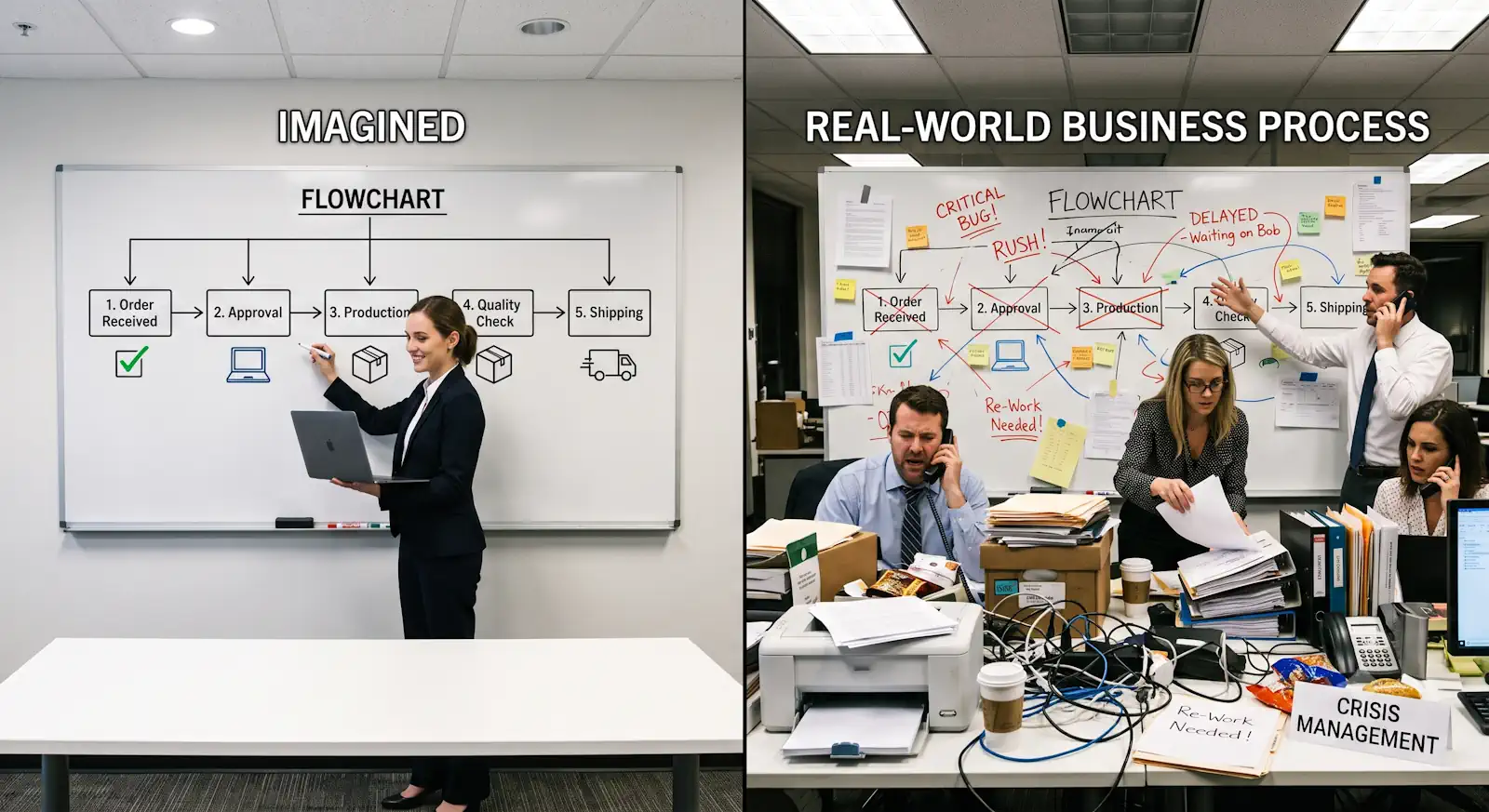
Process mining’s next job is to stop AI agents automating broken work

I attended university during the dotcom era. I still vividly remember a lecturer telling us during an information systems class, “garbage in, garbage out”. The idea being that any system is only as good as the information and logic that went into creating it.
When researching ARIS’s agentic AI strategy – we all have our hobbies – I kept coming back to that advice. Why? Because the enterprise rush to agentic AI rests on a flattering assumption: that the workflows we want to automate are worth automating.
Often, they are not.
Many contain plain garbage – bottlenecks, manual workarounds and exceptions that staff have learned to navigate over years. Handing such processes to an AI agent does not cure the dysfunction. It scales it at light speed!
The workflow is not the work
A workflow diagram, for example a purchase-to-pay, may look reassuringly tidy but reality is rarely so neat.
Approvals may routinely have to be done via email because the designated system is too slow. Maybe the finance team maintains a shadow spreadsheet to correct poor supplier data or perhaps a regional manager has an unofficial shortcut to keep customers happy but one that leaves an audit hole big enough for a lorry to drive through.
These are not peripheral glitches. This is often the process.
Handing this formal workflow to an AI agent does mean it will necessarily be able to distinguish between a valid exception and a bad habit. It may replicate the workaround faster, across more transactions and with a confidence that makes the result appear intentional.
That is not transformation, it is industrialised inefficiency.
Mine before automating
Process mining is imperative before automating anything. Rather than rely on workshops, interviews and static process maps, process mining uses system event data to reveal how work actually flows through ERP, CRM, supply chain and finance systems.
ARIS, a process intelligence platform, is positioning process intelligence as the foundation for agentic AI. The company is combining process models, task and process mining, and a “living” view of enterprise operations. Its object-centric approach also aims to show dependencies across functions such as sales, procurement, logistics and finance, as opposed to treating each department as an isolated workflow.
This gives leaders a chance to spot the recurring exception, approval bottleneck or manual correction before an AI agent turns it into a standard operating procedure.
Context before autonomy
To be clear, this is not just another governance issue. Governance would be concerned with issues such as whether the AI agent is allowed to act. Process intelligence confronts a far more uncomfortable reality: is this specific task even worth automating?
As I explored in a recent article discussing why agentic AI needs process intelligence to close the enterprise value gap, AI agents need a structured view of how work crosses departments. They also need to understand where the process breaks.
ARIS’s agentic AI push makes that proposition timely. Before companies deploy AI agents to accelerate operations, they should first establish whether the operation deserves to be accelerated.
Otherwise, garbage in will simply become garbage, faster.
About The Author