Trending Topics

 Trending
Future of chip design: Four things we learned from the Synopsys CTO Prith Banerjee at MWC 2026

Much like battles, the first rule of trade shows is that nothing goes to plan. So it was that 11.20am on Wednesday found me lost in Hall 5 of MWC Barcelona 2026, desperately seeking not Susan but Synopsys. I had an interview with Prith Banerjee, who modestly describes himself as “Synopsys CTO”, and I was running 20 minutes late.
Viewed from above, if you watched my zigzagging route through the maze of booths, you could almost imagine the circuit routes in processors. Except that my queer route wasn’t one that Synopsys would design: this is the company that AMD, Intel and Qualcomm rely on to turn their designs into deliverable silicon. Its whole purpose is to optimise.
These days Synopsys describes itself as “the leader in engineering solutions from silicon to systems, enabling customers to rapidly innovate AI-powered products”, and the hot news on the day was its latest work with Innatera. The Dutch company is using Synopsys technology to create tiny controllers that can perform “brain-like neuromorphic computing for ultra-low-power intelligence at the sensor edge”.
Which brings me to the first thing I learned from chatting to Prith…
What Innatera’s neuromorphic chips are actually going to do

“They are going to make control chips using what is called neuromorphic computing,” said Prith. This uses hardware and software mimic the brain’s design, he explained, with huge benefits in terms of inferencing. Essentially it uses data inputs, be they visual, audio or other sensory information such as air pressure, and then makes deductions based on the huge, pre-trained AI model.
“So Innatera has made some really cool neuromorphic computing chips,” said Prith. “And they have actually shown chips that are working at the edge, so you can do this kind of inferencing, but at one-hundredth the power and energy consumption of a GPU.”
Think of this as “sort of AI at the edge”, he explained, where the edge could be a video camera in an airport. “They actually have some chips in production that can be embedded into all the glasses you are seeing, like the Meta glasses. So the glasses are just a thing to visualise, right? But it requires a lot of back-end processing, so Innatera [chips] could be used in those kind of devices.”
You can already buy AI inferencing controller chips that perform these tasks, but Innatera has a grander vision, Prith explained. “So the world around us is multimodal. I can listen, I can see, and the brain processes it.” The next step is for devices at the edge, packed with sensors, can do the same thing.
“How many sensors can it do is an ongoing work. But the grand vision is it will be multimodal, different sensors. All those sensors input will be trained by this AI inferencing, and then it will react in real-time or near real-time with low power. That is the vision that Innatera is working towards.”
Future of chip design: Synopsys is already working on quantum computing
Being a CTO at a company like Synopsys is clearly a tough job. No sooner have you tackled AI, and shipping product, your boss asks for me.
“So my CEO basically said, so what’s next?” said Prith, with a smile. “Next is actually quantum, right? So, in the normal digital world, you have a bit which is either a zero or a one. With a quantum bit, a qubit, it can be a zero and one at the same time. So if you have two qubits, you can represent 00, 01, 10, 11 – four states at the same time. If you have three qubits, it’s eight states. If you have 10 qubits, it’s 1,000 states.
“So now you can do 1,000 different things at the same time. If you have 20 qubits, that’s a million. If you have 30 qubits, that’s a billion. So we are actually working on quantum algorithms for our simulation problems with 30 qubits, which will be a billion times faster. Same thing for the world of electronic design, automation, placement, routing, synthesis, which will be a billion times faster. So those are being cooked in my city office as we speak.”
Prith is keen to point out these aren’t yet products, but predicts that at some future point – possibly even within five years – “you will have these mega, mega quantum computers that will be doing this kind of stuff very, very quickly”.
And this opens up the idea of quantum machine learning. “So all the machine learning stuff that people are using with GPUs will run on quantum computers. It’s a field called quantum machine learning. We are working on that field also.
“And then the natural thing that happens is in the quantum world – this quantum computing, this quantum sensing, and this quantum communications – all of of those things are going to come together right in the world of physical AI, which will enable quantum computers, quantum sensors, quantum communications, to solve these things a billion, a trillion times faster.
“So Mobile World Congress, five years from now, is where you will see those things.”
AI will be the superpower helping us design even faster, denser processors
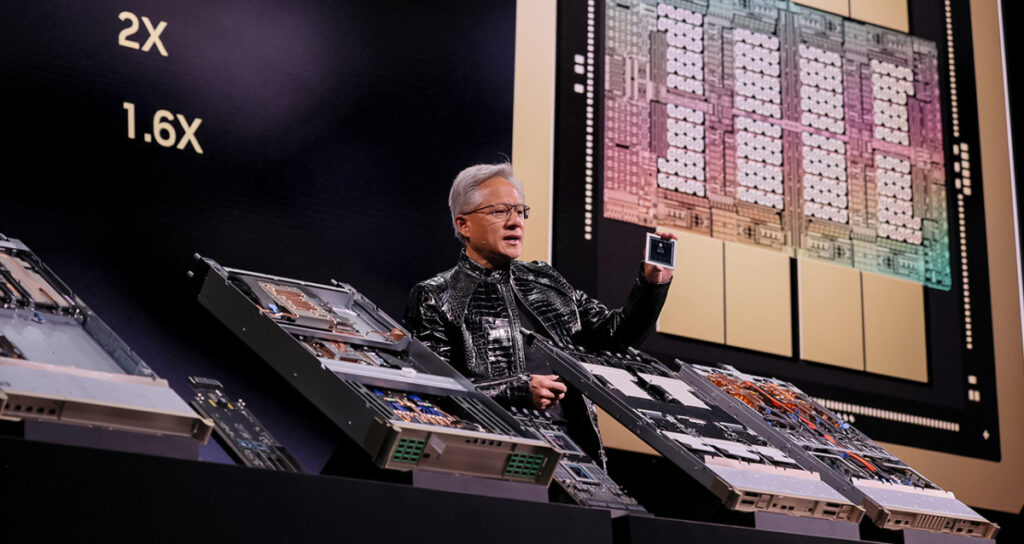
While quantum computing is a few years away (hasn’t it always been?), one technology is already having an impact on Synopsys: AI. As Prith points out, it helps to have some perspective on the rapid growth in the number of transistors in our processors: if you remember the first Intel Pentium chip from 1993, that had 3.1 million transistors inside. At this year’s CES, Nvidia announced a Rubin chip with 126 billion transistors.
“The complexity of these things has gone through the roof,” said Prith. And, at the same time, chipmakers want the time of development to drop. “Intel, AMD, they would come up with a new design and the time from concept to fab was maybe three years. That pace of innovation is now, hey, I want a chip every year. Jensen is asking for a new chip every year.
“If you want to do a 100,000-transistor chip, that’s possible. But a 1 trillion transistor chip in a year, it’s like asking for God’s help.”
Then there’s the software layer that transistors need. “So if you are a company like AMD, Intel, suppose you [may currently have] 100,000 engineers. Just to handle the complexity and the pace they would have to hire one million engineers, ten million engineers. And if everybody started hiring ten million engineers, the world is not producing that many engineers. That’s where AI comes in.”
The natural next question: how does it help? “AI is good at training – it’s like how you train a child. Here is how you run, how to ride a bike. You can train a child to do anything, right? So what we have been doing at Synopsys is to train the AI to run our solvers, like for fluid simulation, or HFSR for electromagnetic simulation, or fusion compilers for chip design.”
Prith says its current efforts fall under the title of “reinforcement learning”, where if the settings created by the AI provide a gain then there’s a reward. And if it’s worse than current settings, there’s a penalty. Again, much like training a child.
“Then we started working on agents like assistive agents and creative agents,” he said. “The future is AI agents that will automate that entire process for chip design.”
Don’t worry, there will still be entry-level jobs for chip designers
According to Prith, all this doesn’t mean that AI is going to replace the current chip designers. Instead, he believes it will be possible for the current 10,000 chip designers at AMD, Intel, Qualcomm and the rest to become “superhuman engineers” that can “do the work of ten million engineers”.
And what of the newcomers, I asked? The students currently studying engineering at university? Will they have jobs to go into? Here, Prith used an example of an era I know well, having written a book about the world’s earliest computers (The Computers That Made The World).
“When the original vacuum tube computers came in, we in universities used to teach students programming using ones and zeros, which is called machine code programming, but that’s clearly not very scalable.”
To make it easier, the industry moved to “assembly languages, like move instruction, store instruction, add register one to register two. It was easier to programme in assembly than at the machine code level. So it raised the level to machine assembly.
“Then came high-level languages like Fortran, COBOL, C, Pascal. Instead of of assembly coding or machine coding, you programmed at that level. So we train students to programme at the higher level.”
Which brings us to do today’s world where an AI prompt in Claude or Copilot can create a whole programme right. “So basically, the education system will have to train students to programme in the new world, not to write a C programme. But how do you do a prompt engineering to generate a C code out of the cloud.
“Same thing for chip design. How do you do prompts to do the right things for our agentic engineers? So we will always need students, but the students will have to be trained in the new technologies of the future.”
About The Author

Tim Danton
NEXT UP


