Trending Topics

 Trending
All-photonics networks (APNs): what businesses need to know about this breakthrough networking technology

APNs are set to radically improve latency, speeds and bandwidth on our networks, as we discovered when we spoke to the organisation in charge of making it happen

People moan about how much faster life is these days. The finger of blame is often pointed at social media, at the phones in our pockets, at the constant need for new, bigger, better. But here’s another point of view: that our culture, our economy, is fundamentally built on communication.
Consider the simple business need to link one person with another. In ancient times, that meant couriers delivering messages. We eventually switched to organised postal networks, backed up by cutting-edge technology like steam locomotives. That took us right up to the mid-19th century, when the telegraph and Morse code made it possible to instantly relay messages from one side of a country to the other. With subsea cables, this eventually stretched to the world.
The world’s communication network became the foundation for how businesses worked. No business built on 19th century comms could exist once telephones became commonplace. The same was true with the advent of the internet in the 1970s, with email starting slow – the Queen sent an email in 1976 – but becoming the de facto communication tool for 21st century businesses. Even in the word of Slack and instant messaging, email remains king.
All of which means that businesses need to understand what’s round the corner when it comes to communication. If you don’t take advantage, your competitors will. So consider this an early warning about APNs and photonics: they’re hurtling towards you. Ignore them at your peril.
What is photonics?
The clue is in the name: where electronics is based on electrons, photonics is based on photons. Otherwise known as light. So rather than building our network infrastructure on electronics, a switch to photonics means using light to communicate. In APNs, that boils down to either lasers or light-emitting diodes (LEDs).
You then need to encode data into the light. You can do so by adjusting its brightness, its frequency or even its phase (where the light wave is in its up/down cycle).
In photonics, the light travels along optical fibres made of glass. This means they come incredibly close to the speed of light. Along with the usual boosters to avoid loss of data, the final ingredient is a photo detector at the other end of the connection. These convert the light waves back into electronic signals for computers and servers to process.
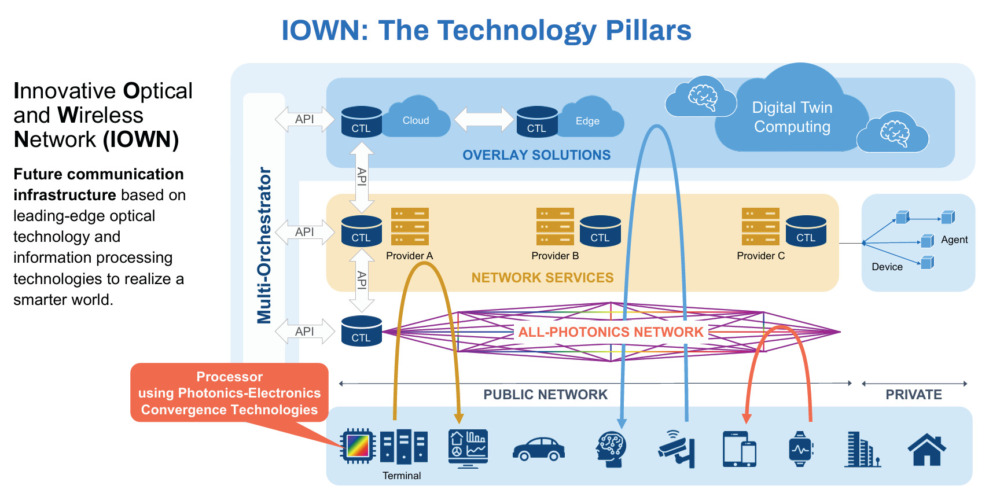
What are APNs (All-Photonics Networks)?
We all know that the tech industry loves a TLA, and it has deviously turned what sounds interesting into something that sounds dull. Stand aside photonics, welcome APNs. Standing for All-Photonics Networks, this is very much what it sounds like. Networks entirely made of photonics. No electronics welcome here.
It all sounds great, of course, but in terms of general use we’re talking years away. But planning and early implementations are well under way thanks to the industry body IOWN Global Forum (IOWN GF).
“Our mission is to lead the evolution from electronics to photonics,” Gonzalo Camarillo, Head of the Marketing Steering Committee at the IOWN GF, told TechFinitive at MWC 2025. “Now we are at the fifth anniversary, we have come up to more than 150 members.”

It’s a truly international organisation, with representatives from Japan (such as Epson, NTT and Sony), Europe (such as BT, Ericsson, who Camarillo works for, and Nokia) and the US (AMD, Dell, HPE, Microsoft, Nvidia and many more).
“We have members from many verticals, many geographies, many roles in their industry. And that sets the base for all the work we’ve been doing.”
Advantages of photonics/APNs for businesses
So how can APNs help you business? The four main benefits it brings are:
- faster speeds
- lower latency
- greater bandwidth
- lower power consumption
Here are the IOWN Global Forum’s 2030 objectives to summarise:

Other than those overarching improvements, it’s difficult to pinpoint advantages to businesses. Instead, explains Camarillo, the IOWN GF concentrates on early adoption use cases and a strategy of continuously consulting with industry.
What are the early adoption use cases for photonics?
Right now it’s expensive to update network infrastructure from electronics to photonics. You need a strong business case to justify the investment, and none comes stronger than for financial institutions.
“One early use case is about connecting data centers so that you can do synchronous replication,” said Camarillo. “They do synchronous replication for trades, transactions and all that. And they are heavily regulated.” Nor can there be any risk of data loss, so the technology must be 100% reliable.
But for financial institutions, the real advantage is latency. “With the delay advantage that they get [with APNs], they can actually connect to data centers which are further away.” This is crucial: today, they must be within 30km of a data center or latency becomes an issue. “They said, if we can give them even 50, 60 kilometers, that would make a huge difference.”
Camarillo pointed to companies based in central London, who must use data centers within a relatively small diameter. “These guys are charging them whatever they like, because just everyone needs to use a data center in that circle. If you expand it, then you are basically in the rural areas. Then they have a lot more data center [options to choose from at] much less cost.”
Broadcasters and APNs

That example is all about decentralization, but the opposite could also be true. Some industries, such as live broadcasting, could benefit from centralization.
“Liverpool, Real Madrid, Manchester City, whatever your favourite club is, they have a lot of video streams from a game, a lot of data,” said Camarillo. To keep time delays at a minimum, right now a broadcaster will send a truck or van stacked with equipment and satellite dishes to process the multiple streams of video data and turn it into a single stream, or very few streams, to the broadcaster’s headquarters.
“In this case, they can actually centralize all this production from all the events that they are trying to cover,” he said. “We have Sony, one of our members, which is driving this use case. This is interesting because this shows that when you have an APN, you can use it in different ways.
“For the financial institutions, it’s all about distributing functionality that before had to be more centralized. Video production is all about centralizing. [Today] you’re forced to distribute it because technology didn’t allow you to be centralized. But you have cost advantages and functionality advantages in terms of centralization.”
Remote GPUs and AI
He also gave the examples of accessing remote GPUs as if they were on your local PC. “In particular if they have secure enclaves,” explained Camarillo, pointing to the need for businesses that want to take advantage of AI on demand but need to keep their data secure. “So maybe you don’t want to upload everything and say, ‘Hey, you do this’. [Businesses may have] to send the information they need piecemeal. You cannot do that if you don’t have very well-performing networks.”
The businesses in question could even be second-tier football/soccer clubs, who don’t have the same immense resources as Liverpool FC but want to instantly access the same level of compute power. “And the same is true for many use cases. If you’re a big player, probably you can spend a bit more money, you can get it done, but if you are a bit smaller you really need this type of network.”
The world’s first APNs

APNs aren’t just theory or proof of concepts. In fact, the first commercial APN has already seen action in Japan. In January this year, NTT showcased the world’s first live remote production – similar to the live broadcast use case discussed above – after it linked a studio in Tokyo to one in Akasaka. Admittedly, that’s only a distance of around 3km, but these things have to start somewhere.
In the press release, it claimed the “first successful remote production of audio for live broadcast music programs using IOWN APN”. So while the recording took place in Akasaka, all the production was done by experts in the main Tokyo broadcasting station.
And distance is far less of an obstacle than you might imagine, explains Camarillo, as NTT has already linked up two piano players to play a duet hundreds of miles away. “There were two piano players playing synchronously, and the effective distance it would be like if they were in the same room, three metres apart.”
If anything the problem could be that the APNs are too fast. “When they applied that type of super-fast connection, where you could actually see the piano player in real life, the sound was getting to you earlier than the actual sound hitting you, because of the speed of light and the speed of sound. So they said that it was really something they didn’t expect.”
What’s next for APNs
As the example above shows, in some geographies – and for certain early adoption uses cases – APNs aren’t the future, they’re the present. Or at least, very near future.
Right now the IOWN Global Forum is working with industry on standards that will define the networks of the next 50 years. In the meantime, you owe it to your business to ask whether you can gain a commercial advantage from photonics before it hits the mainstream.
Related features
About The Author

Tim Danton
NEXT UP


