Trending Topics

 Trending
All Chromebook Plus laptops compared

There will soon be nine Chromebook Plus laptops available to buy, so this article has one aim: to work out which is right for you. To do that, we’ll compare all nine Chromebook Plus laptops based on our years of testing experience.
We will also be realistic. While Google has wisely set down its parameters of what makes a laptop worthy of Chromebook Plus status rather than a mere Chromebook, these are still budget machines. You can’t expect miracles when it comes to screen quality, for instance.
Jump to the section you’re most interested in below:
- Price & availability of all Chromebook Plus laptops
- How fast is a Chromebook Plus laptop?
- Which is the best convertible “flip” Chromebook Plus?
- Which is the best “clamshell” Chromebook Plus?
- Which is the best Chromebook Plus laptop for gaming?
- What if none of these Chromebook Plus laptops is right for me?
Price & availability of all Chromebook Plus laptops
| Model | CPU | Screen | Flip? | Price* |
| Acer Chromebook Plus 514 | AMD | 14in | No | £500 |
| Acer Chromebook Plus 515 | Intel | 15.6in | No | £399 |
| Asus Chromebook Plus CM34 Flip | AMD | 14in | Yes | £499 |
| Asus Chromebook Plus CX34 | Intel | 14in | No | £399 |
| HP Chromebook Plus 15.6-inch | Intel | 15.6in | No | £449 |
| HP Chromebook Plus x360 14-inch | Intel | 14in | Yes | $790 |
| Lenovo IdeaPad Flex 5i Chromebook Plus | Intel | 14in | Yes | €549 |
| Lenovo IdeaPad Gaming Chromebook Plus | Intel | 16in | No | €599 |
| Lenovo IdeaPad Slim 3i Chromebook Plus | Intel | 14in | No | €649 |
One immediate observation is that the four laptop manufacturers are picking and choosing which markets to launch in. And it isn’t consistent. Lenovo, for instance, is launching all three models in the UK and Europe, but not selling the Gaming Chromebook in the USA.
HP, meanwhile, doesn’t appear to be selling its Chromebook Plus laptops anywhere outside of North America. This could be a supply issue, however, and we are waiting for confirmation from HP.
Acer is selling both models widely, but in the UK we will miss out on touchscreen versions of its Chromebook Plus laptops. And Asus appears to be focusing its attention on the non-flip CX34.
How fast is a Chromebook Plus laptop?
One of Google’s rules is that a Chromebook Plus must include a recent, fast chip from AMD or Intel. So far, it looks as if that means the manufacturers are opting for one of these processors:
- AMD Ryzen 3 7320C
- AMD Ryzen 5 7520C
- Intel Core i3-N305
- Intel Core i3-1215U or Core i3-1315U
- Intel Core i5-1235U or Core i5-1335U
- Intel Core i7-1255U or Core i7-1355U
Compared to a standard Chromebook with, say, a Pentium inside, any of these laptops will fly. If you’re looking for all-out speed, though, we recommend you choose a Chromebook Plus with an AMD Ryzen 5, Core i5 or Core i7 inside. It will be notably faster.
Here, I rank them roughly by speed, with the fastest at the top and the slowest at the bottom:
| Processor | Cores/Threads | Speed rating |
| Intel Core i7-1355U | 10/12 | Extremely fast |
| Intel Core i7-1255U | 10/12 | Extremely fast |
| Intel Core i5-1335U | 10/12 | Very fast |
| Intel Core i5-1235U | 10/12 | Very fast |
| AMD Ryzen 5 7520C | 4/8 | Very fast* |
| Intel Core i3-1315U | 6/8 | Fast |
| Intel Core i3-1215U | 6/8 | Fast |
| AMD Ryzen 3 7320C | 4/8 | Fast* |
| Intel Core i3-N305 | 8/8 | Medium fast* |
Note that the Core i7-1355U (for example) is faster than the Core i7-1255U because it is a 13th-generation rather than a 12th-generation Core processor. This is denoted by the “13” at the start of its model name.
The outlier is Intel’s Core i3-N305. We expect this to be slower than the other Core i3 chips as it doesn’t have any “performance” P-cores, only “efficiency” E-cores. However, we have not yet tested it.
All Chromebook Plus models include at least 8GB of RAM. For demanding users, that will make a notable difference compared to 4GB of a typical Chromebook when using demanding web applications. Indeed, Photoshop Online requires at least 8GB of RAM.
More expensive models include 16GB of RAM. While this will make some apps quicker, the difference won’t be as notable so we don’t consider this a key upgrade.
Which is the best convertible “flip” Chromebook Plus?
Three of the Chromebook Plus laptops have the ability to flip their lid 360 degrees, turning them into a thick but effective tablet. I’ll run through some quick pros and cons of this type of device.
Pros of a flip Chromebook
- As all modern Chromebooks support Android apps, being able to flip the screen means you can use it as an Android tablet.
- It’s much easier to draw or write on a screen that lies flat than one that sits at an angle, like a normal laptop. So if your work involves annotation, scribbling notes or drawing then you will massively appreciate it.
- Then there’s the simple benefit of a touchscreen. Chromebook Plus laptops are fast enough to handle Photoshop Online and similar graphics tools, and this is where it’s much easier (often) to tap a screen than to use the touchpad.
Cons of a flip Chromebook
- It’s likely that a flip Chromebook will be heavier and perhaps thicker than a design that doesn’t include the convertible mechanism.
- You will often find that a convertible Chromebook is also slightly more expensive than its clamshell rivals.
- Finally, a convertible design does bring one more thing to go wrong. And they can be more expensive to repair, too.
What’s the difference between the three convertible Chromebook Plus laptops?
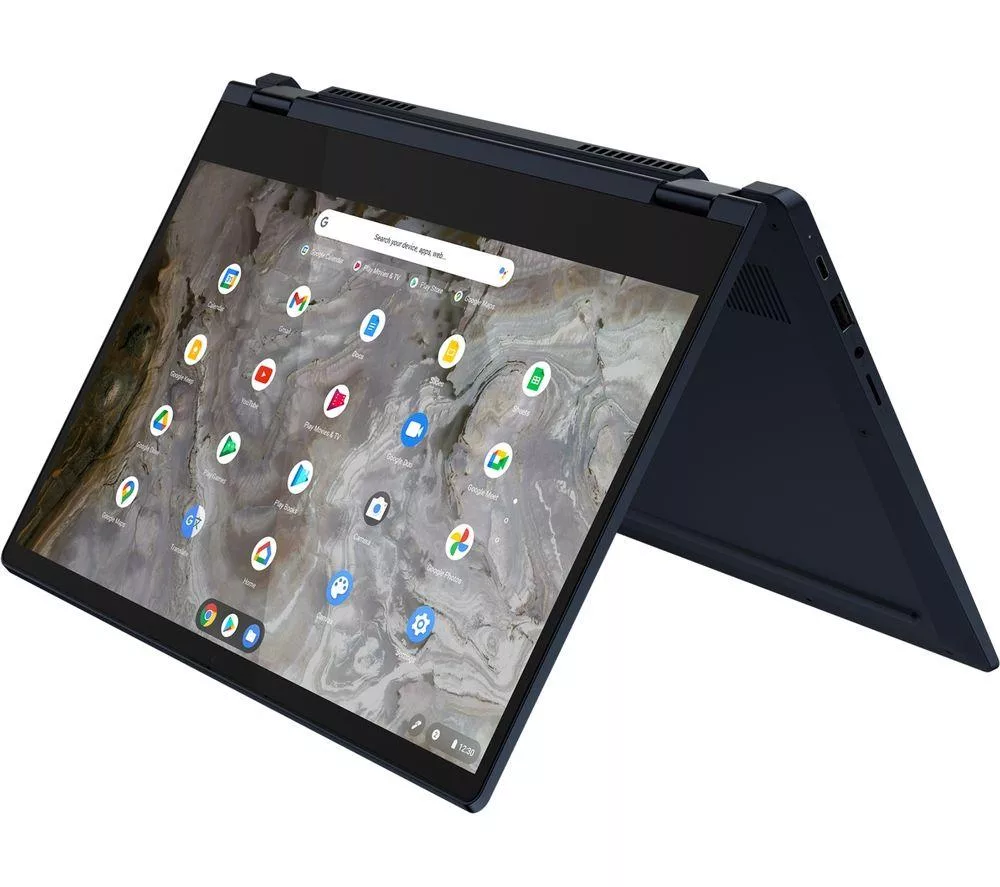
| Model | CPU | Screen | Storage | Weight | Price |
| Asus Chromebook Plus CM34 Flip | AMD Ryzen 3 7320C | 14in 1,920 x 1,200 | 128GB | 1.85kg | TBC (around $500) |
| HP Chromebook Plus x360 14-inch | Intel Core i3-1215U | 14in 1,920 x 1,200 | 256GB | 1.5kg | $699 |
| Lenovo IdeaPad Flex 5i Chromebook Plus | Intel Core i3-1315U | 14in 1,920 x 1,200 | 128GB | 1.6kg | €499 |
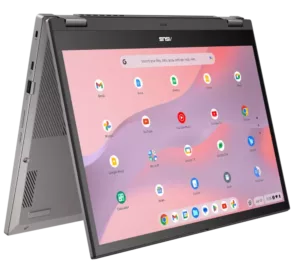
As you can see, we don’t have easy-to-compare pricing for the three convertible Chromebook Plus models. The HP and Lenovo are available in the US (from Best Buy), but not the UK; the Asus Chromebook Plus CM34 Flip isn’t yet available anywhere, but we expect it to be around $500/£500.
It’s the Lenovo IdeaPad Flex 5i Chromebook Plus that jumps out of the three thanks to its price and its 13th-generation Intel Core processor. From the specifications, we can safely judge that their 14in screens will be similar in quality (that is to say, good but not spectacular).
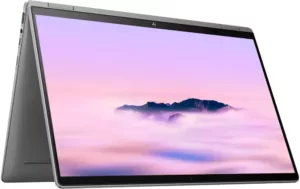
There are four reasons why you might prefer the HP Chromebook Plus x360 14-inch, however. One is that it includes a 5-megapixel webcam, compared to the bog standard 1080p webcam in the Lenovo and Asus, and we expect this to provide sharper results and better performance in low light.
The second reason is its extra storage, with 256GB to 128GB. But perhaps most compelling is that it is both lighter and includes a bigger battery (58Wh to 51Wh), and we suspect it will give an extra hour or so battery life.
What is the best “clamshell” Chromebook Plus laptop?
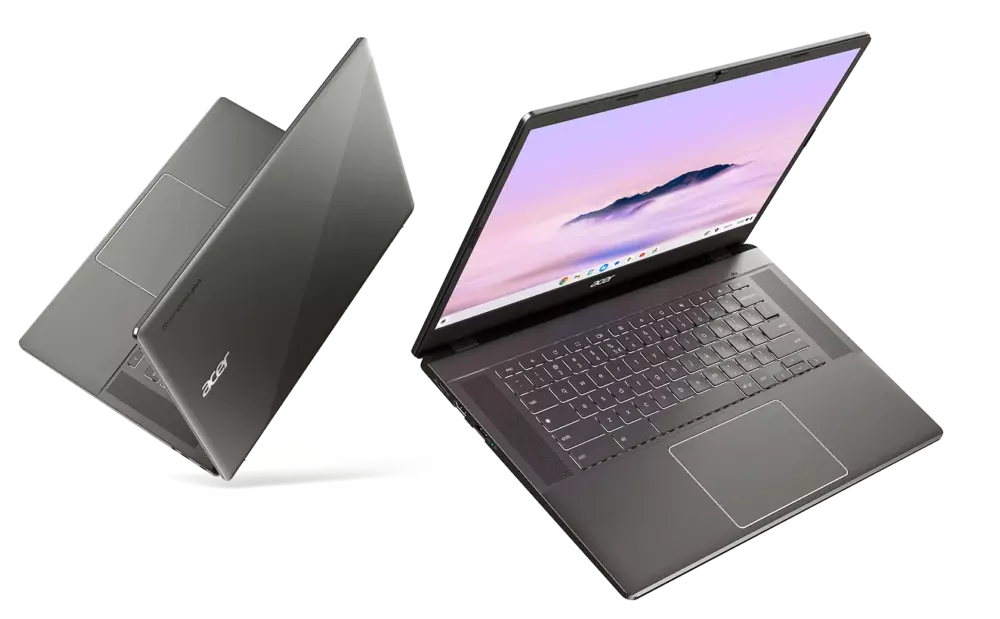
A “clamshell” laptop is essentially a normal laptop. One that doesn’t have a screen that flips over to form a tablet, to be precise. And, of the nine Chromebook Plus laptops announced so far, six fall into this category:
| Model | CPU | Screen | Weight | Price* |
| Acer Chromebook Plus 514 | AMD Ryzen 5 7520C | 14in 1,920 x 1,200 | 1.45kg | £500 |
| Acer Chromebook Plus 515 | Intel 13th generation | 15.6in 1,920 x 1,080 | 1.68kg | £399 |
| Asus Chromebook Plus CX34 | Intel 12th generation | 14in 1,920 x 1,080 | 1.44kg | £399 |
| HP Chromebook Plus 15.6-inch | Intel Core i3-N305 | 15.6in 1,920 x 1,080 | 1.73kg | £429 |
| Lenovo IdeaPad Gaming Chromebook Plus | Intel 12th generation | 16in 2,560 x 1,600 | 1.95kg | €599 |
| Lenovo IdeaPad Slim 3i Chromebook Plus | Intel Core i3-N305 | 14in 1,920 x 1,080 | 1.5kg | €649 |
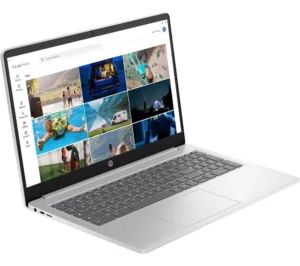
I may yet be proved wrong, but I find it hard to get excited by Chromebooks powered by Intel’s Core i3-N305 processor. As mentioned above, this includes eight cores but they are all tailored to efficiency — I expect that neither the Lenovo IdeaPad Slim 3 nor the HP Chromebook Plus will slice through tasks in the same way that other Chromebook Plus laptops will.
Both the Asus Chromebook Plus CX34 and Lenovo IdeaPad Gaming Chromebook Plus use 12th-generation Intel Core chips. They will still be fast, but these are effectively rebranded versions of previous Chromebooks. This lack of fresh thinking again makes it difficult to become excited by them.
This leaves the Acer Chromebook Plus 514 and Acer Chromebook Plus 515. These will both be fast and Acer has designed them specifically to meet the Chromebook Plus criteria. I have also used both, so can say with good faith that they are built to a high quality.
Personally, I lean towards the 14in Chromebook Plus 514 laptop, as its screen is a fraction sharper and it’s also lighter. However, if you need a larger screen then the 15.6in Acer Chromebook Plus 515 won’t disappoint.
Which is the best Chromebook Plus laptop for gaming?
Fortunately, this is an easy one to answer. Only one of these laptops is designed for gaming, and that’s the Lenovo IdeaPad Gaming Chromebook Plus. It’s chunky at 2kg (and 20mm/0.8in thick) but in return, you get a high-quality 16in screen with a 120Hz refresh rate.
You’re unlikely to use the integrated graphics for local gaming — instead, use the GeForce Now service to stream games to the laptop — so you don’t need to buy the more expensive version with Intel Iris Xe graphics.
What if none of these Chromebook Plus laptops is right for me?
Over the next few months, we expect more Chromebook Plus laptops to emerge, so you can just wait. Alternatively, Google has stated that the following Chromebooks will receive an OS update which means they benefit from the same Chromebook Plus features as their official brethren.
| Model name | Flip? |
| Acer Chromebook Spin 514 (CP514-3H, CP514-3HH, CP514-3WH) | Yes |
| Acer Chromebook Spin 714 (CP714-1WN) | Yes |
| Acer Chromebook Spin 714 (CP714-2W, CP714-2WN) | Yes |
| Acer Chromebook 516 GE (CBG516-1H) | No |
| Acer Chromebook Vero 514 (CBV514-1H, CBV514-1HT) | No |
| Asus Chromebook CM34 Flip (CM3401) | Yes |
| Asus Chromebook Flip CX5 (CX5601) | Yes |
| Dell Latitude 5430 Chromebook | No |
| Dell Latitude 5430 2-in-1 Chromebook | Yes |
| Framework Laptop Chromebook Edition | No |
| HP Chromebook 15.6 15a-nb0xxx (xxx: 001~999) | No |
| HP Chromebook x360 14 inch (14c-cd0xxx) (xxx: 001~999) | Yes |
| HP Dragonfly Pro Chromebook | No |
| HP Elite Dragonfly Chromebook | No |
| HP Elite c640 14 inch G3 Chromebook | No |
| HP Elite c645 G2 Chromebook | No |
| Lenovo IdeaPad Flex 5i Chromebook (14″, Gen 7) (IP Flex 5 Chrome 14IAU7) | Yes |
| Lenovo IdeaPad Gaming Chromebook 16″ | No |
| Lenovo IdeaPad Slim 3i Chromebook 14″ | No |
| Lenovo ThinkPad C14 Chromebook | No |
| Lenovo IdeaPad 5i Chromebook (16″, Gen 7) | No |
| Lenovo IdeaPad 14e Chromebook Gen 3 | No |
About The Author

Tim Danton
NEXT UP


