Trending Topics

 Trending
HP aims to tame cloud costs with tiny AI Station

HP has unveiled the HP ZGX Nano AI Station, a dinky workstation that it claims will give companies more certainty over the cost of AI workloads.
The company says it has spoken to more than 50 customers about their AI needs and the number one concern is cost. “We heard loud and clear that AI development is continuing to drive hardware needs, and it didn’t surprise us that concerns remain around data privacy and rising unpredictable cloud costs,” said Brian Allen, Manager of HP’s global desktop and workstation products.
“80% of customers really need a specialised AI development hardware, and they’re really concerned about rising cloud costs, and then at 70% continue to say data privacy is a concern.”
HP’s proposed solution is the ZGX Nano, a 1.1kg mini PC that “fits in the palm of your hand”. It’s based on the Nvidia GB10 Grace Blackwell architecture, which is an ARM-based system-on-a-chip design. It ships with 128GB of unified core system memory and that can support up to 200 billion parameter AI models. It also supports ConnectX 7, which is a high-speed copper cable that allows you to chain two of the AI Stations together, doubling the capability to models with up to 400 billion parameters.
Allen said the AI Station would be well suited to tasks such as prototyping, “where teams quickly test ideas through small-scale models”; fine-tuning “where pre-trained models are customised for specific business or research needs”; or inference, “where models run at scale to deliver real-time insights”.
The device can be used standalone at a desktop, connected to a mouse, keyboard and monitor, or remotely accessed over the network.
Although HP’s chief selling point is certainty over price, it’s not yet willing to provide that certainty, saying prices will be announced when the product becomes available later this autumn.
The HP ZGX Nano follows in the footsteps of the GB10-powered Acer Veriton GN100 AI mini workstation, which made the shortlist of our best business products from IFA 2025.
Super-widescreen monitor
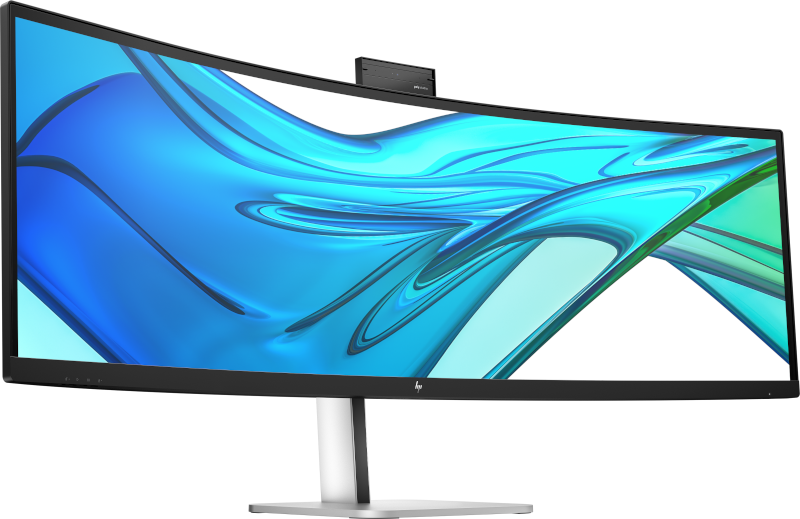
One of the screens you might want to attach the Nano AI Station to is the newly announced HP Series 5 Pro 49-inch Conferencing Monitor.
This is an absolute beast of a display, with a 32:9 aspect ratio and DQHD (5,120 x 1,440) resolution, which Umang Patel, Senior Manager of NPI displays and docks at HP, described as “spanning almost four 14in notebooks open side by side”.
“You have a single mammoth screen that has a sweeping, curved glass that creates a massive canvas for juggling all of your critical applications, AI agents and productivity tools,” he said.
Describing it as the ideal screen for AI product managers or software developers, Patel said “you can have your debug console, your business applications and data model open on your desktop and still have plenty of room for email, chat and your shared content”.
As the screen is so large, you might not want to treat it as one contiguous display. So HP has built in what it calls “virtual multiple displays”, where you can slice the screen into three unique displays, each with its own taskbar and Start menu, as if you had three screens side-by-side. HP Device Bridge also allows you to connect two different PCs simultaneously.
There’s a tiltable webcam built into the top of the display, which is a Poly Studio unit with a 5-megapixel resolution. It supports auto-lock and waking, meaning passers-by (or frankly anyone within a radius of about six miles with a screen of this size) can’t see what’s on screen when you step away. The webcam can also be popped down when not in use to guarantee privacy.
HP’s also being coy about the price of the 49in display, saying it will reveal pricing when it’s launched in November. Like the screen, we expect it to be massive.
Related articles
About The Author

Barry Collins
NEXT UP