Trending Topics

 Trending
Meet HPE Juniper Networking’s new Mist AI agents that promise to bring “self driving” to your network

The monster merge of HPE and Juniper Networks is only a few weeks old, but this week saw the first signs of how this newborn networking giant will work. In particular, its promised creation of secure AI-native networks. Here, we explain HPE Juniper Networking’s steps towards a fully “self-driving network”.
It came via a press release announcing that “HPE accelerates self-driving networking operations with new Mist agentic AI-native innovations“, but I’m not going to regurgitate that.
Instead, this article goes into more depth in terms of what the announcement means for existing HPE Aruba Networking customers, existing Juniper Networking customers, and any organisation who might be thinking about jumping ship.
It relies on a pre-briefing with Jeff Aaron. He is now VP of Product Marketing at HPE Juniper Networking, but was – until the last week of July – previously GVP of Product Marketing at Juniper. I split it into six parts, which you can jump to via the table of contents below.
The big picture: what HPE Juniper Networking just announced

The main reason why HPE bought Juniper was for its Mist AI platform, which has long promised a “self-driving” mode for networks. So the IT team can largely allow the AI to detect problems and recommend fixes, and more recently assist in making them – with user permission.
With this latest announcement – which Juniper was working on before the merger completed, so largely focuses on its own platform rather than HPE’s – it is introducing agentic AI to automatically fix problems.
There are clear analogies with self-driving cars, however. While Tesla drivers can opt for self-driving mode where the car makes all the decisions, they are meant to keep their hands on the wheel at all times. Here, those hands on the wheel are from the IT team, who are always the “human in the loop”, to use Jeff Aaron’s term. This technology falls under the umbrella term of AIOPs.

4 ways to keep your network adaptable
Network decision makers face the challenge of supporting more users, diverse environments, IoT devices, and AI workloads while future-proofing their networks for new demands. Network modernization is not just updating infrastructure—it’s an ongoing journey to create an agile foundation that enables faster adoption of initiatives and adaptation to changing conditions.
Read more here to see how HPE networking solutions help create an agile, secure, and adaptable network ready for today and tomorrow.
HPE also announced enhanced conversational abilities, where users can gain better insights from the Marvis AI assistant. Plus, it promises that its all-new Marvis Minis – “digital twins that simulate user experiences” – will enhance the Generallzed Large Experience Model. More of that later.
Rami Rahim, EVP, President and General Manager, HPE Networking, had this to say about the announcement. “Today’s networks must do more than connect – they must understand, adapt and act,” he said.
“With these new digital experience twin and agentic AI capabilities in Juniper Mist, we continue to turn the network into a proactive partner for IT, capable of solving problems before they impact users. This is a major leap toward truly self-driving operations, helping our customers simplify complexity, reduce costs, and deliver exceptional digital experiences at scale.”
The journey to self-driving networks
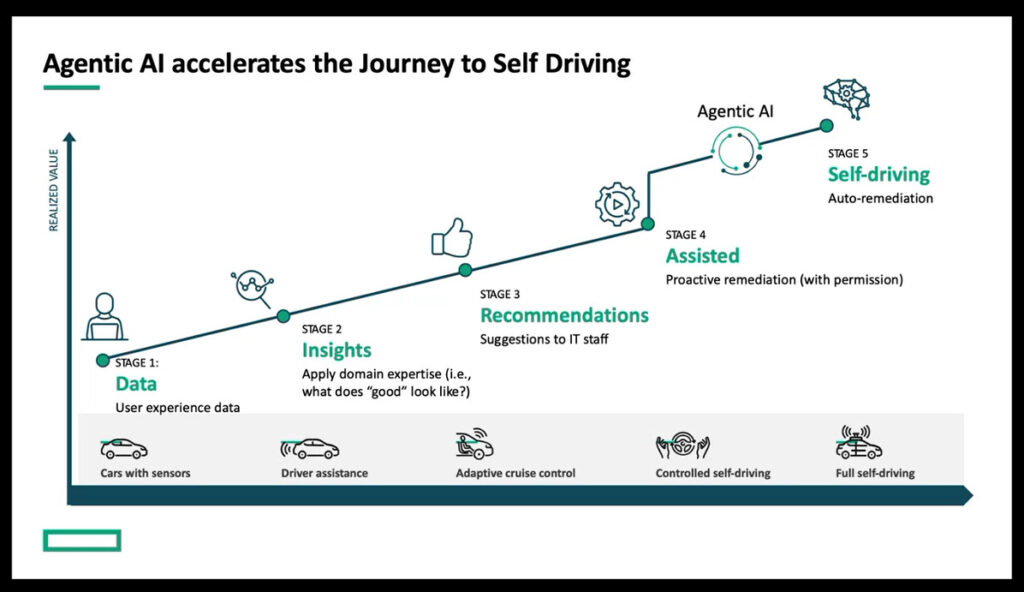
During the briefing, Aaron emphasised that the Mist AI platform has been on the journey to full self-driving networks for over a decade.
It started, he said, with “just pulling in the right data into the cloud” from devices such as access points and streaming switches. The next step was to understand that data and apply expertise, so that the platform could make recommendations on how to improve, say, Wi-Fi performance.
That takes us up to stage 3. Stage 4 is the assisted mode, where it tells “you exactly how to go fix [the problem], and then actually maybe go do it with you, if you give permission to do it,” said Aaron. “And then there’s full self driving, which is a fully autonomous mode in our mind. Agentic is a catalyst to go from stage four to stage five. It adds more functionality.”
Using GenAI for troubleshooting
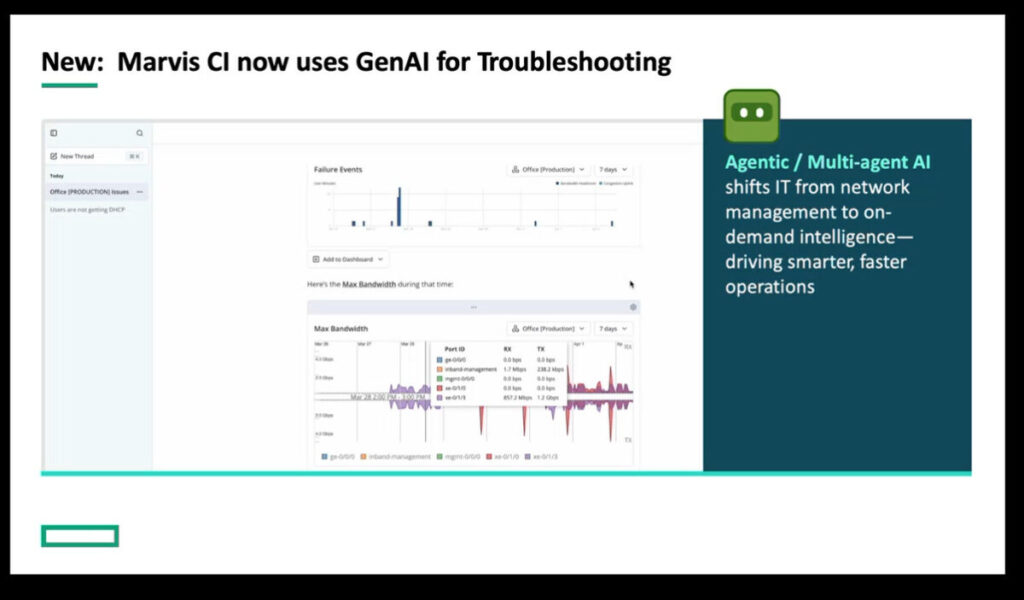
Juniper customers will have grown used to asking Marvis, effectively Mist AI’s chatbot, natural language questions and getting natural language answers.
“In addition to our own real-time troubleshooting, you can use a GenAI model to come back and say, ‘Why is a light blinking three times on my access point?'” said Aaron of an existing feature. “It’s a very static question and answer that we’ve been able to use in terms of a nice conversational interface.”
What’s new is “the ability to do real-time troubleshooting using GenAI,” he explained. “So again, we’ve brought in our real-time troubleshooting capabilities. They’ve always existed, but now it’s a more conversational interface, and now it leverages agents across all the domains.
“For example, I can say what’s wrong with my office, and it’ll come back and query a wireless agent, a WAN agent, a wired agent, and come back and say, in this instance, you had a WAN problem. Here’s the problem, here’s how to go fix it. Do you want me to go do it autonomously?”
Expanded AIOps for data centre

“About a year ago we started to extend our tentacles into the data centre,” said Aaron of Mist AI. Previously, it had been limited to wired, wireless and SD WAN networks. “We’re able to pull in information from our data centre management tool Apstra, and be able to launch Apstra from from Mist to go do things.”
The latest development is that you can do more from using Marvis AI.
“You can actually use the conversational interface to go query the system and actually do changes to the system,” he said. “[Marvis] Minis are now available on data centre, where we can actually go troubleshoot problems when there’s no one on the network by simulating end user experiences.
“So if you remember that five-stage journey of self driving, we’ve just brought data centre up on par with wired and wireless to that stage four/stage five area by bringing even more capabilities here.”
Enhancements to Generalized Large Experience Model (LEM)

Juniper Networking launched its Generalized LEM around a year ago. “[This is the] notion that we are pulling in billions of data points from Zoom and Teams into our AI engine,” said Aaron.
Then then crunch that data to predict what might go wrong in the future – for example, a video call on a Monday morning when everyone comes online at once.
“In addition to all that information being pulled from Zoom and Teams and our own real-time networking information, we’ve now added simulated traffic to this – our Marvis Minis – so it can go and actually probe the network.”
This might happen on a Sunday night when the network is otherwise quiet. “[The LEM will] use that simulated traffic to predict that you may have a video call happening on Monday morning when students show up or whatever, and then it can actually go and fix it. So it can obviously recommend changes, or it can go into autonomous mode… and actually correct any things that may impact your video experience in the future.”
Message to existing HPE and Juniper customers: “Better together”
Finally, some words of reassurance from Jeff Aaron for any existing customers, who says that the aim of the new HPE Juniper Networking group is to deliver “the secure AI-native network”. This is neatly summarised below, but Aaron described it as “a platform for delivering both AI for network ops and network for AI workloads”.

“We have a vision that we will execute on to have all the products that you’re seeing here, all these solution areas, come together under a single cloud, a single AI engine with single, centralised operational capabilities,” he said.
“So it’s on us to ensure that whatever starting point you are on that journey, we are going to get to that end state in a clean and productive manner, where you just wake up one day and hopefully there’ll be just one set of hardware and one set of back end, and we’re going to get you there.
“We’re on the journey to sort that out right now. And that’s our main goal of the platform.”
About The Author

Tim Danton
NEXT UP