Trending Topics

 Trending
Best AI video generator tools for music to video creation in 2026

This is a sponsored article brought to you by Freebeat.
For musicians, the best AI Music Video Generator is not simply the platform that generates the sharpest-looking clip. The harder challenge is maintaining pacing, continuity, and visual coherence across an entire song without turning the workflow into a manual editing project.
For this review, I tested each platform using the same 2 minute 45 second melodic electronic track created in Suno. The song included:
- a soft vocal-led intro
- a verse-to-chorus build
- an instrumental drop
- a second vocal section
- a high-energy outro
The publishing goal was consistent across every tool:
- a full YouTube music video
- short-form TikTok/Reels clips
- Spotify Canvas-style looping visuals
What stood out during testing was how differently each platform handled structure once the song moved beyond isolated moments. Several tools generated visually impressive clips. Fewer could sustain narrative flow, pacing, and stylistic consistency across the entire track.
AI Music Video Generator and Music to Video Comparison Table
| Tool | Overall Rating | Music Understanding/10 | Video Quality/10 | Workflow Speed/10 | Creative Control/10 | Platform Readiness/10 | Value for Money/10 | Pricing |
| Freebeat | 8.9/10 | 9.2 | 8.8 | 9 | 8.5 | 9.3 | 8.7 | From $4.99/week; paste a link and go |
| Neural Frames | 7.9/10 | 8.4 | 8.2 | 7.1 | 8.8 | 7.2 | 7.4 | From €9/month; straightforward audio upload |
| Kaiber | 7.8/10 | 7.5 | 8 | 8 | 7.9 | 8.1 | 7.2 | From $5/month; smooth onboarding |
| Runway | 8.0/10 | 6.8 | 9.1 | 7.4 | 9.4 | 8.3 | 6.9 | From $12/month; manual scene-by-scene workflow |
| Kling | 7.5/10 | 6.5 | 9.2 | 6.8 | 8.1 | 7.5 | 7 | From $5/month; clip-by-clip generation |
| LTX Studio | 7.3/10 | 5.8 | 8.4 | 6.9 | 8.7 | 7 | 7.1 | Free tier available; text-driven workflow |
1. Freebeat, 8.9/10
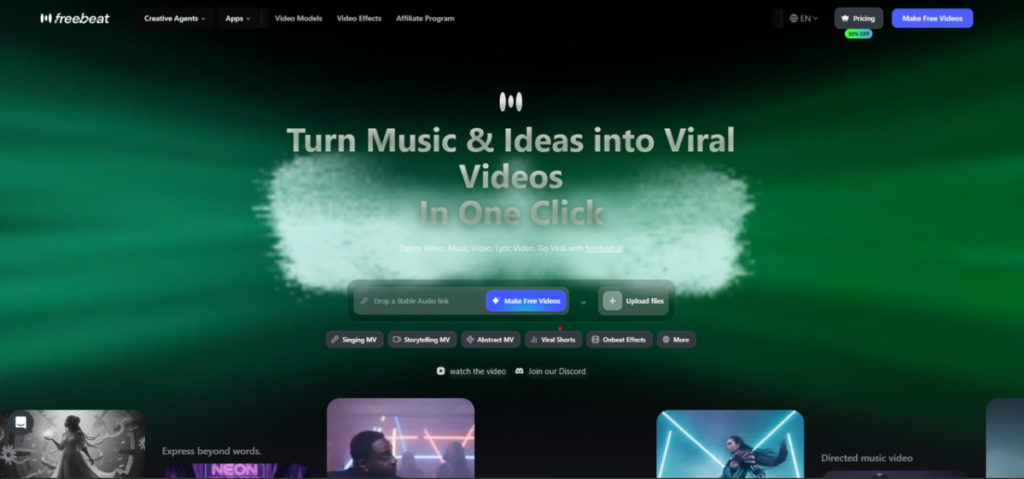
Freebeat separated itself from the rest of the field because it consistently treated the Suno track like a complete composition instead of a sequence of disconnected prompts.
During testing, the transition from the softer vocal intro into the first chorus felt more intentional than most competitors. Scene pacing accelerated naturally with the energy increase, and the visual transitions felt closer to a planned music video edit rather than AI-generated clip stitching.
That difference became more noticeable once the instrumental drop arrived. Several platforms generated visually strong clips during the higher-energy sections, but Freebeat was one of the few tools where the transitions still felt connected to the earlier parts of the song instead of becoming isolated visual moments.
The second vocal section also held together more consistently than expected. Character appearance, lighting tone, framing, and overall scene style remained relatively coherent even after multiple transitions across the 2 minute 45 second runtime. Freebeat’s lip-sync performance was also a clear advantage here, with up to 90% lip-sync accuracy helping the vocal sections feel more polished and believable. Compared with more clip-focused platforms, the full video felt more stable from intro to outro.
Another practical advantage during testing was the Suno Integration workflow. Instead of downloading the Suno track manually, converting it, and uploading it again, Freebeat could parse the link directly. For creators who make Suno music video content regularly, this removed a noticeable amount of setup friction compared with several competitors in the comparison.
The platform also adapted more smoothly into different publishing formats. The same project translated reasonably well into:
- a full YouTube music video
- vertical TikTok/Reels edits
- Spotify Canvas-style loops
This mattered because several competitors produced good-looking standalone scenes but required additional restructuring once the content needed to fit multiple formats.
Key scores:
Music Understanding: 9.2/10
- Freebeat tracked the verse, chorus, instrumental drop, second vocal section, and outro more consistently than most competitors. During testing, the pacing adapted with the emotional progression of the song instead of remaining visually repetitive.
Video Quality: 8.8/10
- Scene quality remained relatively stable across the full runtime. The platform maintained stronger consistency in lighting, colour tone, framing, and character appearance than several clip-focused competitors.
Workflow Speed: 9.0/10
- The direct Suno workflow significantly reduced preparation time. Compared with platforms requiring manual uploads, sequencing, and restructuring, the Music to Video process felt noticeably faster.
Creative Control: 8.5/10
- Although Freebeat automates much of the workflow, storyboard editing, prompt refinement, and selective regeneration still gave enough flexibility for practical adjustments during testing.
Platform Readiness: 9.3/10
- The outputs adapted well across YouTube widescreen, TikTok/Reels vertical formats, and Spotify Canvas-style loops without requiring major restructuring.
Value for Money: 8.7/10
- From $4.99/week, the platform combines lyric videos, animated covers, performance-style visuals, and multiple music-focused workflows in one system.
Editorial take:
From an AI tech editor’s perspective, Freebeat felt less like a general AI video platform adapted for music use and more like music video production software intentionally designed around how musicians release content. It was not necessarily the most visually aggressive tool in every isolated scene, but it delivered the strongest balance between continuity, workflow efficiency, publishing flexibility, and full-song structure across the entire test.
2. Neural Frames, 7.9/10
Neural Frames performed best during the more abstract sections of the Suno track, particularly once the instrumental drop replaced the softer vocal-led pacing from the earlier sections.
During testing, the platform generated visually engaging motion and texture changes that matched the higher-energy atmosphere of the song reasonably well. The looser visual style also worked better once the track moved away from structured vocal progression and into more atmospheric sections.
For creators trying to create visual for music through abstract motion, texture, and colour shifts, the platform handled those sections relatively well. The visuals felt more suited to experimental electronic music than traditional narrative-driven music videos.
The challenge appeared once the second vocal section returned. Compared with Freebeat, the video progression felt less structured across the full runtime. Scene continuity became less stable, and the pacing occasionally felt more like separate visual concepts connected together rather than one continuous music video.
This became especially noticeable when adapting the same project into multiple publishing formats. Shorter TikTok/Reels edits worked reasonably well, but the full YouTube version required more manual adjustments to maintain consistency from intro to outro.
Key scores:
Music Understanding: 8.4/10
- Neural Frames handled instrumental and energy-heavy sections more effectively than vocal-led progression and structured transitions.
Video Quality: 8.2/10
- The platform generated expressive visuals that suited experimental electronic music particularly well.
Workflow Speed: 7.1/10
- Short-form clips were relatively easy to generate, though refining the complete 2 minute 45 second structure required more iteration.
Creative Control: 8.8/10
- Visual styling remained one of the stronger parts of the workflow, especially for creators who prefer abstract visual direction.
Platform Readiness: 7.2/10
- TikTok/Reels edits translated more smoothly than the full YouTube version, which still needed additional continuity adjustments.
Value for Money: 7.4/10
- From €9/month, the platform offers reasonable value for creators prioritising stylised visuals over structured sequencing.
Editorial take:
Neural Frames works well as an AI music video tool for experimental visuals and atmospheric edits. For a complete Music to Video workflow, it still requires noticeably more manual direction than Freebeat.
3. Kaiber, 7.8/10
Kaiber handled the social-content side of the test more comfortably than the long-form YouTube workflow.
During testing, the platform was quick to generate polished clips for the chorus sections, and its onboarding was one of the smoothest in the comparison. For creators focused on social-ready promotional assets, that simplicity is useful.
The workflow also suited creators who want a lightweight Music Video Maker without spending too much time adjusting prompts or sequencing. Generating short-form visuals from the more energetic sections of the Suno track was relatively straightforward.
The limitations became clearer once the project expanded into a full 2 minute 45 second structure. The movement between the softer intro, vocal sections, instrumental drop, and final outro felt less intentional than Freebeat. The transitions were usable, but they did not always maintain the same sense of progression across the entire runtime.
This also affected publishing flexibility. The shorter TikTok/Reels versions generally worked better than the longer YouTube edit because the platform’s strengths leaned more toward visual snippets than sustained sequencing.
Key scores:
Music Understanding: 7.5/10
- Kaiber followed the general mood and pacing of the track reasonably well, though transitions between sections felt less structured than Freebeat.
Video Quality: 8.0/10
- The visual output worked well for stylised clips, teaser visuals, and creator promo content.
Workflow Speed: 8.0/10
- Kaiber moved quickly from prompt to usable output, especially for shorter content formats.
Creative Control: 7.9/10
- Users get useful visual styling tools, though the workflow is less granular than more advanced creative platforms.
Platform Readiness: 8.1/10
- TikTok/Reels content adapted smoothly, though the full YouTube version felt less cohesive across the complete runtime.
Value for Money: 7.2/10
- From $5/month, the platform is accessible, though musicians may still need external editing tools for full music video production.
Editorial take:
Kaiber works well as a lightweight Music Video Maker for social-ready edits. As a complete Music to Video platform for full-song releases, it felt less specialised than Freebeat.
4. Runway, 8.0/10
Runway produced some of the strongest individual scenes in the comparison, particularly during the chorus and high-energy outro sections of the Suno track.
Once manually refined, several shots looked genuinely cinematic. Lighting, motion, and visual detail were consistently strong, especially when the workflow focused on building standout moments scene by scene.
From a pure production standpoint, Runway still feels closer to professional music video production software than most consumer-focused AI video platforms. The trade-off is that the creator needs to manage much more of the sequencing manually.
Compared with Freebeat, maintaining alignment between visuals and the pacing of the song required significantly more planning. The softer intro, instrumental drop, second vocal section, and outro all needed deliberate sequencing decisions to feel connected as one continuous music video.
This made Runway feel less like a music-first workflow and more like a professional AI video suite that musicians can adapt for music production purposes.
Key scores:
Music Understanding: 6.8/10
- Runway is not inherently structured around music sequencing, so rhythm and pacing still depend heavily on manual direction.
Video Quality: 9.1/10
- The platform consistently produced some of the strongest standalone visuals in the comparison.
Workflow Speed: 7.4/10
- Scene-by-scene generation slowed down full YouTube music video production considerably.
Creative Control: 9.4/10
- This remained Runway’s strongest category. The platform offers extensive control for creators comfortable directing manually.
Platform Readiness: 8.3/10
- The visuals were strong for publishing, though pacing and formatting still required careful editing.
Value for Money: 6.9/10
- From $12/month, the platform offers strong creative capability, though the time investment is higher than more music-focused tools.
Editorial take:
Runway is a strong AI music video tool if the creator is prepared to direct and edit manually. For musicians looking for a faster Audio to Video workflow, the amount of manual sequencing still felt significantly heavier than Freebeat.
5. Kling, 7.5/10
Kling stood out most during the instrumental drop and high-energy outro sections of the test track.
Several generated clips looked sharp, cinematic, and visually detailed, particularly when focusing on shorter sequences with stronger lighting contrast and movement. On a clip-by-clip basis, Kling consistently produced visually impressive moments.
For creators trying to create visual for music through dramatic cinematic scenes, Kling handled individual moments very well. The visuals looked polished enough for trailers, short-form edits, and highlight sequences from the track.
The issue appeared once the project expanded into a complete music video.
Compared with Freebeat, the softer intro, second vocal section, and transitions between major sections required noticeably more manual editing to maintain continuity. The workflow handled isolated moments well, but less naturally as a connected 2 minute 45 second progression.
This became more noticeable when preparing multiple publishing formats. TikTok/Reels clips translated reasonably well, but building a coherent full YouTube version required additional sequencing work.
Key scores:
Music Understanding: 6.5/10
- Kling focused more on visually strong moments than maintaining structured progression across the full track.
Video Quality: 9.2/10
- One of the strongest platforms in the comparison for standalone visual fidelity.
Workflow Speed: 6.8/10
- The clip-by-clip workflow slowed down long-form music video creation.
Creative Control: 8.1/10
- Good control over individual visuals, though broader continuity management still depended on external editing.
Platform Readiness: 7.5/10
- Short-form outputs worked better than the longer YouTube version, which required more manual sequencing.
Value for Money: 7.0/10
- From $5/month, Kling offers strong value for creators prioritising visual quality in shorter clips.
Editorial take:
Kling can create strong visual moments, but it feels less practical as standalone music video production software. The workflow works better as part of a wider editing process rather than a complete Music to Video solution.
6. LTX Studio, 7.3/10
LTX Studio performed best during the planning and sequencing stage of the test.
The platform handled story structure more comfortably than rhythm-heavy visual progression, which made it useful during the softer intro and second vocal section where narrative pacing mattered more than fast visual transitions.
For creators building concept-driven projects, the workflow can help shape a stronger overall direction before generation begins. The text-driven system also makes it easier to map scenes around lyrical themes and emotional shifts in the song.
The limitation appeared once the music moved into the instrumental drop and high-energy outro. Compared with Freebeat, the pacing still depended more heavily on manual guidance rather than automatic music understanding.
This meant the creator still needed to shape much of the final rhythm and sequencing themselves before the project felt ready for YouTube or TikTok/Reels publishing.
Key scores:
Music Understanding: 5.8/10
- Better at narrative sequencing than rhythm-aware progression across the full track.
Video Quality: 8.4/10
- The platform generated strong narrative-oriented visual structures and scene layouts.
Workflow Speed: 6.9/10
- Useful for planning, though slower when turning the full song into publish-ready content.
Creative Control: 8.7/10
- Strong control over scene structure, story direction, and visual planning.
Platform Readiness: 7.0/10
- Additional editing was still needed before outputs felt fully ready for TikTok/Reels, YouTube, and Spotify Canvas-style publishing.
Value for Money: 7.1/10
- The free tier makes it accessible for creators experimenting with story-driven music video concepts.
Editorial take:
LTX Studio is useful for storyboarding and planning narrative direction. As a complete Music to Video workflow, it feels more like a creative planning tool than a fast AI music video tool for musicians.
Final verdict: The best Music to Video tool for musicians in 2026
After testing the same Suno track across all six platforms, Freebeat delivered the strongest overall balance for musicians.
That does not mean it dominated every category individually. Runway and Kling produced stronger standalone visuals. Neural Frames generated more experimental audio-reactive motion. Kaiber was faster for lightweight social content. LTX Studio offered stronger narrative planning tools.
But Freebeat handled the complete workflow more effectively than the rest of the field.
Most importantly, it understood the difference between reacting to a beat and understanding the structure of a song.
That distinction mattered throughout testing:
- transitions felt more intentional
- pacing stayed more coherent
- continuity remained stronger across the full runtime
- the workflow required less manual correction before publishing
For musicians trying to create visual for music efficiently, Freebeat felt the closest to a purpose-built Music to Video production environment rather than a general AI video platform adapted for music use.
About The Author

Gabriel Jones
NEXT UP


