Trending Topics

 Trending
Water cooling and nuclear fusion: Italian research supercomputer gets a five-petaflop upgrade

Italy’s National Agency for New Technologies, Energy and Sustainable Economic Development (ENEA) is upgrading its high-performance computing estate with a new system from Lenovo.
The upgrade will take the agency’s CRESCO (short for Computational Center for Research on Complex Systems) supercomputer from around one petaflop to 6.5 petaflops, using 758 new nodes with two Intel Xeon Platinum 8592+ CPUs.
Lenovo will upgrade ENEA’s CRESCO hub in the town of Portici, near Naples. The hub is one of six, each dedicated to different strands of the agency’s research.
ENEA will put the Portici hub’s newfound computing power to work on clean energy research: the organisation’s work covers diverse areas from solar and biomass to fuel cells and smart cities.
The CRESCO upgrade will boost nuclear fusion research in particular, according to Lenovo; ENEA is investigating whether heat created by nuclear fusion could potentially be harnessed to provide a source of CO2-free energy.
CRESCO started life in 2006, when it was also used for nuclear fusion research workloads. Back then, however, it had a peak performance of around 27 teraflops.
Neptune water cooling
ENEA’s new HPC system will be making its own contribution to the environment by using Lenovo’s Neptune water cooling as a method of capturing nearly 98 percent of the heat generated by the supercomputer.
The upgrade “will allow ENEA researchers and all its research partners to be able to perform numerical codes, computational models, simulations and artificial intelligence algorithms in a next-generation high-performance parallel computing cluster, capable of responding to the new needs of the scientific community and research projects”, Giovanni Ponti, Head of ENEA’s ICT Division of the Department of Energy Technologies and Renewable Sources said.
Download “A New Cooling Solution for a Rising Heat Problem…” from HPE
Air cooling has long been the default method for managing heat in data centers. However, as CPUs and GPUs grow more powerful, the heat they produce and the energy they demand are surpassing what air cooling can handle. Liquid cooling offers a way forward, one that’s not only efficient but also ready for the future.
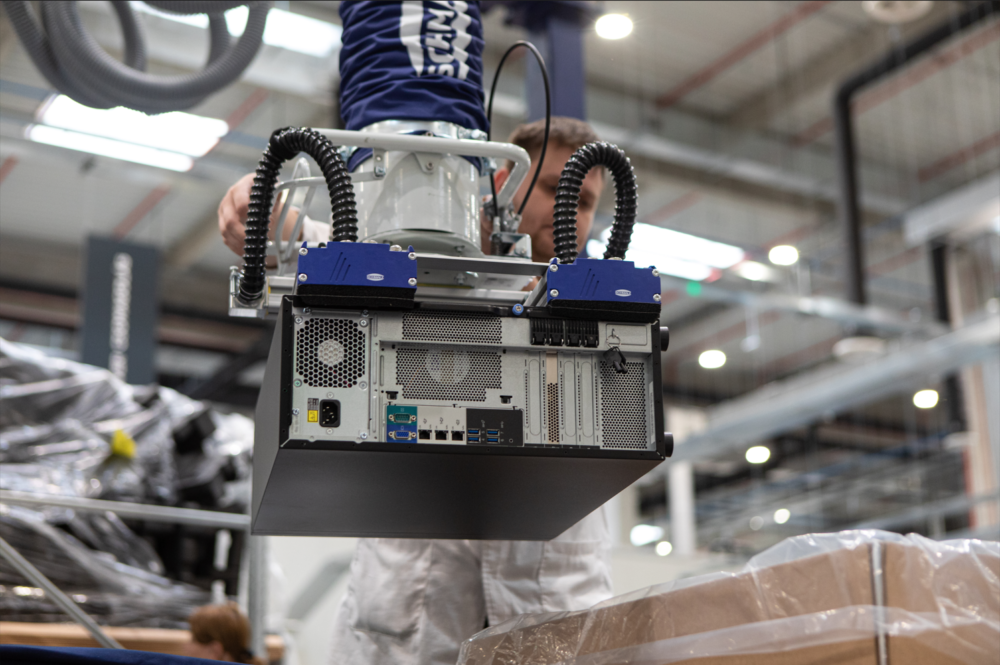
The system was built in Lenovo’s Hungarian factory, the company said, and will be installed by local provider Ricca IT.
Earlier this year, Lenovo announced another supercomputer win in Italy. The company inked a deal to upgrade the University of Pisa’s HPC system, with 16 SD650 V3 nodes with two Intel Xeon Max 9480 CPUs. The system is now the largest supercomputer in an Italian university, according to Lenovo. It also uses the same Neptune water cooling technology which, the company said, will cut its energy consumption by 40%.
Italy’s most powerful supercomputer currently is Leonardo. Located in Bologna, Leonardo is capable of 240 petaflops and is ranked the seventh most powerful supercomputer in the world.
More on Lenovo
About The Author

Jo Best
NEXT UP


